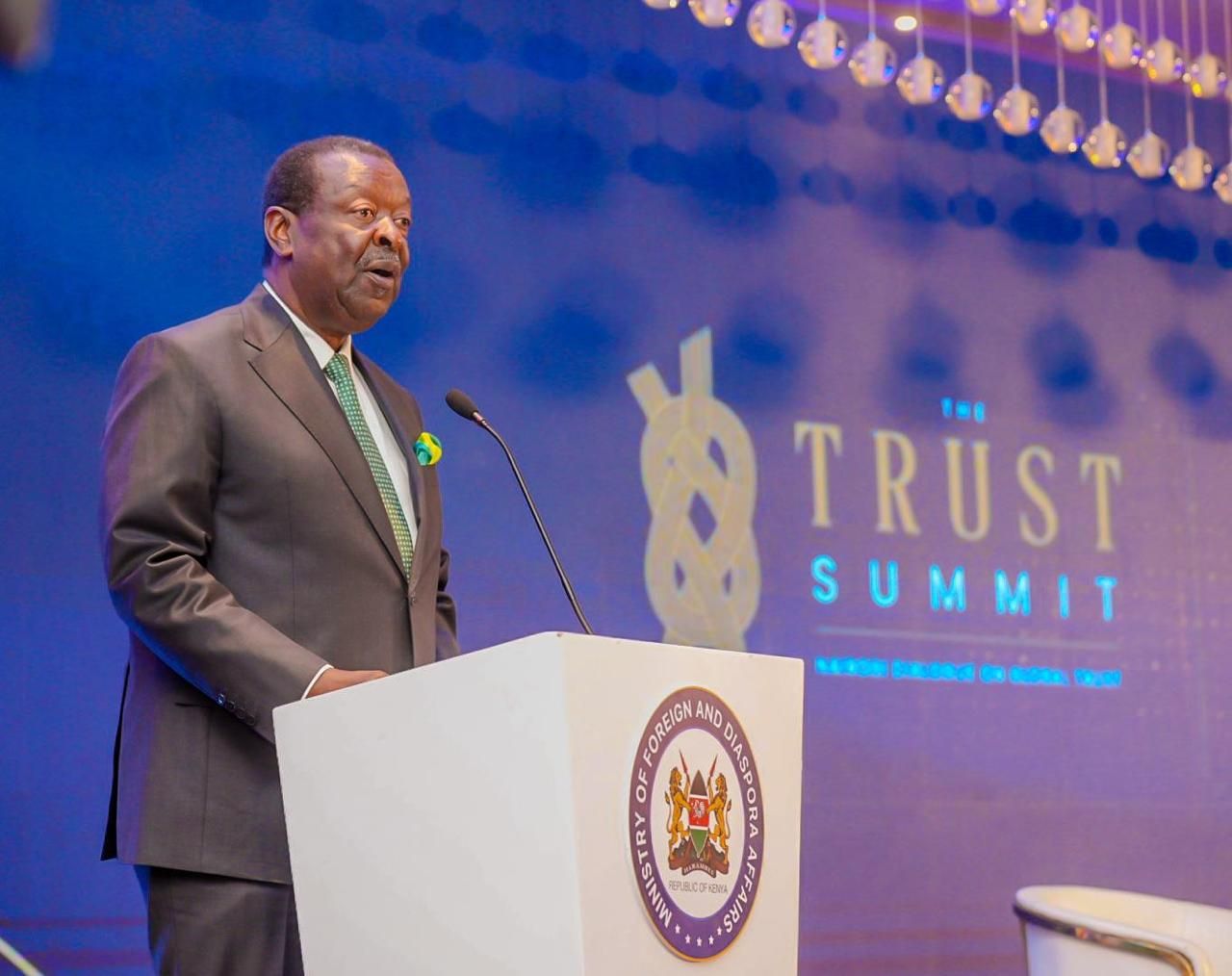
Prime Cabinet Secretary Musalia Mudavadi urged reforms to international institutions to rebuild public confidence while speaking at the Global Trust Summit in Nairobi.
He warned that a decline in trust threatens the foundations of institutions, economic growth and a shared future, and said accountability, inclusive governance and tangible results are essential.
Mudavadi referred to an Afrobarometer working paper covering 37 African countries that showed higher trust in presidents and ruling parties was linked to weaker public support for accountability tools such as parliamentary oversight, media scrutiny and citizen oversight.
He also cited the Wellcome Global Monitor 2026, noting that the share of people who believed most citizens benefit from science dropped from 42 percent in 2018 to 37 percent in 2025, and stressed that scientific credibility depends on evidence, fairness, accessible health care, openness about uncertainty and visible benefits.
Describing trust as economic infrastructure, Mudavadi said it lowers barriers to business and cooperation and that contracts cannot replace integrity and a reputation for keeping one’s word.
He argued that global bodies must earn confidence through fairness, representation and delivery, highlighting Africa’s lack of a permanent seat on the United Nations Security Council as a legitimacy issue and saying permanent African representation in line with the African Union’s Common African Position would boost confidence among African citizens.
Mudavadi called for the summit to move beyond declarations and produce a practical framework with clear commitments, a coalition for implementation and a mechanism to track delivery, adding, “It is my wish that Nairobi be remembered not simply as the place where the world discussed trust, but as the place where we strengthened our resolve to become more trustworthy.”
He also quoted, “The strongest institutions are not those that ask people to trust them blindly, but those that inspire confidence through their conduct while remaining transparent, answerable and open to scrutiny.”
Tanzania’s Deputy Minister for Foreign Affairs and East African Cooperation James Millya used the forum to outline progress on non-tariff barriers between Kenya and Tanzania, saying 68 barriers had been identified, 54 resolved and 14 still pending.
Millya said the remaining barriers keep traders facing repeat inspections, delays and unexpected charges at border points, and remarked, “The last fourteen are where trust is won or lost.”
He referred to bilateral agreements signed in May 2026 that introduced common standards to avoid repeat inspections at Namanga and Holili, a 30-day window for dispute resolution and quarterly implementation reporting, and noted Tanzania’s removal of its Industrial Development Levy on several Kenyan goods.
Millya reported that bilateral trade fell from roughly US$950 million (KSh123 billion) in 2024 to US$860 million (KSh111 billion) in 2025, and said traders still lack a clear complaints channel; Tanzania will appoint a focal point to follow up complaints within 30 days and propose regular consultations with traders, truckers, women and young traders at the border points.
The Global Trust Summit runs in Nairobi from October 21 to 23, gathering public-sector leaders and other stakeholders to explore how trust can strengthen governance, resilient societies, inclusive economies and international cooperation.
Related reporting
More Politics →
Festus Ruto Challenges Equitable Party Name Change Over Procedure
Edwin Sifuna Blames Government for Insults Over Housing Debate and Gachagua Meeting

Former Meru Governor Kawira Mwangaza’s Vehicle Stoned During Mashujaa Day Clashes