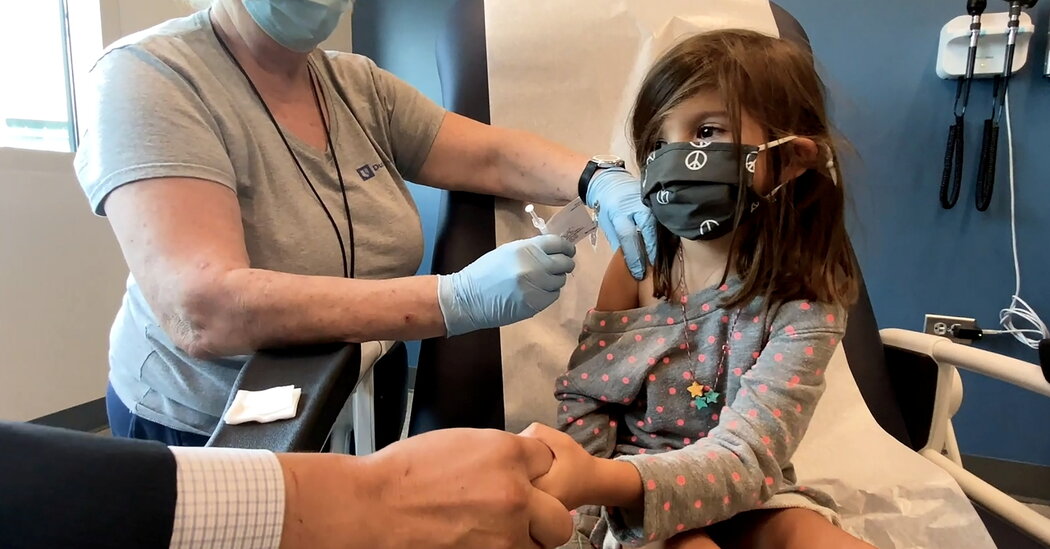
But the younger group will not be expected to line up at mass vaccination sites: “We don’t want lines of kids,” said Ms. Bernstein, who pointed out that children tend to be more sensitive patients. (Read: They cry.) Pediatrician’s offices, children’s hospitals and pharmacies with in-store clinics will be the preferred options.
UpdatedOct. 20, 2021, 10:36 a.m. ET
“Kids have different needs than adults, and our operational planning is geared to meet those specific needs, including by offering vaccinations and settings that parents and kids are familiar with,” Mr. Biden’s coronavirus response coordinator, Jeffrey Zients, told reporters on Wednesday when officials announced the plan. “We’re going to be ready, pending the F.D.A. and C.D.C. decision.”
Mr. Zients, treading carefully on a politically sensitive topic, indicated on Wednesday that the administration would support state coronavirus vaccine mandates for children.
“We support states and school districts taking actions to ensure that everyone who is eligible get vaccinated,” he said, “but again, those decisions should be made at the state and local level.”
What to Know About Covid-19 Booster Shots
Who is eligible for a booster shot?The F.D.A. authorized booster shots for a select group of people who received their second doses of the Pfizer-BioNTech vaccine at least six months before. That group includes: vaccine recipients who are 65 or older or who live in long-term care facilities; adults who are at high risk of severe Covid-19 because of an underlying medical condition; health care workers and others whose jobs put them at risk. People with weakened immune systems are eligible for a third dose of either Pfizer or Moderna four weeks after the second shot.
Will people who receive Moderna and Johnson & Johnson vaccines be eligible?What underlying medical conditions qualify for a booster shot?The C.D.C. has said the conditions that qualify a person for a booster shot include: hypertension and heart disease; diabetes or obesity; cancer or blood disorders; weakened immune system; chronic lung, kidney or liver disease; dementia and certain disabilities. Pregnant women and current and former smokers are also eligible.
What occupations are eligible for boosters?The F.D.A. authorized boosters for workers whose jobs put them at high risk of exposure to potentially infectious people. The C.D.C. says that group includes: emergency medical workers; education workers; food and agriculture workers; manufacturing workers; corrections workers; U.S. Postal Service workers; public transit workers; grocery store workers.
Can I mix Covid vaccines?For now, it is not recommended. Pfizer vaccine recipients are advised to get a Pfizer booster shot, and Moderna and Johnson & Johnson recipients should wait until booster doses from those manufacturers are approved. The F.D.A. is planning to allow Americans to receive a different vaccine as a booster from the one they initially received. The “mix and match” approach could be approved once boosters for Moderna and Johnson & Johnson recipients are authorized.
Can I get a flu shot at the same time as a Covid vaccine or booster shot?Yes. The C.D.C. says the Covid vaccine may be administered without regard to the timing of other vaccines, and many pharmacy sites are allowing people to schedule a flu shot at the same time as a booster dose.
The needles that administer the vaccine and the vials that hold it will need to be smaller to be more easily stored. (The Pfizer dose for children ages 5 to 11 is expected to contain 10 micrograms, rather than the 30-microgram dose used for ages 12 and up.) The child-size vials can be stored for up to 10 weeks at standard refrigeration temperatures, and six months at colder temperatures, according to guidance administration officials made public on Wednesday.
Taking cues from what worked when shots were opened to teenagers, whose vaccinations generally require parental consent, officials are also leaning heavily on local health experts, who they believe are more trusted in their communities and can help reach high-risk children. “Children’s hospitals and health systems will be a critical part of our efforts to advance equity and ensure access for our nation’s highest-risk kids, including those with obesity, diabetes, asthma or immunosuppression,” the guidance read.
But while the administration aims to eliminate the types of availability and efficiency problems that plagued the initial vaccine process, reluctance has persisted among parents.
Related reporting
More World News →
Paul Biya’s Re-Election: What Cameroon’s Political Longevity Reveals About Leadership and Governance in Africa

From Power to Prison: The Fall of France’s Former President Nicolas Sarkozy

The War in Ukraine: A Comprehensive Analysis of the Conflict
