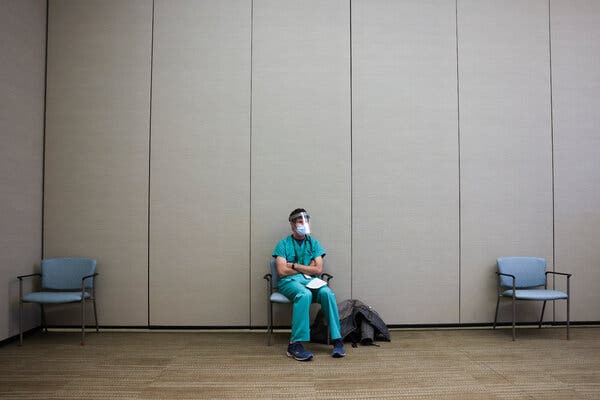
Colorado is experiencing its worst coronavirus wave in a year and its overwhelmed hospitals are now allowed to turn away new patients.
An executive order, signed on Sunday by Gov. Jared Polis, allowed hospitals to redirect incoming patients. Many medical facilities have reported being over 90 percent capacity, with severe staffing shortages.
Covid hospitalizations in Colorado have increased 14 percent in the last two weeks. The state’s new daily cases have also increased 14 percent in two weeks, and recently reached their highest level since their peak in November 2020, according to a New York Times database.
Hospitals in Larimer County, where vaccine hesitancy is fueling a surge, are using 110 percent of their I.C.U. beds, according to the local health department. That has forced some patients to double up in rooms, and hospitals in the area are close to turning patients away to prioritize emergencies, Tom Gonzales, public health director for Larimer, told CBS Denver.
At least 62 percent of the state is fully vaccinated, above the national average of 58 percent. Most hospitalized Covid patients are unvaccinated.
At UCHealth, one of the state’s biggest health systems, 76 percent of patients hospitalized with Covid-19 are unvaccinated, and over 86 percent of Covid-19 patients who are in need of a ventilator and are in intensive care are unvaccinated.
. Masks in the state are optional and restaurants are mostly running at full capacity; Mr. Polis, the governor, is reluctant to revive statewide restrictions.
The governor’s executive order coincided with a state mandate that required health care workers to be fully vaccinated against Covid by Oct. 31. More than 90 percent of Colorado’s hospital workers have now been fully vaccinated, according to the state’s health department.
Last month, the Centers for Disease Control and Prevention urged residents of high-transmission areas to wear masks in public indoor spaces, regardless of their vaccination status, citing evidence that vaccinated Americans with breakthrough infections can carry as much coronavirus as unvaccinated people do.
Other nearby states, like Arizona, are also enduring surges. New daily cases are rising faster in Arizona than any other state, up 50 percent over two weeks.
The Navajo Nation managed to tame Covid-19 earlier this year, mounting a campaign that drove its vaccination rate far above the United States average, after the virus ravaged the Navajo people.
But now the nation — the largest reservation in the United States — is enduring yet another virus surge, and experts and tribal leaders aren’t sure why. Other highly vaccinated tribes are also contending with a resurgent virus.
Over the course of the pandemic, the Navajo went from having one of the country’s worst case rates in the spring of 2020 to being lauded in September by Dr. Anthony Fauci, the nation’s top infectious disease official, as an “example of success” in its fight against Covid-19. The rate of fully vaccinated tribal members — 70 percent, according to tribal data — is substantially higher than the nationwide rate of 58 percent.
Indigenous leaders around the country have pushed hard to vaccinate their communities, knowing that Covid has had a disproportionate effect on Native American people, who now have the highest vaccination rate in the United States, according to the Centers for Disease Control and Prevention.
Despite their successes in overcoming mistrust in the federal government and inoculating hard-to-reach communities, the Navajo and other highly vaccinated tribes find themselves experiencing yet another virus surge.
In addition to the Navajo Nation in Arizona, New Mexico and Utah, the Indian Health Service said on Friday that it was seeing “intermittent” increases in the Billings area, covering Montana and Wyoming, and in the Great Plains area, covering the Dakotas, Nebraska and Iowa. It said that tribal communities — though they tend to have high vaccination rates — were affected by the surrounding states and communities, which may have much lower vaccination rates.
Many tribal members also commute to work in urban areas or border towns, where they may be at higher risk of exposure.
The Blackfeet Nation of Montana, which has vaccinated nearly every eligible member, experienced a spike in August after recording few to no cases for weeks. That was after the tribe, confident after its successful vaccination campaign, voted to welcome back tourists by reopening its roads into the eastern section of the popular Glacier National Park. Cases are running relatively high among the Blackfeet as the virus surges throughout Montana, where vaccination rates in counties surrounding the reservation are as low as 38 percent.
In Minnesota, the White Earth Nation, where 60 percent of eligible members are vaccinated, recently recorded its highest-ever surge in daily cases, said Ed Snetsinger, the tribe’s emergency manager.
As for the Navajo, officials said that the latest surge had been less severe than the nation’s first two, which came last winter and in the spring of 2020, because 70 percent of eligible members are vaccinated.
The nation has exceeded 100 confirmed cases in a day several times recently, according to tribal data. Confirmed cases peaked at almost 400 a day in the winter, and reached a low point in single digits in June and July.
The Navajo Nation is the largest U.S. tribe, with an official enrollment of nearly 400,000 members as of May.
Jonathan Nez, the president of the Navajo Nation, said that some members had brought the virus back to the reservation after visiting neighboring communities in Arizona and New Mexico, which have looser Covid regulations than the tribe does. The Navajo have been required to wear masks in public since April last year, indoors and out, but there is no such outdoor mandate in surrounding areas.
“We do have multigeneration families living under one roof, and when someone brings Covid home, it spreads quickly in the house,” Mr. Nez said in an interview last week.
While tribes have largely been successful in vaccinating their members, pockets of people continue to resist getting the shots, said Dr. Mary Owen, the director of the Center for American Indian and Minority Health at the University of Minnesota medical school and president of the Association of American Indian Physicians.
“These pockets seem to be greater in the 17- to 45-year-old range,” said Dr. Owen, who is Tlingit. “From what I’m hearing and what I’m seeing in our clinic, is that people in this age group have a greater sense of invincibility and also seem to be relying more on social media for their news about the vaccine.”
The Centers for Disease Control and Prevention on Tuesday formally endorsed the Pfizer-BioNTech coronavirus vaccine for children aged 5 through 11, a move that will buttress defenses against a possible surge as winter arrives and ease the worries of tens of millions of pandemic-weary parents.
At a meeting earlier in the day, a panel of scientific advisers had unanimously recommended that the vaccine be given to these children. Inoculations could begin as soon as this week.
“Together, with science leading the charge, we have taken another important step forward in our nation’s fight against the virus that causes Covid-19,” Dr. Rochelle Walensky, director of the C.D.C., said in a statement Tuesday night.
The C.D.C.’s endorsement arrives just as Americans prepare for a potentially risky holiday season. Cases in the United States have been falling steadily for weeks, but experts have warned that indoor gatherings may send the rates soaring again. Many Americans seem determined to celebrate; already airlines are bracing for what may be the busiest travel season since the start of the pandemic.
While relatively few of the 29 million children in this age group will be fully immunized a month from now, even partial vaccination will provide some protection against the coronavirus. Every million doses given to children ages 5 to 11 would prevent about 58,000 cases and 226 hospitalizations in that group, according to the C.D.C.
Immunizing these children is expected to prevent about 600,000 new cases from November 2021 to March 2022. And rising immunity may reduce the chances that young children will transmit the virus to vulnerable adults in their families and communities, health officials noted.
Vaccinations of younger children are likely to help keep schools open. Virus outbreaks forced about 2,300 schools to close between early August and October, affecting more than 1.2 million students, according to data presented at the committee meeting.
The pandemic has also stalled routine immunizations, widened education gaps and escalated rates of anxiety and depression among children. “Vaccination of children ages 5 to 11 years will not only help prevent Covid-19 infection and serious consequences of infection in this age group, but will also help children emotionally and socially,” said Dr. Pamela Rockwell, who represents the American Academy of Family Physicians on the C.D.C. panel.
Still, about three in 10 parents say they will definitely not get the vaccine for their 5- to 11-year-old child, according to the most recent poll by the Kaiser Family Foundation. Only about three in 10 parents said they would immunize their child “right away,” a percentage that has barely budged since similar polls in July and September.
Many other parents are eager to see their children vaccinated as quickly as possible. Anticipating the C.D.C.’s decision, the Biden administration has enlisted more than 20,000 pediatricians, family doctors and pharmacies to administer the shots. About 15 million doses are already being shipped to vaccination sites across the country, federal officials said on Monday.
Daniel E. Slotnik contributed reporting.
Related reporting
More World News →
South Sudan’s Oil Looters: How Young Elite Gatekeepers Plunder Nation While Citizens Starve

General to Private: Kiir Crushes Economic Vice President in South Sudan's $1.7 Billion Corruption Purge

Paul Biya’s Re-Election: What Cameroon’s Political Longevity Reveals About Leadership and Governance in Africa