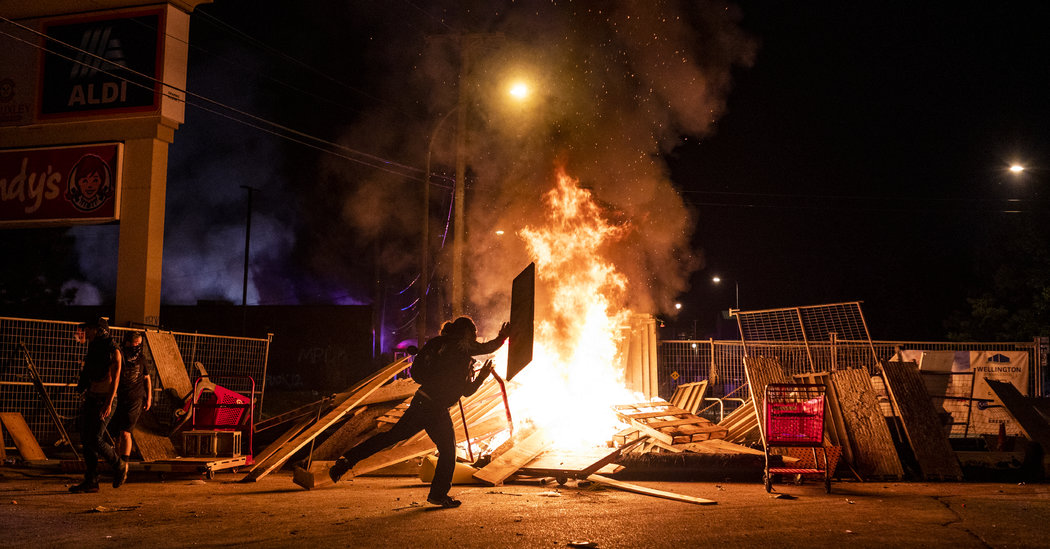
A violent wave of protests erupted across South Minneapolis overnight Thursday, with the police firing tear gas and rubber bullets as people set buildings on fire and looted stores days after George Floyd, an African-American man, died in police custody.
Mr. Floyd, 46, died on Monday after being handcuffed and pinned to the ground by a white police officer who pressed his knee on Mr. Floyd’s neck for several minutes. A video of the arrest, in which he is heard pleading “I can’t breathe,” spread widely online, and was followed by protests in Minneapolis and around the country.
“They executed my brother in broad daylight,” Philonise Floyd told CNN on Thursday morning, breaking down in tears. “I am just tired of seeing black people dying.”
Four officers involved in the encounter were fired from the Minneapolis Police Department, and the F.B.I. joined the investigation into the death of Mr. Floyd, a resident of St. Louis Park, Minn. Minneapolis’s mayor called for the police officer who had pressed his knee to Mr. Floyd’s neck to be arrested and charged.
Unlike the first night of protests, when thousands gathered peacefully, the police reported widespread civil disobedience, looting and multiple fires beginning Wednesday afternoon and stretching into Thursday.
“Tonight was a different night of protesting than it was just the night before,” said John Elder, a police spokesman.
Mayor Jacob Frey pleaded on Twitter for people to stay at home. “Please, please Minneapolis,” he wrote, “we cannot let tragedy beget more tragedy. Please, help us keep the peace. Stay safe and evacuate the area.”
The police said that a fatal shooting in the protest area appeared to be related to the looting of a pawnshop where the store owner fired shots. A man was wounded and taken to a hospital, where he died, according to the police.
The violence came at the end of what had been a tense period.
Protesters began gathering Wednesday afternoon outside Police Headquarters, but by early evening, things started to take a turn and officers tried to disperse the crowds using flash-bang grenades and tear gas.
As night fell, more people filled the streets, and soon fires lit up the sky. Images on television and social media showed at least one business, an auto-parts store, ablaze and people carrying goods from another store that had been vandalized.
The Minneapolis Star Tribune reported that a Target and Cub Foods store anchoring the corner of East Lake Street and Hiawatha Avenue were looted, as were several small businesses, including a liquor store.
The episode was seen as part of a broader pattern of devastating encounters between African-Americans and law enforcement denounced by civil rights leaders. It has laid bare tensions between members of the local community and the 800-plus police force in Minneapolis, a divide mirrored in other communities across the country.
Mr. Floyd’s sister, Bridgett Floyd, called for justice on NBC’s “Today” show on Thursday.
“I would like for those officers to be charged with murder because that’s exactly what they did,” Ms. Floyd said.
“I don’t want the protests to be for just show,” said Tara Brown, Mr. Floyd’s cousin, who appeared with two of Mr. Floyd’s brothers. “I want to see action.”
“This was clearly murder,” she added. “We want to see them arrested; we want to see them charged; we want to see them convicted for what they did.”
The Minneapolis police said they had been investigating an accusation of forgery on Monday in the southern part of the city when they confronted a man who was sitting on a blue car and was later identified as Mr. Floyd.
“He was ordered to step from his car,” the Police Department said in a statement on Monday. “After he got out, he physically resisted officers. Officers were able to get the suspect into handcuffs and noted he appeared to be suffering medical distress.”
Video footage from nearby security cameras and bystanders did not show any attempt by Mr. Floyd to resist officers. Instead, it showed him begging for his life as he lay handcuffed on the ground, one officer grinding a knee into his neck while three others stood by.
The episode also spurred protests overnight Thursday in Memphis and Los Angeles, where law enforcement officials faced off with people blocking the 101 Freeway downtown.
The Minneapolis Police Department on Wednesday identified the fired officers as Derek Chauvin, Thomas Lane, Tou Thao and J. Alexander Kueng. The mayor said that the dismissals were not enough, calling for criminal charges against the officer who was recorded with his knee on Mr. Floyd’s neck.
“I’ve wrestled with, more than anything else over the last 36 hours, one fundamental question: Why is the man who killed George Floyd not in jail?” Mr. Frey said in a news briefing. “If you had done it, or I had done it, we would be behind bars right now. And I cannot come up with a good answer to that.”
The mayor said he understood the need to protest and could not fathom the pain and emotions felt by families across the city and around the country.
“But those rights must stop when other public safety is put at risk,” he said.
Mr. Frey said he had decided to call for the arrest of the police officer after watching the graphic video that was shared widely online.
“We watched for five whole excruciating minutes as a white officer firmly pressed his knee into the neck of an unarmed handcuffed black man,” he said. “I saw no threat. I saw nothing that would signal that this kind of force was necessary.
“There’s somewhere around 300 seconds in those five minutes, every one of which the officer could have turned back, every second of which he could have removed his knee from George Floyd’s neck.”
As dawn broke on Thursday, fires were still smoldering as lines of police officers in riot gear stood off against people who were still out on the streets.
Related reporting
More World News →
South Sudan’s Oil Looters: How Young Elite Gatekeepers Plunder Nation While Citizens Starve
General to Private: Kiir Crushes Economic Vice President in South Sudan's $1.7 Billion Corruption Purge
Paul Biya’s Re-Election: What Cameroon’s Political Longevity Reveals About Leadership and Governance in Africa