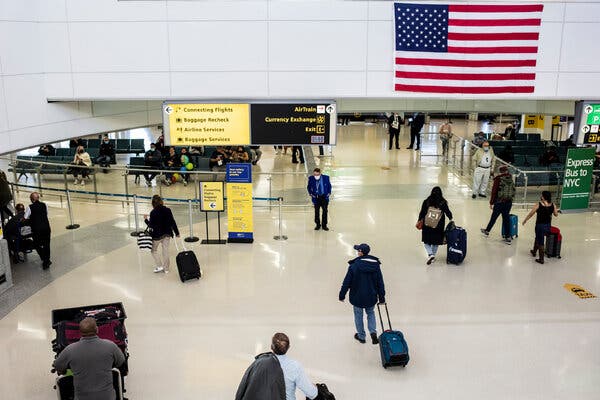
WASHINGTON — The Centers for Disease Control and Prevention plans to toughen coronavirus testing and screening of international fliers to the United States by requiring them to provide a negative result from a test taken within 24 hours of departure, a spokesman for the agency said Tuesday night.
The move to strengthen the testing regime reflects growing concern about the Omicron variant, a highly mutated form of the virus that was first documented by researchers in South Africa and detected in more than a dozen countries around the world.
“C.D.C. is working to modify the current global testing order for travel as we learn more about the Omicron variant; a revised order would shorten the timeline for required testing for all international air travelers to one day before departure to the United States,” said the spokesman, Jason McDonald.
“This strengthens already robust protocols in place for international travel, including requirements for foreign travelers to be fully vaccinated,” he added.
Earlier Tuesday, a senior administration official, who spoke on the condition of anonymity because no final decisions had been made, said health officials were examining whether current testing — which allows fully vaccinated people to take a P.C.R. test up to three days before departing on a flight to the United States — was stringent enough. It was unclear whether the new 24-hour rule would require a rapid P.C.R. or antigen test.
President Biden has said he will announce on Thursday his plans for enhancing the fight against the pandemic. It is not clear whether he will announce tougher testing requirements for international travelers, which were first reported by The Washington Post, during Thursday’s speech. Mr. McDonald offered no timeline for the C.D.C.’s action.
In the meantime, Mr. McDonald said, the C.D.C. continues to recommend that all travelers get a coronavirus test three to five days after arrival in the United States. Unvaccinated travelers should self-isolate and quarantine for seven days after arrival, even if they test negative.
Natalie Quillian, the deputy coordinator for the Covid response at the White House, said in an interview on Monday that the Omicron variant had prompted the administration to re-evaluate its efforts to ensure that people entering the country were not carrying the virus.
“We’re constantly looking at what can we do to make that travel system even stronger,” she said. “For example, right now we’re assessing all of our tests to make sure they’re effective in picking up this variant.”
She added: “If we found that a test was not effective at picking up the variant, we would remove that from the list that is accepted to enter the country.”
A 24-hour testing rule could make visiting the United States difficult, some travelers said. Paula Tolton, 23, a student in Taipei, Taiwan, said the plan made her worry about missing the flight she planned to take next month to visit her family in Jacksonville, Fla.
Even the current 72-hour rule is nerve-racking, she said. “I’ve had that stress before when a P.C.R. test didn’t come back when I was supposed to fly here in April,” she said. “I was freaking out.” Finding a clinic that could meet the 24-hour mark would make traveling home much harder, she added.
A federal judge issued a preliminary injunction on Tuesday to halt the start of President Biden’s national vaccine mandate for health care workers, which had been set to begin next week.
The injunction, written by Judge Terry A. Doughty, effectively expanded a separate order issued on Monday by a federal court in Missouri. The earlier one had applied only to 10 states that joined in a lawsuit against the president’s decision to require all health workers in hospitals and nursing homes to receive at least their first shot by Dec. 6 and to be fully vaccinated by Jan. 4.
“There is no question that mandating a vaccine to 10.3 million health care workers is something that should be done by Congress, not a government agency,” Judge Doughty, of U.S. District Court for the Western District of Louisiana, wrote. He added: “It is not clear that even an act of Congress mandating a vaccine would be constitutional.”
The judge, who was nominated to the court by former President Donald J. Trump, also wrote that the plaintiffs had an “interest in protecting its citizens from being required to submit to vaccinations” and to prevent the loss of jobs and tax revenue that may result from the mandate.
Several cities and states had already imposed their own vaccine mandates for health care workers, in an effort to contain outbreaks that were often passed from communities into medical settings like nursing homes. The momentum for vaccine mandates gained steam during the summer as the Delta variant swept through nursing homes, causing spikes in staff and resident infections, as well as overwhelming hospitals in many states with another Covid surge.
Some of the larger hospital chains and several big nursing home operators also began requiring staff vaccinations, before the president began calling for nationwide compliance. Vaccinations among health care employees have increased since the summer, although cases among residents and staff remain in the thousands reported each week. Nationwide, the immunization rate among nursing home staffs is more than 74 percent, although much lower rates still exist in some regions.
In leading a 14-state lawsuit against the mandate, Attorney General Jeff Landry of Louisiana said the federal mandate would blow holes in state budgets and exacerbate shortages in health care facilities.
The Biden administration tied compliance with the vaccine mandate to federal funding, requiring immunizations of millions of workers at hospitals, nursing homes or other health facilities that heavily rely on the Medicare or Medicaid programs. But many health care providers — especially nursing home and rural hospital operators — complained that staff members who were hesitant to be immunized would leave, aggravating employee shortages that plagued the industry long before the pandemic.
Those complaints helped swell opposition in many states, like Texas and Florida, that have been vehemently against dictates on vaccines, mask-wearing and other federal policies at the heart of public health advice during the pandemic.
More than a dozen states and some employers joined forces to fight a broader mandate that would require private employers of 100 or more workers to impose companywide immunization. An appeals court has temporarily blocked that mandate as well, as the challengers to the policy pursue their arguments that the Occupational Safety and Health Administration overstepped its authority.
In response to recent court decisions, the Centers for Medicare & Medicaid said in a statement, “While we cannot comment on the litigation, CMS has remained committed to protecting the health and safety of beneficiaries and health care workers. The vaccine requirement for health care workers addresses the risk of unvaccinated health care staff to patient safety and provides stability and uniformity across the nation’s health care system.”
The injunction issued on Tuesday is a first step in the lawsuits against the vaccine mandate. The cases still have to be argued before a judge, and any lower-court ruling will likely be appealed.
— Azi Paybarah and Reed Abelson
The head of the United Nations-backed global vaccine distribution program said on Tuesday that it had shipped more than 11 million doses in the last 24 hours, its busiest day of deliveries ever.
The leader, Seth Berkley, said the program had been asking donors and vaccine manufacturers for months “to give us better-quality donations” and more information on when doses would arrive. That message, he wrote on Twitter, “is just starting to be heard.”
Covax, a multibillion-dollar alliance between international health bodies and nonprofits, was supposed to ensure that poor countries got access to coronavirus vaccines and that rich countries did not hoard them. It has struggled in that mission and had to scale back its goals.
The new Omicron variant has prompted rich, highly vaccinated countries like the United States, Britain and Japan to expand their booster programs, while poorer, less vaccinated countries like South Africa are still trying to get first doses to residents.
Only about 5 percent of people living in low-income countries have received even one vaccine dose, according to the Kaiser Family Foundation, a health organization that is tracking coronavirus infections and vaccine distribution.
“Getting doses to countries is the easy part,” Mr. Berkley wrote on Twitter. Making the doses readily available “is harder & requires active collaboration” among manufacturers, shipping companies and officials in those countries.
The Japanese government said on Wednesday that it had asked airlines to stop taking new bookings for all flights into the country for the rest of the year, extending one of the world’s most far-reaching border closures in response to the Omicron variant.
Existing bookings would not be affected, officials said.
On Monday, Japan barred all nonresident foreigners from entering the country, and on Tuesday it closed its borders to all non-Japanese travelers, including permanent residents of Japan, from 10 southern African countries.
Japan confirmed its second Omicron case, in a traveler from Peru, on Wednesday. Its first case, confirmed on Tuesday, involved a traveler from Namibia.
Japan had only tentatively opened last month to business travelers and students, despite recording the highest vaccination rate among the world’s wealthy democracies — and after seeing its coronavirus caseloads plunge by 99 percent since August.
In South Korea, where suspected cases of the Omicron variant were being studied, the Korea Medical Association on Wednesday recommended pausing quarantine exemptions for inbound travelers.
The government is also considering expanding genomic sequencing for more inbound travelers, a South Korean Health Ministry spokesman, Son Young-rae, said at a news conference on Wednesday.
— Andrew Parsons and John Yoon
A federal advisory committee on Tuesday voted to recommend that the government for the first time authorize the use of an antiviral pill to combat the worst effects of Covid-19.
The advisory committee, in a surprisingly narrow 13-to-10 vote, endorsed the pill from Merck, while public health officials worldwide raced to buttress their defenses against the newly emerging Omicron variant of the coronavirus.
The Merck treatment, known as molnupiravir, has been shown to modestly reduce the risk of hospitalization and death from Covid. The pill could be authorized for use in the United States within days and available to patients within weeks.
In the coming weeks, the F.D.A. may also authorize a similar pill from Pfizer that appears to be significantly more effective than Merck’s. Together, the arrival of the two easy-to-use treatments could provide a cushion against a resurgent virus.
The F.D.A. advisory panel, a group of experts on antimicrobial drugs, recommended that Merck’s treatment be authorized for people with Covid who are at high risk of becoming severely ill. That would most likely cover tens of millions of Americans who are older or have medical conditions such as obesity, diabetes or heart disease.
But the committee’s close vote reflected doubts about the pill’s effectiveness and concerns that it could cause reproductive harm.
“The efficacy of this product is not overwhelmingly good,” said Dr. David Hardy, an infectious-disease physician in Los Angeles. Still, he voted to recommend the drug, saying “there is a need for something like this.”
Other members of the committee who voted against authorization said more research was needed about the drug’s safety. “The risk of widespread effects on potential birth defects, especially delayed effects on the male, has not been adequately studied,” said Dr. Sankar Swaminathan, an infectious disease specialist at the University of Utah.
The pills, which doctors will prescribe and will be dispensed at pharmacies, are much more convenient and are expected to reach many more people than the monoclonal antibody treatments that have typically been used to aid high-risk Covid patients. The antibody treatments are expensive and typically given intravenously at hospitals or clinics.
The Biden administration has been hoping that the emergence of the antiviral pills from Merck and Pfizer will help end the most acute phase of the pandemic. The U.S. government has spent billions of dollars to secure millions of treatment courses of the new pills.
Merck’s clinical trials primarily enrolled people who were infected with the Delta, Mu and Gamma variants of the coronavirus. Scientists have yet to run experiments to see how well the pills block Omicron viruses from replicating. But there are reasons to think they would remain effective even if the variant can sometimes evade vaccines, as well as monoclonal antibodies.
— Rebecca Robbins and Carl Zimmer
Los Angeles Lakers star forward LeBron James has entered the N.B.A.’s coronavirus health and safety protocols, the team announced Tuesday.
James missed the team’s game Tuesday night against the Sacramento Kings. It is unclear when he will be able to play again, and it is also unclear whether James has tested positive for the coronavirus or has come into close contact with someone who tested positive.
Lakers Coach Frank Vogel told reporters before the game that he found out Tuesday morning that James had entered the health and safety protocols. Vogel said the team arranged for James to get “back to L.A. safely.”
Players who test positive for the coronavirus must miss at least 10 days before they can return. All players who enter the protocol must return two negative tests on separate days before being allowed to play again.
James, 36, said before the season that he had been vaccinated against Covid-19.
Typically, players who are vaccinated face less stringent requirements than unvaccinated players. After Thanksgiving, though, the league implemented enhanced testing requirements even for vaccinated players, according to documents sent by league officials to each of the 30 teams. They did so with the expectation that the holiday would increase players’ potential exposure to the virus.
“We just want the best for him right now,” Vogel said. “That’s where our thoughts are. We have a next man up mind-set. It’s an 82-game season. You got to deal with guys being in and out of the lineup. We’ve been without him some already this season.”
This will be the 12th game James has missed this season. He missed 10 because of ankle and abdominal injuries. He also missed the Lakers’ game against the Knicks earlier this month after being suspended for the first time in his 19-season career.
Among the many unknowns surrounding the new coronavirus variant called Omicron, named after the 15th letter of the Greek alphabet, one has stood out to many English speakers: How is it pronounced?
There is no single, agreed-on English pronunciation, experts say.
One pronunciation, according to Merriam Webster, is “OH-muh-kraan,” with a stress on the first syllable.
A World Health Organization official, Dr. Maria Van Kerkhove, recently said it that way when announcing that the variant was of concern.
Pronouncing ‘Omicron’
There are several widely accepted ways in English to pronounce “Omicron,” a variant of the coronavirus named after the 15th letter of the Greek alphabet.In the United States, it is often pronounced “AH-muh-kraan,” Merriam Webster says. Less common are “OH-mee-kraan,” as Prime Minister Boris Johnson of Britain pronounced it this week, or “OH-my-kraan.”
On the New York Times podcast “The Daily,” Apoorva Mandavilli, who reports on the coronavirus and its variants, said she was going with “AH-muh-kraan.”
“I don’t think it really matters that much, honestly,” she said.
The New Oxford English Dictionary gives a pronunciation that differs from those in Merriam-Webster, according to Dr. Andreas Willi, a comparative linguistics professor at Oxford University. “Namely rather like an English phrase ‘o-MIKE-Ron,’” he said.
The word is a compound from the Greek “o mikron,” meaning “small o.” In classical Greek, the word was pronounced with the second syllable sounding like an English “me,” Dr. Willi said.
Peter Sokolowski, editor at large at Merriam Webster, said that because the Greek word is transliterated for pronunciation into English, sounding much as the word “omnipotent” is different from its Latin “omni-potent” origin, then the “AH-muh-kraan” pronunciation “makes perfect sense.”
But, he added, “There isn’t a wrong answer.”
“The question of British versus American pronunciation of the first syllable isn’t really specific to this particular word,” Dr. Willi said. “Compare the British versus American pronunciation of ‘god.’”
The divergences are to do with the name having been adopted as a loanword and used by English speakers in different places at different times, Dr. Willi said.
“When we speak of ‘Paris’ in English, that is also very different from the ‘proper’ French way of pronouncing the same name,” he said. “But it is hardly wrong in a strict sense.”
Related reporting
More World News →
South Sudan’s Oil Looters: How Young Elite Gatekeepers Plunder Nation While Citizens Starve

General to Private: Kiir Crushes Economic Vice President in South Sudan's $1.7 Billion Corruption Purge

Paul Biya’s Re-Election: What Cameroon’s Political Longevity Reveals About Leadership and Governance in Africa