One needs no sectarian or contentious conception of the common good to think that America in 2022 desperately needs healing of the public community. Americans’ life expectancy is now roughly five years below that of people in comparable countries. Overdosing, rural despair and politicized anger are not hallmarks of a flourishing community in any reasonable view of what the common good means. Stable families, material security, dignified work and a sense of social harmony are objectively good for all. We may disagree on how precisely to achieve these ends, but denying they are something to aspire to as a community is irrational, and the laws should be interpreted accordingly. In hard cases, where legal sources are conflicting, ambiguous or unclear, the common good and its subsidiary ideals serve as principles for interpreting the laws.
American judges in the classical legal tradition applied the common good with a healthy measure of deference to the reasonable decisions of public authorities. In important cases from the past few decades, this approach would have changed both reasoning and outcomes. One example is the 2002 case Ashcroft v. Free Speech Coalition, in which Justice Anthony Kennedy, writing for a majority, struck down a federal law that barred the creation of virtual child pornography — images of people who appear to be minors, engaging in sexually explicit conduct, that were generated by computer or by adult actors posing as children. Justice Kennedy wrote that the law was “overbroad” because it prohibited speech “that records no crime and creates no victims by its production.” This neglects the diffuse harms to the community and the broader corrosion of the social fabric that occur when virtual child pornography is available. The law is a teacher of virtue, and it should not teach that animated or simulated child porn is somehow a victimless crime.
Likewise, the court erred in the recent decision in National Federation of Independent Business v. Department of Labor that, in effect, barred the Occupational Safety and Health Administration from requiring vaccination (or a test-and-mask regimen) in large workplaces. The safeguarding of public health is a core duty of governance, and Supreme Court precedent long ago established that “a community has the right to protect itself against an epidemic of disease which threatens the safety of its members.” The court held that because the relevant laws gave OSHA the power to regulate workplace safety specifically, it could not regulate more general public health risks, like Covid, that also have important effects in and through the workplace — a libertarian non sequitur. The fear of rule by unelected bureaucrats in government agencies does not justify actual rule by unelected bureaucrats on the bench.
Finally, the court also erred in the landmark 1992 decision in Lujan v. Defenders of Wildlife, which required plaintiffs to show a personal “injury in fact” in order to challenge inadequate enforcement of environmental laws in federal court — even if, as the Court recently clarified, statutes create a right to sue. This constitutional requirement of a private stake to bring suit is backward. The law should encourage, not hamper, those who wish to articulate public interests in legal proceedings, especially where the health of the natural environment is at stake — the ultimate common good.
All officials are duty bound to consider the common good. As Justice Antonin Scalia once put it, governmental decisions are subject to “the fundamental constraint that the decision must be taken in order to further a public purpose rather than a purely private interest.” Common-good constitutionalism urges that this principle be remembered and renewed to heal the ills of our law. One hopes that Justice Breyer’s replacement can transcend the tired opposition of progressivism and originalism, and revive the orientation to the common good that was once central to the American legal tradition.
Adrian Vermeule is the Ralph S. Tyler, Jr., professor of constitutional law at Harvard Law School and the author of the forthcoming book “Common Good Constitutionalism.”
Related reporting
More World News →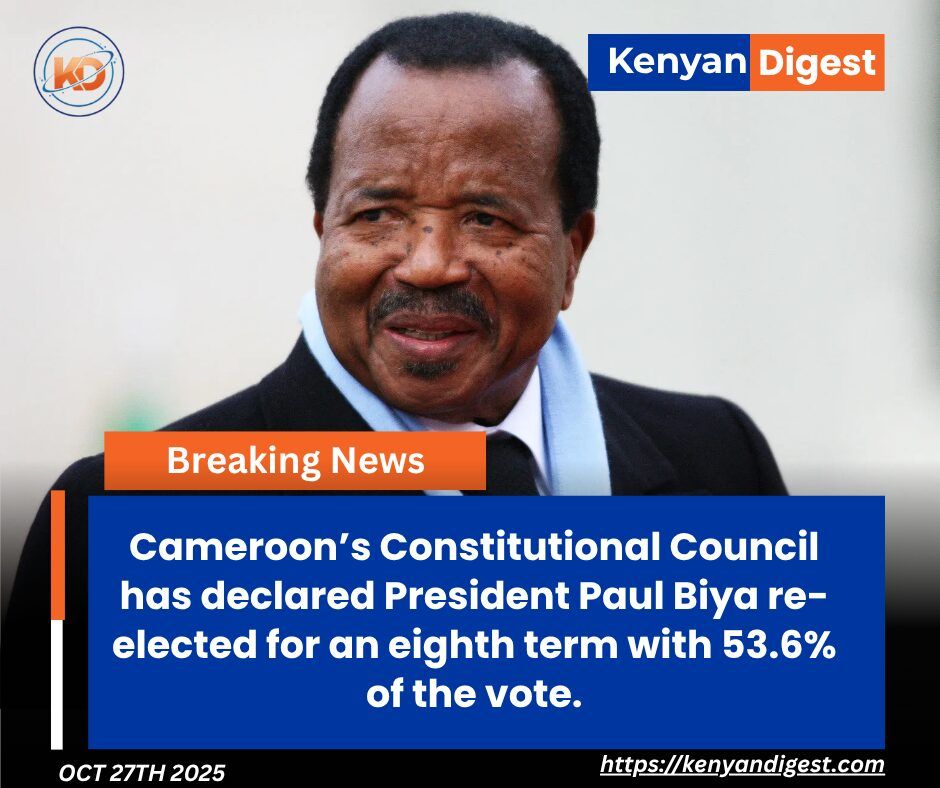
Paul Biya’s Re-Election: What Cameroon’s Political Longevity Reveals About Leadership and Governance in Africa

From Power to Prison: The Fall of France’s Former President Nicolas Sarkozy

The War in Ukraine: A Comprehensive Analysis of the Conflict
