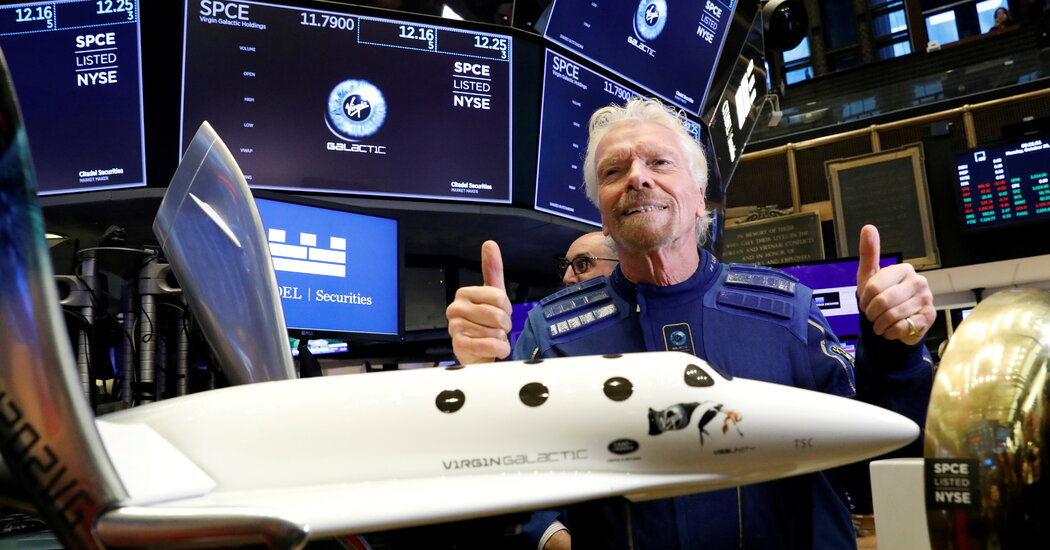
Richard Branson is finally getting his trip to space on Sunday.
It has been a very long wait for Mr. Branson, the irreverent, 70-year-old British billionaire who leads a galaxy of Virgin companies. In 2004, he founded Virgin Galactic to provide adventurous tourists with rides on rocket-powered planes to the edge of space and back.
At the time, he thought commercial service would begin in two to three years. Instead, close to 17 years have passed. Virgin Galactic says it still has three more test flights to conduct, including the one on Sunday, before it can be ready for paying passengers.
For this flight, Mr. Branson will be a member of the crew. His task is to evaluate the cabin experience for future customers.
When is the flight, and how can I watch it?
The flight is scheduled to take off on Sunday morning from Spaceport America in New Mexico, about 180 miles south of Albuquerque.
What is Virgin Galactic’s space plane, and what will it do?
The rocket plane, a type called SpaceShipTwo, is about the size of an executive jet. In addition to the two pilots, there will be four people in the cabin. This particular SpaceShipTwo is named V.S.S. Unity.
To get off the ground, Unity is carried by a larger plane to an altitude of about 50,000 feet. There, Unity will be released, and the rocket plane’s motor will ignite. The acceleration will make people on board feel a force up to 3.5 times their normal weight on the way to an altitude of more than 50 miles.
At the top of the arc, those on board will be able to get out of their seats and experience about four minutes of apparent weightlessness. Of course, they will not have actually escaped gravity. Fifty miles up, Earth’s downward gravitational pull is essentially just as strong as it is on the ground; rather, the passengers will be falling at the same pace as the plane around them.
The two tail booms at the back of the space plane rotate up to a “feathered” configuration that creates more drag and stability, allowing the plane to re-enter Earth’s atmosphere more gently. This configuration makes SpaceShipTwo more like a badminton shuttlecock, which always falls with the pointy side oriented down, than a plane.
Still, the forces felt by the passengers on the way down will be greater than on the way up, reaching six times the force of gravity.
Once the plane is back in the atmosphere, the tail booms rotate back down, and the plane will glide to a landing. The whole flight may take less than two hours.
Who are the crew members aboard the flight?
The pilots are David Mackay and Michael Masucci.
In addition to Mr. Branson, three Virgin Galactic employees will evaluate how the experience will be for future paying customers. They are Beth Moses, the chief astronaut instructor; Colin Bennett, lead operations engineer; and Sirisha Bandla, vice president of government affairs and research operations. Ms. Bandla will also conduct a science experiment provided by the University of Florida.
Is Virgin Galactic’s space plane safe?
The federal government does not impose regulations for the safety of passengers on a spacecraft like Virgin Galactic’s. Unlike commercial passenger jetliners, the rocket plane has not been certified by the Federal Aviation Administration. Indeed, the F.A.A. is prohibited by law from issuing any such requirements until 2023.
The rationale is that emerging space companies like Virgin Galactic need a “learning period” to try out designs and procedures and that too much regulation too soon would stifle innovation that would lead to better, more efficient designs.
Future passengers will have to sign forms acknowledging “informed consent” to the risks, similar to what you sign if you go skydiving or bungee jumping.
What the F.A.A. does regulate is ensuring safety for people not on the plane — that is, if anything does go wrong, that the risk to the “uninvolved public” on ground is minuscule.
The Virgin Galactic design already has an imperfect safety record. The company’s first space plane, the V.S.S. Enterprise, crashed during a test flight in 2014 when the co-pilot moved a lever too early during the flight, allowing the tail booms to rotate when they should have remained rigid. The Enterprise broke apart, and the co-pilot, Michael Alsbury, was killed. The pilot, Peter Siebold, survived after parachuting out of the plane.
The controls were redesigned so that the tail booms cannot be unlocked prematurely.
In 2019, Virgin Galactic came close to another catastrophe when a new metal thermal protection film was improperly installed, covering up holes that allow air trapped inside a horizontal stabilizer — the small horizontal wing on the tail of a plane — to flow out as the craft rises into the rarefied layers of the atmosphere. Instead, the pressure of the trapped air ruptured a seal along one of the stabilizers.
The mishap was revealed earlier this year in the book “Test Gods” by Nicholas Schmidle, a staff writer at The New Yorker. The book quotes Todd Ericson, then the vice president for safety and testing at Virgin Galactic, saying, “I don’t know how we didn’t lose the vehicle and kill three people.”
Related reporting
More World News →
Paul Biya’s Re-Election: What Cameroon’s Political Longevity Reveals About Leadership and Governance in Africa

From Power to Prison: The Fall of France’s Former President Nicolas Sarkozy

The War in Ukraine: A Comprehensive Analysis of the Conflict
