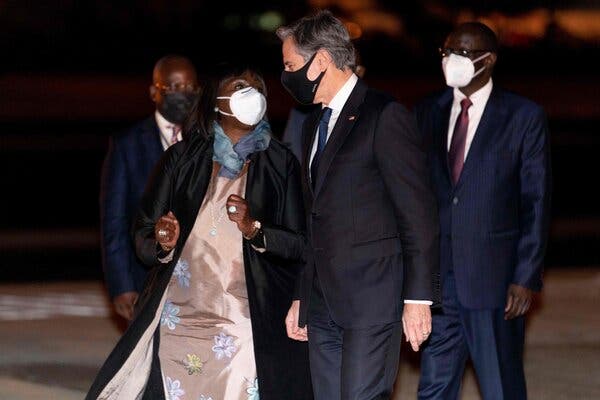
Secretary of State Antony J. Blinken is visiting Kenya, starting a swing through Africa amid political upheaval and questions about the Biden administration’s approach to the continent.
Mr. Blinken arrived in Nairobi overnight Wednesday, making him the highest-ranking Biden administration official to visit sub-Saharan Africa. He will try to advance diplomacy to pull Kenya’s neighbor, Ethiopia, back from the brink of what experts say could be an expansion of the devastating civil war that has been raging in the north of the country, with the potential for genocide.
On a stop in Nigeria this week, Mr. Blinken will outline a vision for U.S. policy toward Africa, one that is expected to focus on the value of democracy to the continent’s future.
Some critics say the Biden administration has been inattentive to Africa, a common complaint about U.S. foreign policy but one that has gained more currency as China, America’s top strategic competitor, plants deeper political and economic roots on the continent and anti-American jihadist groups continue to thrive there.
American officials are concerned about democratic backsliding across the continent, which has seen a wave of military coups in recent months — including in Sudan, where a coup last month quashed a democratic transition that followed the 2019 ouster of the country’s longtime autocratic ruler, Omar Hassan al-Bashir. Experts say the four successful military coups in Africa this year — including in Guinea, Chad and Mali — are the highest number in more than 40 years.
Nigeria’s democracy is also troubled: As a candidate, Mr. Biden condemned the country’s government for endemic corruption, and for violently cracking down on demonstrators seeking more freedom for civil society.
Kenya has played a key role in diplomatic efforts to peacefully resolve a conflict between the Ethiopia’s central government and rebels in its northern Tigray region.
“This is Rwanda-esque,” added Patricia Haslach, who served as the U.S. ambassador to Ethiopia from 2013 to 2016. Ms. Haslach stopped short of saying that a genocide might be occurring, but other experts have called that a realistic possibility in a conflict increasingly defined by ethnic identity.
The Clinton administration’s failure to intervene and potentially prevent the massacre of as many as 800,000 ethnic Tutsis in Rwanda in 1994 has haunted former U.S. officials for decades.
Mr. Blinken plans to conclude his trip with a visit to the Senegalese capital, Dakar.
Not long ago, the East African region known as the Horn was seen as among the most dynamic on the continent, a place of fast-growing economies, dictator-toppling revolutions and intense jockeying between rival foreign powers seeking influence. It even had a Nobel Peace Prize winner, Ethiopia’s youthful prime minister, Abiy Ahmed.
Now, as Secretary of State Antony J. Blinken begins a visit to neighboring Kenya, the Horn of Africa is a crucible of chaos, plagued by spreading war and famine in Ethiopia and a recent military coup in Sudan that threatens to derail its transition to democracy.
Those crises have made the Horn by far the greatest focus of American policy in Africa this year. Yet Washington has little to show for its efforts.
In Ethiopia, the Biden administration dispatched senior envoys to reason with Mr. Abiy, imposed visa restrictions on Ethiopian officials linked to alleged atrocities and threatened sanctions against leaders on both sides of the conflict.
At the United Nations, American officials have issued impassioned appeals for international unity. “Do African lives not matter?” a visibly exasperated Linda Thomas-Greenfield, the U.S. ambassador to the United Nations, said in July.
Those efforts have failed to halt Ethiopia’s slide. Two million people have been forced from their homes; seven million urgently need humanitarian assistance; and human rights abuses continue unabated.
Mr. Abiy, who is facing off against ethnic Tigrayan rebels pressing toward the capital, has spurned repeated American appeals to negotiate — a priority item for Mr. Blinken, whose arrival in Kenya is part of a diplomatic scramble to avert what he has called the risk that Ethiopia could implode.
In some ways, it’s a similar story in Sudan. The United States bet heavily on the success of the 2019 revolution that ousted the dictator Omar Hassan al-Bashir, lifting decades-old sanctions and welcoming Sudan back into the international fold.
Now that progress is also in danger since Sudan’s army chief, Lt. Gen. Abdel Fattah al-Burhan, seized power on Oct. 25 — only hours after Washington’s senior regional envoy, Jeffrey Feltman, flew out of the country.
Some critics have blamed the Biden administration for reacting too slowly, in particular for not taking firm action sooner against Mr. Abiy.
Others say the growing field of foreign countries with interests in the Horn of Africa — including the United Arab Emirates, Turkey, Qatar and Russia — has frustrated American diplomacy.
And the growing crisis may simply have spun too far out of control.
“The Americans might have handled their relations with Ethiopia a bit better, but on the whole they have been committed,” said Murithi Mutiga, a senior analyst with the International Crisis Group. “I think this crisis mostly stems from the cold logic of conflict in a country with a long history of domination rather than accommodation.”
Related reporting
More World News →
South Sudan’s Oil Looters: How Young Elite Gatekeepers Plunder Nation While Citizens Starve

General to Private: Kiir Crushes Economic Vice President in South Sudan's $1.7 Billion Corruption Purge

Paul Biya’s Re-Election: What Cameroon’s Political Longevity Reveals About Leadership and Governance in Africa