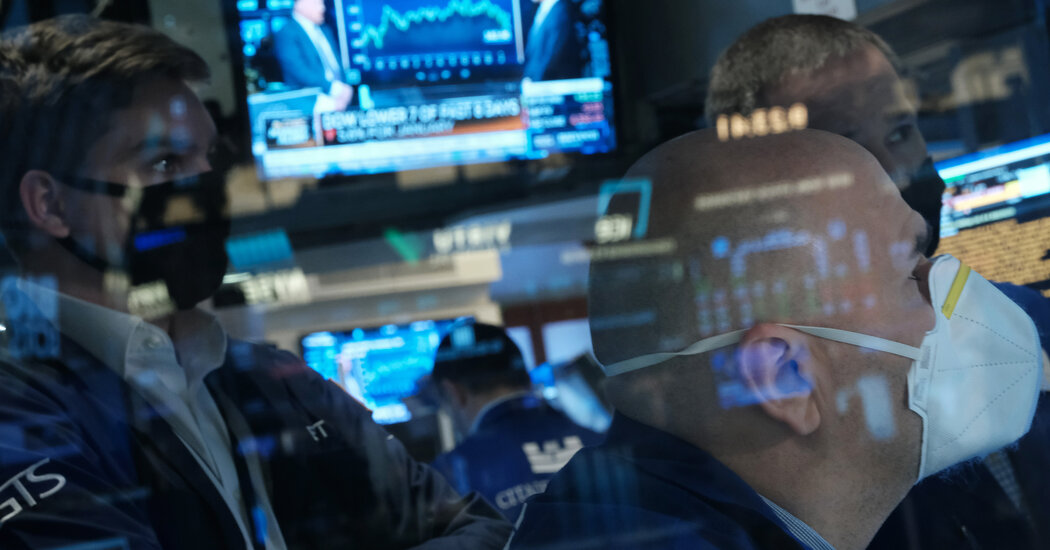
It once was a rule of thumb on Wall Street that January set the tone for the year. By that measure, the stock market in 2022 is in a downbeat mood — and subject to wild swings.
The S&P 500 index, a broad measure of the market, is down 6 percent this month, its worst monthly performance since March 2020, when stocks suffered stomach-churning drops in the early days of the pandemic.
It would be even worse, if not for strong rallies on Friday and Monday that regained some of ground lost earlier in the month. By early afternoon on Monday, the S&P 500 was up 1.2 percent, building on a 2.4 percent gain on Friday. This was in keeping with sharp moves — up and (mostly) down — in previous weeks, as investors reassess their assumptions about markets and the economy.
Over the past two years, the market has defied the uncertainty of the world outside of Wall Street. Stocks quickly recovered from declines in the early days of the pandemic, and are now are up more than 90 percent from their 2020 low. Many investors feared missing out on the seemingly unstoppable gains, especially in technology stocks and other risky companies, and piled in.
Recently, that feeling has given way to a growing concern that the market may no longer be such a sure thing. Driving that worry, and the turbulence in January, is inflation. More specifically, it’s about how the Federal Reserve will fight stubbornly high inflation, which has been stoked in part by extensive emergency support provided by the Fed to bolster the economy during the pandemic, including cutting its key policy interest rate to near zero.
For decades, many economists have presumed that globalization and technological innovation made persistently high inflation last seen in the 1970s and ‘80s unlikely to return. The rationale for steadily rising stocks has been based on inflation and interest rates remaining historically low. Now, that appears to be changing.
Last week, Jerome H. Powell, the Fed chair, confirmed a plan to raise interest rates “soon,” probably starting in March. But he gave few details on how high interest rates would need to go, or what the Fed might do about the trillions in bonds it has bought to lift the economy during the past two years.
“The Fed really changed its tone in the last month,” said Kathy Bostjancic, the chief U.S. financial economist at Oxford Economics. “It had been communicating that inflation had been transitory, and now they’re worried it’s not and that it will be more persistent.”
This has left investors feeling uneasy about the markets. That said, the link between January trading and the rest of the year has been weaker recently. January market drops are now fairly common, including in the previous two years, which ended up recording large annual gains.
Many Wall Street strategists are predicting that the market will end 2022 higher. David Kostin, the chief U.S. stock market strategist at Goldman Sachs, for instance, predicts that the market will finish the year up 15 percent from where it closed on Friday. UBS’s top stock strategist, Mark Haefele, said in a note to clients on Thursday that he was also sticking to his year-end target: up 15 percent from the close on Friday. “We expect the equity rally to resume,” Mr. Haefele wrote in his note.
The market seems volatile, but its recent swings have been only slightly bigger than usual. During the past 60 years, the average high-low spread — the difference between the highest point of the day and the lowest point of the day as measured by the market-tracking S&P 500 index — has been 1.4 percent, said Howard Silverblatt, a senior analyst at S&P Dow Jones Indices. So far this year, that measure is 1.8 percent, about the same as it was in 2020, but far less than the 3 percent it averaged in 2008, during the height of the financial crisis.
The average investor has yet to be scared off. Bank of America wrote in a research note last week that its retail clients, as a group, had put more money into the stock market than they pulled out. In the first three weeks of the year, individuals with accounts at Bank of America have bought $2.3 billion more in stocks than they have sold.
In the same time, though, hedge funds that use Bank of America to trade have sold nearly $3 billion in stock and bond funds than they have bought. “Retail clients remained the biggest buyers (as is typically true in January),” Jill Carey Hall, a Bank of America strategist, wrote in the note. “Clients bought the dip.”
One thing buoying optimism is that corporate profits have kept climbing. Analysts believe that fourth-quarter profits rose 24 percent for companies in the S&P 500 compared with the same period the year before, according to the market data service FactSet. Earnings are expected to slow this year, but still rise 9 percent in the first three months.
Strong earnings from Apple supported the market last week, easing fears that the tech industry’s period of fast growth may be coming to an end. Amazon and Alphabet, Google’s parent company, will publish their reports for the last three months ending December this week.
Another good sign: Sectors like financial stocks and industrials that are tied closely to the economy have done better than the market as a whole. Shares of General Electric, for instance, are down only about 2.5 percent since the start of the year. Wells Fargo’s stock price is up 2.5 percent in 2022.
“I don’t think there is a very big risk for a recession right now,” said James Paulsen, a strategist at Leuthold Group. “Then I don’t think it is a bull ender.”
Related reporting
More World News →
South Sudan’s Oil Looters: How Young Elite Gatekeepers Plunder Nation While Citizens Starve

General to Private: Kiir Crushes Economic Vice President in South Sudan's $1.7 Billion Corruption Purge

Paul Biya’s Re-Election: What Cameroon’s Political Longevity Reveals About Leadership and Governance in Africa