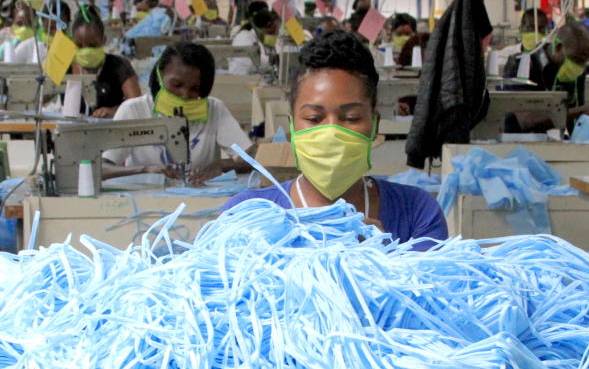
National Youth Service (NYS) Textile and Garment Technology Institute at NYS headquarters in Nairobi tasked with the production of face masks distributed for free as a measure to prevent the spread of corona virus, in Nairobi, on Friday, May 29, 2020.
Business
Yatani says move meant promote the “Build Kenya, Buy Kenya” initiative.
SEE ALSO: Yatani bets big on jobs, taxes and loans to rescue limping economy
He, at the same time, allocated Sh712 million to provide Micro, Small and Medium Enterprises (MSMEs) in the manufacturing sector with credit. Of the Sh18.3 billion, Sh1.4 billion will go to the Kenya Industry and Entrepreneurship Project, Sh3.6 billion to the development of Special Economic Zone Textile Park in Naivasha, the Kenanie Leather Industrial Park and the Athi River Textile Hub. Textile manufacturer Rivatex will also benefit from a Sh843 million allocation to support the modernisation of its operations, while Sh500 million will go towards supporting dairy processing. Another Sh3 billion has been allocated to the Dongo Kundu Special Economic Zone. The coronavirus pandemic has given Kenya’s manufacturing sector a reality check, exposing the country’s high dependency on imports, especially from China. The sector has been performing poorly, with its contribution to the Gross Domestic Product (GDP) – the sum of goods and services produced by a country – standing at 7.6 per cent in 2019.Lowering rates
SEE ALSO: Yatani gives with left and grabs more with the right
The Central Bank of Kenya has been lowering its benchmark rate since January, this year, to encourage banks to lend to the private sector in order to aid local manufacturing. Yatani noted that Kenya has the capacity to manufacture baby diapers, but the inputs used in manufacturing the products attract import duty. “In order to support manufacturing of the products locally, all inputs for manufacture of baby diapers will be imported duty-free under East African Community Duty Remission Scheme,” he said. He also said that local production of new clothing and apparels including fashion and design, inputs used in the textile and apparel sector will be imported duty-free under the scheme. He further added that inputs for assembly or manufacture of mobile phones will be imported duty-free under the scheme.Related reporting
More Business News →
High Court Blocks Oigara Bank Fraud Probe as Stanbic CEO Escapes Questioning

15 Proven Ways to Make Money Online in Kenya; No Scams!

High Court Halts Equity Bank's Takeover Bid on Swafi Foods in Landmark Ruling
