Business News
Release SME cash now, Central Bank boss tells Treasury

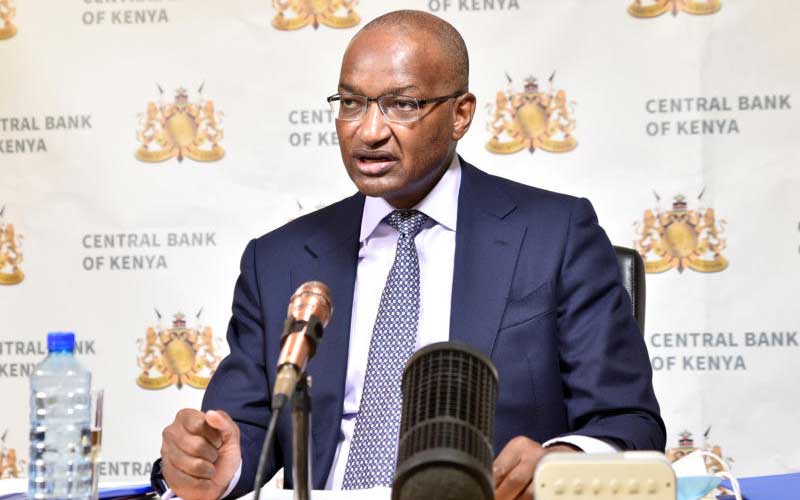
Central Bank of Kenya Governor Patrick Njoroge at a past press briefing in Nairobi, April 30. [Elvis Ogina, Standard]
Business News
. Worry is lifeline unlikely to come before July when the next financial year kicks in
Central Bank of Kenya (CBK) Governor Patrick Njoroge has urged the government to urgently unveil the planned credit guarantee scheme to forestall the death of small businesses.
Briefing the press in Nairobi yesterday, Dr Njoroge noted that micro, small and medium-sized enterprises (MSMEs) have thin buffers, which can barely last them more than two months.
Pointing out that it was still unclear when the scheme would be rolled out, the governor said it had to “be as soon as possible”.
“MSMEs don’t have a lot of buffers. They generally would die quickly,” said Njoroge during the regulator’s post-Monetary Policy Committee (MPC) briefing. He cited a survey which showed that three-quarters of SMEs do not have cash that could last them past two months, with most of them unlikely to survive beyond June.
“They (MSMEs) are on the ropes,” said Njoroge, noting that they needed both financing and other assistance, such as being provided with appropriate solutions and products.
Under the guarantee scheme, the government will pay part of the loans taken by SMEs, thus enabling banks to extend more loans to small businesses at lower rates.
However, it looks like the fund might be implemented in the next financial year that starts in July, way past next month when Njoroge noted most SMEs are expected to buckle under the weight of the Covid-19 pandemic.
As part of his Sh53.7 billion eight-point economic stimulus programme that he unveiled on Saturday, President Uhuru Kenyatta noted that the government will inject Sh3 billion as seed capital for the SME Credit Guarantee Scheme.
“The intention here is to provide affordable credit to small and micro-enterprises and to do so in an efficient and structured manner, borrowing from the professional standards and practices of private sector credit arrangements,” said President Kenyatta.
The National Treasury and a number of International Finance Institutions (IFIs), including the World Bank, are working on modalities of the scheme.
Having a credit guarantee scheme in place will ensure that banks lend to risky borrowers, including SMEs without fearing default.
In his last press briefing, Njoroge was, however, quick to clarify that such a scheme was likely to have less moral hazard where borrowers default knowing that they are guaranteed, a situation that would hit the government coffers. “This will ensure that SMEs borrow at rates that are affordable. Work is ongoing in that area and will come into fruition in the near future,” he said.
To support financial sector lending to MSMEs, the World Bank has proposed the enhancement of de-risking instruments such as payment/credit guarantees for small enterprises.
Credit to the private sector in May grew by nine per cent in the 12 months to April, with manufacturing registering the highest jump at 20.1 per cent.
Credit growth to trade grew by 10.3 per cent, transport and communication (9.1 per cent), building and construction (7.7 per cent) and consumer durables (19.6 per cent).
CBK on Wednesday retained its benchmark lending rate – the Central Bank Rate (CBR) – at seven per cent, signalling cheaper loans for borrowers distressed by the Covid-19 pandemic.
Following the outbreak, the repayment period of personal/household loans amounting to Sh102.5 billion, or 13.1 per cent of the banking sector personal/household gross loans, had been extended by the end of April.
For other sectors, a total of Sh170.6 billion had been restructured, with beneficiaries being trade, manufacturing, tourism and real estate. This pushed the total loans restructured to Sh273.1 billion. The retention of CBR came at a time when banks are swimming in cash, with the interbank rate, or the rate at which banks lend to each other, dropping to a low of 3.4 per cent by the end of yesterday. The interbank rate, which is critical for banks under a cash crunch, was at 3.92 per cent on Tuesday.
This year, the economy is expected to register a slower growth than in 2019 when the gross domestic product (GDP) expanded by 5.4 per cent. Most forecasters expect real GDP to expand by less than three per cent.
However, banks have also been forced to set aside billions as insurance against possible loan defaults.
With prudential rules requiring any loans to be put under watch even before they become non-performing (not serviced for more than three months), banks have been provisioning for loan-loss even for accounts whose loans have been restructured.
Banks have also been recalling dividends just in case they are faced with a liquidity crisis, a move that Njoroge supported.
He said in case banks need additional liquidity, they will still need shareholders’ funds. “It is important; in the end if they need additional liquidity it should come from shareholders,” said Njoroge.
Bad loans, those which have gone for more than three months without being serviced, as a share of gross loans increased to 13.1 per cent in April, compared to 12.5 per cent in March.
Comments


SportyBet Powers Vurugu 2 — Nairobi’s Biggest Celebrity Fight Night Lands at Sarit Expo Center on 20 June 2026

Allan Chesang Goons Brutally Attack Standard and K24 Journalists in Cherengany as Corruption Cover-Up Claims Deepen

How the DCI and Kisumu County Officials Shield the Medprime Training College Syndicate While Students Buy Worthless Certificates

How Interior PS Raymond Omollo and Senator Allan Chesang Ran a Sh60 Million Fake Tender Scam

The NSSF Audit Dossier on Mismanaged Billions and Stalled Housing Projects

The Absa Kenya Dossier on Extortion Cartels, Boardroom Purges, and the Million-Dollar Client Hunt

“Enough is Enough”: DP Kindiki Issues Stern Warning to Ruto Critics