More by this Author
The education sector is staring at a major crisis as schools prepare to reopen this week. The Kenya National Union of Teachers has declared a national strike to protest the mass transfer of its members in what the employer calls delocalisation. The Teachers Service Commission, the employer, has vowed not to relent, insisting that teachers sent on transfer must report to their new stations, if they wish to keep their jobs.
Transfer of employees is an administrative task that, ordinarily, should not engender any conflict. But underlying this is administrative justice. Any administrative task must be done prudently, fairly and responsibly. It should never be punitive or vindictive.
But the situation at hand is peculiar. The TSC has resorted to an extensive relocation of headteachers with the objective of removing them from their home counties to different geographical areas in an exercise intended to streamline school management. Broadly, there is merit in the undertaking. But the way it is being done is chaotic and disruptive.
Background and context are paramount here. In the 1980s, the TSC undertook to post teachers to their localities for two reasons: Allow them to work in familiar environment with the understanding that it would inspire them to perform; and enable them to develop themselves through engaging in other activities, such as farming, and putting up their homes, for which they earned owner-occupier allowance.
It is this localisation that informed the current teacher recruitment policy — they apply and only get absorbed for positions tenable within their counties, in fact, sub-counties. In effect, the current scenario is a creation of the TSC, not teachers.
Added to this, the appointment to the headship position and posting to schools has not always been transparent. Insiders talk of underhand deals, where some applicants for headship or those seeking to keep their stations bribe their way or use influential politicians to get positions in particular schools.
To remedy the murky situation, the TSC must be tactical. As a starting point, it should stagger the transfers. That may take time, but it will be less acrimonious and successful.
At any rate, poor management of schools is not a consequence of teachers working in their home schools per se. On the contrary, it is because of poor supervision by quality assurance officers, inadequate infrastructure in schools, lack of training and irregular appointment of headteachers due to corruption.
We denounce the hard stance taken by both parties. We cannot afford a teachers’ strike at the beginning of the year.
Related reporting
More General News →
Kisumu Magistrate’s Court Sentences Family Trio to 10 Years for KSh113.2 Million Fraud

Cabinet Secretary Geoffrey Ruku Threatens Disciplinary Action Over Civil Servant Absenteeism
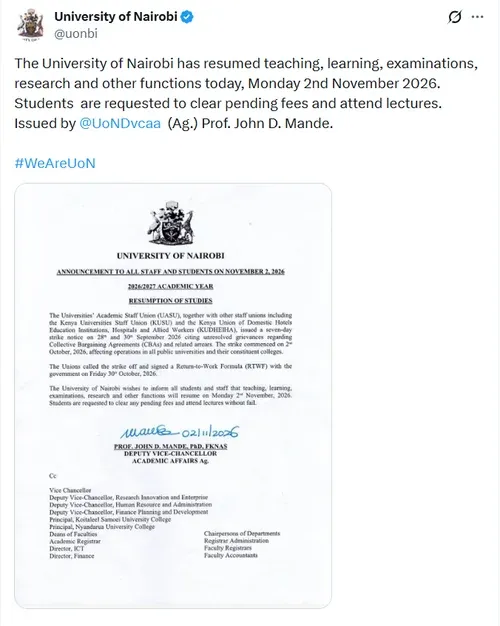
University of Nairobi Orders Fee Payments as Classes Resume After KSh20 Billion Settlement