More by this Author
Multinational tea estates in Kericho and Bomet counties will not have their leases renewed until they agree with the devolved governments on the farms’ future, the National Land Commission has ordered.
Some county government officials have been pushing for the farms to he handed back to the community after the leases expire.
James Finlay and Unilever, which have been growing tea for decades, are among the affected firms.
James Finlay has operated in Kenya since the 1920s and owns 5,000 hectares of tea, employs 9,500 people and operates five factories in the counties.
Unilever has been growing tea in Kenya since 1924 and its estate in Kericho covers over 8,700 hectares.
Local communities have asked the government to surrender to them about 200,000 acres still occupied by James Finlay, Unilever, George Williamson, and Sotik Highlands, among other tea farms in the South Rift.
They claim British colonialists condemned hundreds of families from the Kipsigis and Talai communities to lifelong poverty by depriving them of their land. They accuse the government of failing to recognise this injustice after independence.
Mr Samuel Terer recalls how, one day in 1932, a troop of mean-looking European soldiers ordered them to leave their Chemasingi home in today’s Kericho County.
The then 14-year-old witnessed their house and granary torched and livestock taken before his father and grandfather were forced to register as squatters. African Highlands Produce Company had taken their land for tea growing.
“I was born in Chemasingi Village, which is now part of the James Finlay/Swire Group land in 1918. My place of my birth is right on the house where the Chemasingi Estate manager lives today,” says the frail-looking, landless centenarian.
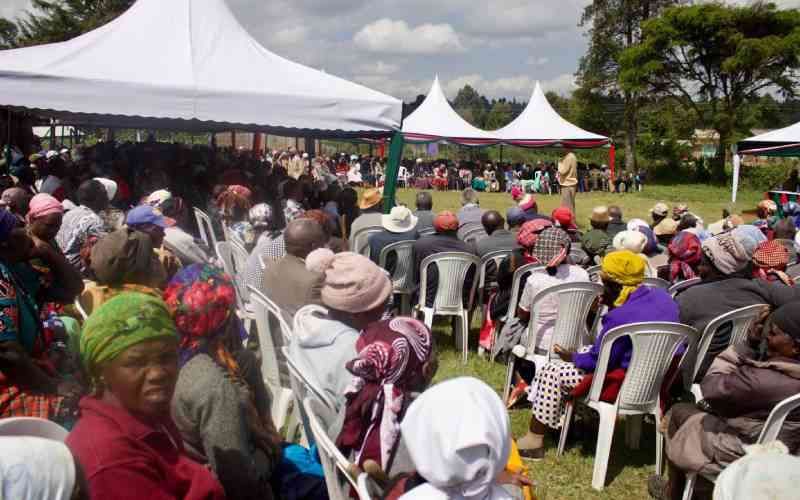
Residents are now celebrating the decision by the land commission requiring the multinational companies and the government to compensate the communities.
How this decision will affect the British multinationals remains to be seen. NLC has ordered that a fresh survey and audit be carried out for land allocated to multinational firms in Kericho and Bomet and that the land in excess of the size documented in official records be passed on to the counties to hold in trust for the communities.
The NLC also ordered that the land rates and rent for land occupied by multinationals and other tea firms be raised to benefit the local communities.
This is after it emerged that the companies did not only under-declare the acreages and value of land, but also paid a paltry Sh294 per acre instead of Sh40,000 agricultural rates according to the law.
“Having read the submission made by the legal team, the various documents and other forms of exhibit brought to us and having conducted our own investigations, we note that in the process of forceful eviction from the parcels of land, the communities were subjected to other forms of human rights violations and suffered historical land injustices as envisaged in law,” ruled the commission.
The Kericho County government had petitioned a panel of four chaired by Commissioner Samuel Tororei on the issue on behalf of the communities.
Besides asking the British government to apologise for the injustices committed against those who lost their ancestral land, the team asked them to pay damages to direct victims like Mr Terer.
The NLC further said multinationals should lease land from the counties at commercial rates and expired leases should only be renewed with host counties’ consent.
They should also build schools, roads, hospitals, a museum and university and provide water and electricity to “alleviate or compensate for their suffering.” The government is expected to own that the so-called crown land ought to have been surrendered to the community at independence.
Kericho Governor Paul Chepkwony said the recommendations are to be implemented within the next three years, in line with the law.
He asked the county assemblies of Kericho and Bomet to pass the required laws.
If implemented, the changes will greatly affect the firms’ bottom line. James Finlay and Unilever, for instance, have been laying off “redundant” workers in a bid to stay afloat.
Meanwhile, Kericho Senator Aaron Cheruiyot wants land rates paid by multinationals revised immediately.
“The law clearly outlines the rates for agricultural land. We want to use their valuation of Sh10 million to calculate the land rates, which will amount to between Sh20,000 and Sh40,000. As residents of Kericho, we demand Sh40,000,” he said.
With the valuation of tea estates having been done last over 25 years ago, the companies have continued to pay a negligible amount for such a prime agricultural zone.
Related Stories
Related reporting
More General News →
President Ruto Announces KSh4 Billion for Teachers' Career Progression and 50,000 Promotions

Inspector Kenneth Kipkemboi Sang Charged With Murder of Lawyer Mbobu, Remanded in Custody
Government Releases KSh1.69bn for Inua Jamii Orphan Cash Transfer