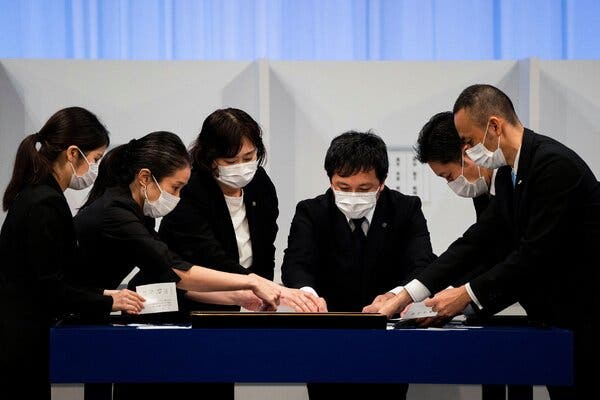
None of the candidates vying for the top spot in the Liberal Democratic Party of Japan garnered enough votes in the first round, forcing the top two candidates into a runoff.
The two leading candidates are Taro Kono, 58, a government minister who has rankled party leaders on policy issues and garnered large public support, and Fumio Kishida, 64, a moderate with tepid support in the polls. Mr. Kono got 255 votes, versus 256 for Mr. Kishida. The top candidate would have needed 382 votes to win outright.
The two female candidates, Sanae Takaichi, 60, a hard-line conservative, and the more socially progressive Seiko Noda, 61, were eliminated.
Voting in the second round should begin shortly and results will be released later Wednesday.
The vote for a new leader of the Liberal Democratic Party of Japan is a staid affair, empty of any of the pomp and ceremony of party congresses in places such as the United States and China.
But the stakes are still high. The election will determine the leadership of the world’s third-largest economy, a country grappling with serious economic and demographic challenges as it cycles through its third prime minister in the year and a half of the pandemic.
The four candidates have spent the last two weeks glad-handing and lobbying for support from their party ahead of today’s secret ballot, hoping to win an absolute majority of the 764 votes up for grabs.
Half of those votes come from rank-and-file party members, who will gather in their local headquarters at 1 p.m. to tally support.
The other half are from the party’s parliamentarians, who will soon assemble in a central Tokyo hotel.
The results of the contest will be announced around 2:20 p.m. But if no one wins an absolute majority — a likely outcome — the top two vote-getters will advance to a second round.
Now things get interesting. In the run off, the power to choose a winner shifts decisively toward the parliamentarians. The rank and file get just 47 votes at this stage, and the outcome will hinge on the political maneuvering and horse trading the candidates carried out in the days leading up to the election as they fought for support from the party’s internal factions.
A final decision will come before 4 p.m. and the winner will hold a news conference shortly after.
Winning the contest will all but guarantee them the premiership, although nothing will be official until Oct. 4, when the Parliament will meet to officially select Japan’s new leader.
The winner of the race to lead Japan’s ruling Liberal Democratic Party is all but assured to be prime minister after the general election. Unlike in past party elections, when leaders unified around a single candidate, there is no clear favorite this time. Here’s a rundown of the three leading contenders.
Front-runners
Polls have found that the public favors Taro Kono, the cabinet minister overseeing Japan’s coronavirus vaccine rollout, by at least two to one. His Twitter following of 2.4 million dwarfs those of his three rivals combined.
But in the back rooms where Japanese political decisions are made, Mr. Kono, 58, is not nearly as well liked. His reputation as the Liberal Democrats’ most outspoken nonconformist and his left-leaning views on social issues put him out of step with the party’s conservative elders.
Many Liberal Democratic members of Parliament consider Fumio Kishida, 64, a moderate with tepid support in the polls, to be the safest choice, according to media tallies of lawmakers.
A Party First
Former Prime Minister Shinzo Abe, who resigned last year because of ill health, has backed Sanae Takaichi, 60, a hard-line conservative. Ms. Takaichi, who would be Japan’s first female prime minister, has strong backing from the right wing of the party, but her poll numbers are low. Another woman in the leadership race, Seiko Noda, 61, has little support from either the public or the party.
When people think of preordained elections these days, they tend to look to Russia or Iran or Hong Kong. But in Japan, a parliamentary democracy and the world’s third-largest economy, the same party has governed for all but four years since 1955, and most expect it to win the general election due by the end of November.
So on Wednesday, when the Liberal Democratic Party chooses a successor to Yoshihide Suga, the unpopular prime minister and party chief, it will almost certainly anoint the prime minister who will lead Japan into the new year.
But why, in a country with free elections, where voters have expressed dissatisfaction over the government’s handling of the coronavirus and the Olympics, can the Liberal Democratic Party remain so confident of victory?
The Liberal Democrats try to be all things to all people.
The party formed in 1955, three years after the end of the postwar American occupation of Japan. Yet the United States had a hand in its gestation.
Fearing that Japan, which had a growing left-wing labor movement, might be lured into the Communist orbit, the C.I.A. urged several rival conservative factions to come together.
“They didn’t necessarily like each other or get along, but they were engineered into one mega-party,” said Nick Kapur, an associate professor of history at Rutgers University.
The new Liberal Democratic Party oversaw Japan’s rapid growth during the 1960s and 1970s, which helped to solidify its power. And over the decades, it has morphed into a big tent, as reflected in the candidates seeking the party’s top position this week.
Sanae Takaichi, 60, is a hard-line conservative. Fumio Kishida, 64, is a moderate who talks about a “new capitalism.” Seiko Noda, 61, supports greater rights for women and other groups. Taro Kono, 58, eventually wants to phase out the nuclear power industry.
The four candidates vying to be leader of the governing Liberal Democratic Party in Japan cast their ballots in an election broadcast on several television channels on Wednesday.
Yoshihide Suga, the departing prime minister, joined the candidates, Taro Kono, the minister overseeing Japan’s vaccine rollout, Fumio Kishida, a former foreign minister, Sanae Takaichi, a staunch ally of Shinzo Abe, Japan’s longest serving prime minister, and Seiko Noda, a left-leaning member of Parliament.
Each party member in Japan’s two houses of Parliament ascended a stage, wrote their choice for leader on a slip of paper, and dropped their votes into a wooden box. After votes are counted, if none of the candidates exceed 50 percent of the votes, the balloting will go to a second round. The first results should be read at about 2:20 p.m. on Wednesday.
Japan’s governing-party election was set in motion earlier this month, when Prime Minister Yoshihide Suga announced that he would not seek re-election.
Mr. Suga, 72, assumed the prime ministership after Shinzo Abe, Japan’s longest-serving prime minister, resigned in August 2020 because of ill health. But Japan’s struggles with the coronavirus left Mr. Suga deeply unpopular, and his decision to step aside made him a rare leader of a large, developed country to resign in large part because of the pandemic.
The son of a strawberry farmer and a schoolteacher from the country’s rural north, Mr. Suga had been a behind-the-scenes operator in the Liberal Democratic Party. A deeply uncharismatic leader who struggled to connect with the public, he often looked uncomfortable as a public-facing leader.
In many respects, Mr. Suga’s quick rise and fall could be attributed to timing. When Mr. Abe resigned, the party bosses decided they did not want a bruising leadership contest and quickly aligned behind Mr. Suga, a power broker and chief spokesman for Mr. Abe who was perceived as malleable and willing to carry on his predecessor’s policies.
But public frustrations with Mr. Suga grew as Japan, which had managed the pandemic quite well in 2020, took months to ramp up its vaccination program and left the population weary with continued economic restrictions. Concerns that the government was plowing ahead with the Olympics as cases rose in Tokyo and surrounding prefectures also damaged Mr. Suga’s credibility.
By early last month, Mr. Suga’s approval ratings, which were above 60 percent at the beginning of the year, had plunged below 30 percent.
With his difficulty connecting with the public, Mr. Suga shouldered the blame for the broader failings of the Japanese bureaucracy, which held up vaccinations with requirements for domestic clinical testing and limits on who could administer the vaccines. But he also embodied a larger challenge facing Japan’s government.
“When you have a crisis, you need an adaptable, break-all-the-rules, get-things-done kind of response, and that is a little harder for Japan,” said Sheila A. Smith, a senior fellow for Japan studies at the Council on Foreign Relations in Washington.
Like much of the Asia-Pacific, Japan is slowly emerging from the strictest pandemic restrictions as reports of new cases fall and vaccinations ramp up. And it’s coming just as the world’s third-largest economy prepares to hold general elections by November.
The government will end its state-of-emergency measures on Thursday amid a fall in the number of new daily coronavirus cases and a vaccine rollout that has reached nearly 60 percent of the population, hoping that the move helps to revive the country’s economy.
It will be the first time since April 4 that no part of Japan is under a state of emergency.
The move was announced by Prime Minister Yoshihide Suga on Tuesday, a day before a Liberal Democratic Party vote that will select a leader to succeed him. Mr. Suga said that he would not be extending the emergency measures currently active in 19 prefectures and that they would instead expire at the end of the month, as scheduled.
“Moving forward, we will continue to put the highest priority on the lives and livelihoods of the people,” Mr. Suga said in Parliament on Tuesday afternoon.
He said that the government would “work to continue to achieve both infection control and the recovery of daily life.”
New daily coronavirus cases in Japan have decreased 73 percent over the past two weeks, to an average of 2,378 a day, according to the Our World in Data project at the University of Oxford. And there has been a sharp improvement in Japan’s vaccine rollout, with close to 60 percent of the population fully inoculated, a rate that exceeds that of the United States and of many other countries around the Pacific Rim.
Under the state of emergency, people were urged to refrain from nonessential outings, and restaurants were asked to close by 8 p.m. and to not serve alcohol. The government plans to ease those restrictions in stages.
Yasutoshi Nishimura, a government minister who is leading Japan’s Covid-19 response, said that serving alcohol would be allowed but that “governors will decide on that appropriately, according to the region’s infection situation.”
Related reporting
More World News →
Saudi Prince Found Dead in Hotel Bathroom as Inquest Rules Death Was Misadventure

South Sudan at the Brink: How Corruption Tightens Its Grip on a Rare Working Institution

South Sudan’s Oil Looters: How Young Elite Gatekeepers Plunder Nation While Citizens Starve