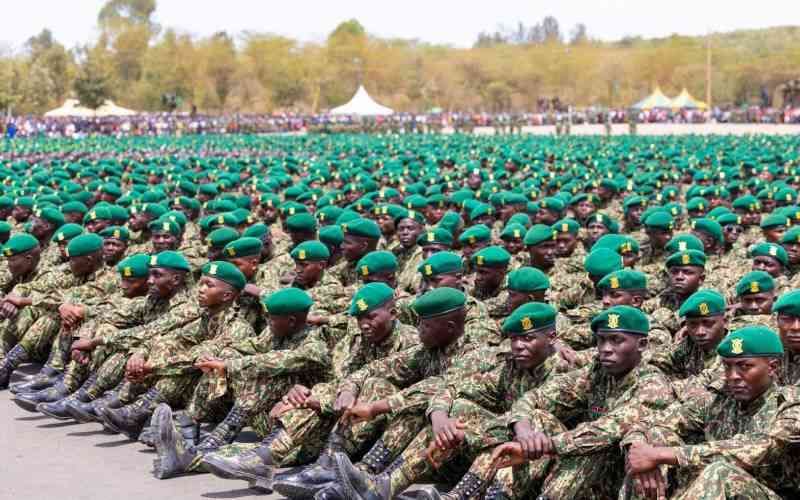
Members of the National Assembly have backed a motion that seeks to create employment pathways for roughly 18,000 young people who graduate from the National Youth Service (NYS) each year, focusing on recruitment into government institutions and private security firms.
The proposal, sponsored by Kilifi County MP Gertrude Mbeyu, calls for a policy framework in line with Article 55 of the Constitution to set guidelines on recruitment, deployment, remuneration, training, career progression and the division of responsibilities between NYS graduates and private security firms.
Kitutu Chache MP Japheth Nyakundi warned that the state risks squandering public resources if graduates remain unemployed after completing NYS training, urging the government to explore absorption of the trainees into the private security industry.
Ol Kalou MP Sammy Douglas Waweru argued that security guards should meet prescribed training standards and that the extensive training provided by NYS could be harnessed to meet the country’s security needs, calling for clear policies to require private security firms to recruit such personnel.
Mbeere North MP Leonard Wa Muthende supported the motion by highlighting the contrast between the rigorous courses undertaken by NYS graduates and the brief two-to-four-day training received by some security guards, stating that NYS graduates are ready to serve as security officers.
Embu County MP Pamela Njoki called for a legal and policy framework to guide an exit programme for trainees, questioning why a structured transition plan for NYS graduates has not yet been established.
The motion notes that ministries, departments and agencies continue to rely on private security companies to supplement the services of uniformed officers, and that NYS graduates possess skills in discipline, security awareness, public-service ethics and emergency response that could be deployed to meet institutional security needs while tackling youth unemployment.
While the motion seeks to provide a more predictable route from NYS training to employment and to set standards for security personnel, its parliamentary backing does not, by itself, create jobs or initiate recruitment, and further government action would be required to implement the proposed framework.
Related reporting
More Politics →
Ida Odinga Calls for Unity Ahead of Raila Odinga First Anniversary Memorial

Fred Matiang’i Urges President Ruto to Stop Attacking Uhuru Kenyatta
Fred Matiang’i Says Opposition Coalition Talks Remain Unresolved Ahead of 2027 Election