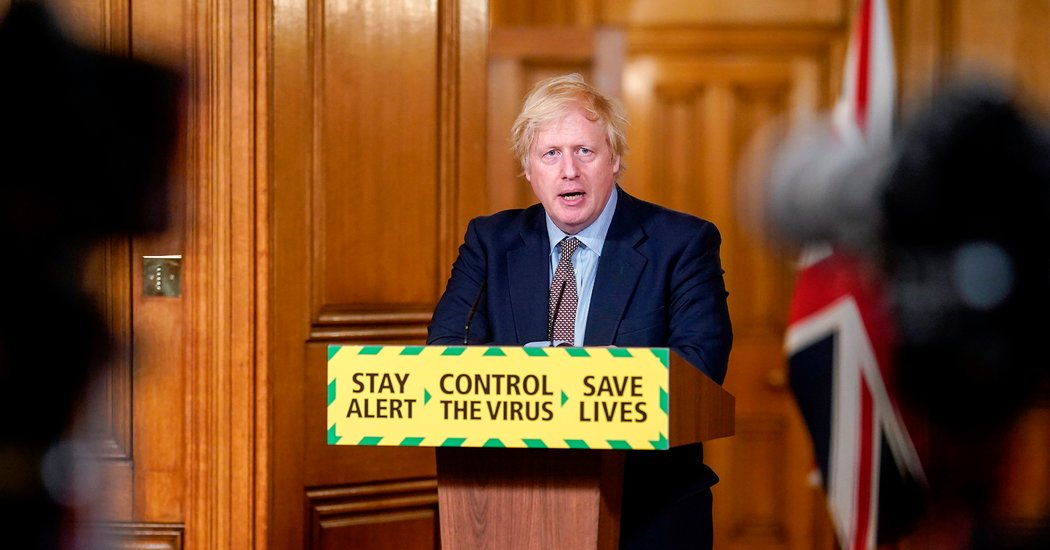
The Conservative Party romped home. With a towering new majority, Mr. Johnson fast-tracked Britain’s departure from the European Union, put in place a one-year transition period and reportedly told ministers to stop using the word “Brexit.” Britain would be free even of the word itself. Mr. Johnson — who referred to his party as “the people’s government” — appeared to be unassailable.
Then came the pandemic. Unable to shake off his trademark combination of bluff and bravado, Mr. Johnson struggled to match the seriousness of the situation. Boasting of shaking hands with Covid-19 patients, he demurred from imposing a nationwide lockdown, even as cases began to stack up. “The freeborn people of the United Kingdom,” he maintained, would not tolerate it.
“We live in a land of liberty,” Mr. Johnson said on March 18, as countries across Europe followed Italy into lockdown. Two days later, as he announced the closure of pubs, bars and restaurants, he noted ruefully “how it seems to go against the freedom-loving instincts of the British people.”
The people disagreed. When a nationwide lockdown was finally declared on March 23, public support for the policy was at 93 percent. It remained high for the next two months, even as much of the press focused on easing restrictions. Britons, it turned out, did not value their liberty above their lives. But Mr. Johnson did, to lethal effect. Twenty thousand people, according to one estimate, would still be alive if the prime minister had imposed lockdown sooner.
It was a calamitous misjudgment, but not necessarily a surprising one. Mr. Johnson’s reticence toward lockdown and his unbridled enthusiasm for Brexit are of a piece. Brexit is born of a mind-set that, at root, doesn’t like being told what to do: It imagines a dream state where neither the island nation nor its citizens are responsible to anyone except themselves, a libertarian nationalism where all state (and supra-state) regulations are given short shrift.
This freewheeling style of politics comes naturally to Mr. Johnson, and it greased his path to power. But it is ill suited to addressing a pandemic. One of the infamous claims of the Brexit campaign was that “the people in this country have had enough of experts”; the attack singled out “organizations with acronyms.” Now Mr. Johnson and his band of true believers deliver news conferences flanked by scientists from SAGE: the Scientific Advisory Group for Emergencies.
The dissonance, jarring to observe, has produced an incoherent response. Claiming at all times to be “led by the science,” the government has frequently changed its position and then denied doing so, offering the public confusing, ambiguous and sometimes impenetrable guidance.
Related reporting
More World News →
South Sudan’s Oil Looters: How Young Elite Gatekeepers Plunder Nation While Citizens Starve

General to Private: Kiir Crushes Economic Vice President in South Sudan's $1.7 Billion Corruption Purge
Paul Biya’s Re-Election: What Cameroon’s Political Longevity Reveals About Leadership and Governance in Africa