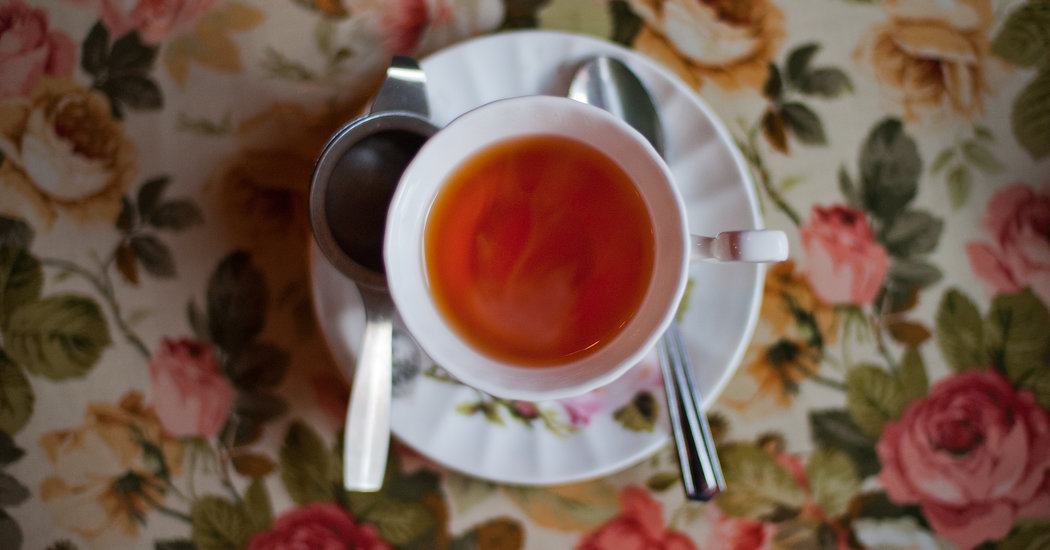
In this week’s episode of “A Bit of Relief,” we turn to tea and toast for comfort. First, Kim Severson, a food writer at The Times, shares her love for buttered toast sprinkled with cinnamon and sugar. Then we hear Mark Thompson, C.E.O. at The Times, explain how to brew his ideal cup of British tea: using a stovetop kettle, loose black tea leaves, a strainer and a splash of milk.
But this is where things get complicated.
There are, apparently, 24 million ways to make a cup of tea. In British offices and homes, this also means there are also millions of ways to fail, quietly but catastrophically, in brewing for someone else. Tea-making is, as George Orwell said, “the subject of violent disputes.”
While tea time is a minefield of fiercely held personal preferences, it is nonetheless an institution — one fortified by crisis.
“We’ve seen a 1,000 percent increase in demand for our products,” said Sebastian Pole, the founder and professed “master herbsmith” at the British tea company Pukka. “A cup of tea is a guaranteed good moment, isn’t it? And there aren’t many guaranteed good moments these days.”
A Brief Guide to British Tea
But first — what is “British tea”?
Since the early 17th century, when tea leaves were first imported from India, black tea has been the British drink of choice. Its popularity propelled the country to attain one of the highest rates of per capita tea consumption in the world. In 2013, traditional British black tea, specifically blends like English Breakfast and Earl Grey, accounted for 89 percent of the country’s tea market.
However, herbal teas, like mint and chamomile; green teas, like Japanese matcha; and different blends of black tea have gained market share over the last decade. In response, many cafes, hotels and tea rooms have diversified their menus to include niche infusions such as herbal, pu’er and oolong teas.
Different approaches to black tea have also gained popularity. Naved Nasir, executive chef at the Indian cafe chain Dishoom, said, “We use Assam or Darjeeling tea simmered slowly with milk, water, fresh ginger, black peppercorns, cardamom, cinnamon, cloves and a generous helping of sugar.”
Angela Pryce, a British tea sommelier, said that while specific black blends designed to be taken with milk comprise the traditional canon of British tea, it is the ritual of drinking any tea that “is at the heart of British celebratory life.”
“Tea is quite personal. Wherever you are from in the world is how you take your tea,” she said. “But no matter the tea, I don’t see any barrier to participating in the culture of British tea drinking.”
Where to start? The kettle and the water.
Most Americans are unacquainted with one of the most common features of British homes: the electric kettle.
“What, really?” Lewis Wall, 26, from Leicester said, shocked to hear the common alternatives to the electric kettle in the United States include stovetop kettles, coffee makers or microwaves. “Why? That’s deffo worse.”
The answer is that electric kettles work much quicker with the higher-wattage power supply standard in British homes — usually 230 volts at 13 amps rather than the 120 volts at 15 amps that’s common in the United States. American electric kettles often heat water about as fast as one on the stove.
More important, Ms. Pryce noted, was the water quality.
“Water type plays a big part,” she said. “If you always use a filter on hard water, that takes out mineral deposits, and the end cup of tea will be much brighter.”
She also noted that black tea should be brewed in boiling water, while it is preferable to place green tea in water at a lower temperature (158 degrees Fahrenheit, to be exact).
Brewing the leaves
In our episode, Mr. Thompson explains how to brew loose leaf tea. He spoons the leaves into a stovetop kettle full of freshly boiled water to steep then uses a small metal tea strainer to avoid pouring the leaves into his cup.
Janice Teale, a 69-year-old resident of Tower Hamlets in East London, agreed with Mr. Thompson’s method. “That’s how you brew a proper cup,” she said. “I’ll brew loose leaf only if I want to feel a little bit posh.”
“But who has time for that?” her 80-year-old neighbor, Ellen Jeffery, replied. “I’m not much of a tea drinker. I just have one cup every morning, but I take my tea with just a Yorkshire bag,” she said, referring to another brand.
Ms Pryce conceded that “loose tea always gives more flavor” but noted that bagged tea far outpaced loose leaf in popularity. Loose leaf teas comprised only 2 percent of the British tea market in 2018.
Whether tea is brewing loose or bagged, the process of steeping it is a matter of both science and preference. Ms. Pryce recommends around five minutes for black tea in boiling water, while Paul Ainsworth, a Michelin-starred British chef, recommended three. But Mr. Thompson argues that the process rejects the precision of our highly optimized world.
“Tea is different! You have to wait for the tea,” he said. “The tea kind of happens on its time, rather than your time.”
The additions: Does milk go in before or after?
The question of whether, when and how to add milk to British black tea dates back centuries. Ms. Pryce said that in the early era of British tea drinking, “Milk was put in first because the fine porcelain and crockery would crack from the heat of the boiling water.”
“Now, there is no reason that milk can’t be added after,” to slowly gauge the quantity and color, she said.
Most of the British public agrees. However, there are some holdouts. Richard Corrigan, a Michelin-starred chef from Ireland who has lived and worked in London for decades, said: “I take my tea the ‘unpopular’ way: weak and very milky. My children joke that it sometimes looks like I’m drinking cups of milk, which I always add first.”
Clare Smyth, another top chef, said that she also took her English Breakfast tea always with “milk in the cup first!”
No matter how much milk or sweetener — usually sugar — is added, Ms. Pryce said she thought it should be done slowly, and “to taste.” And brewing a cup of tea is always “a good excuse to have a slice of cake or biscuits,” Elizabeth Carter, editor at The Good Food Guide, said. “And given the lack of flour in supermarkets, it looks like everyone is baking.”
“The Daily” is made by Theo Balcomb, Andy Mills, Lisa Tobin, Rachel Quester, Lynsea Garrison, Annie Brown, Clare Toeniskoetter, Paige Cowett, Michael Simon Johnson, Brad Fisher, Larissa Anderson, Wendy Dorr, Chris Wood, Jessica Cheung, Stella Tan, Alexandra Leigh Young, Jonathan Wolfe, Lisa Chow, Eric Krupke, Marc Georges, Luke Vander Ploeg, Adizah Eghan, Kelly Prime, Julia Longoria, Sindhu Gnanasambandan, M.J. Davis Lin, Austin Mitchell, Sayre Quevedo, Neena Pathak, Dan Powell, Dave Shaw, Sydney Harper, Daniel Guillemette, Hans Buetow, Robert Jimison, Mike Benoist and Bianca Giaever. Our theme music is by Jim Brunberg and Ben Landsverk of Wonderly. Special thanks to Sam Dolnick, Mikayla Bouchard, Lauren Jackson, Julia Simon, Mahima Chablani and Nora Keller.
Related reporting
More World News →
Saudi Prince Found Dead in Hotel Bathroom as Inquest Rules Death Was Misadventure

South Sudan at the Brink: How Corruption Tightens Its Grip on a Rare Working Institution

South Sudan’s Oil Looters: How Young Elite Gatekeepers Plunder Nation While Citizens Starve