Weather: Cloudy, with a high near 50.
Alternate-side parking: In effect until April 9 (Holy Thursday).
Officials and decision makers across New York State are continuing to weigh possible responses to the spread of the coronavirus. Yesterday, they took steps to reduce large gatherings — including canceling in-person classes at the biggest university systems — and to expand testing of people who are exhibiting symptoms.
[More coverage of the coronavirus outbreak in the New York area.]
The governor wants to ramp up testing capacity.
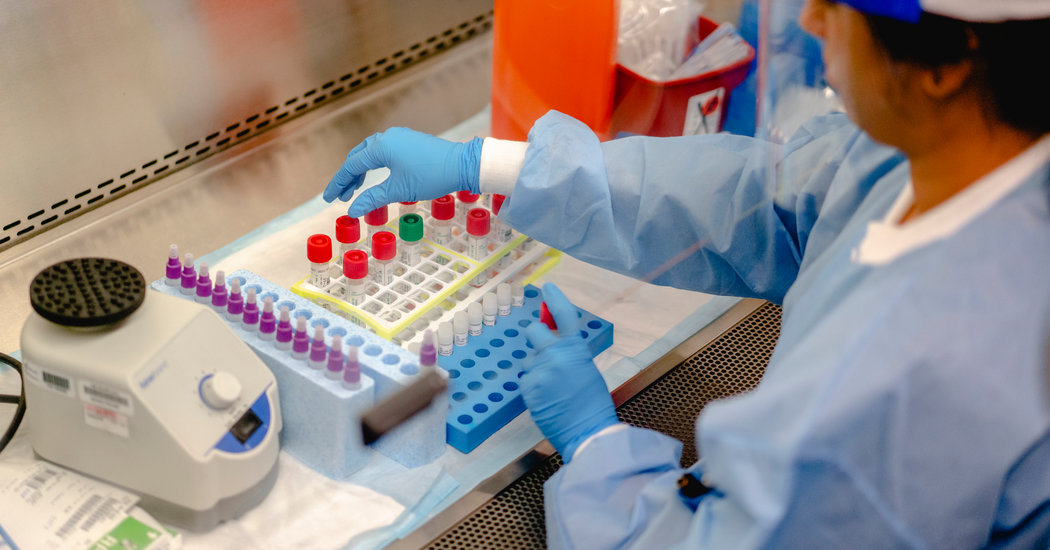
Governor Cuomo has said the state should be testing 1,000 people for the coronavirus a day, but since late February, fewer than 2,000 in total have been tested.
[Desperate for a coronavirus test, they couldn’t get one.]
The governor acknowledged that disparity yesterday at a news conference and said that he had asked 28 private labs to begin testing for the virus. Still, the labs must receive federal approval to move forward.
“We can’t just wait anymore,” Mr. Cuomo said. “It’s compounding the problem.”
CUNY and SUNY canceled most in-person classes.
Following the lead of private colleges across the state, schools in the City University of New York and State University of New York systems will hold most classes online beginning on March 19.
The campuses will remain open, and certain classes, such as labs, may still be taught in person. Students who live on campus and have no other place to go will have access to housing.
“They are not evicting anyone,” Mr. Cuomo said.
The decision might affect graduation ceremonies. One Cuomo aide said the ceremonies would probably “not be happening in person” this spring.
Events have been called off to discourage crowds.
The governor announced yesterday that the St. Patrick’s Day Parade in New York City had been postponed. It is the first time that the event, which in recent years has drawn about 150,000 marchers and as many as two million spectators, will not go on in more than 250 years.
The Jacob K. Javits Convention Center has cleared its event calendar through mid-April because of several cancellations and postponements. The venue’s popular New York International Auto Show has been rescheduled for August.
On Broadway, shows have not been canceled, but my colleague Michael Paulson reported that an usher who had recently worked at two theaters had tested positive for the virus, prompting a scramble to inform the public and clean the buildings.
The coronavirus has now sickened at least 216 people in the state.
As of yesterday, 15 percent of the state’s patients had been hospitalized.
New Jersey’s governor said yesterday that 23 people in his state had the virus. In Connecticut, three people have tested positive.
From The Times
Harvey Weinstein’s Stunning Downfall: 23 Years in Prison
N.J. Transit’s Most Troubled Trains Are Older Than Many of the Riders
Events are subject to change, so double-check before heading out. For more events, see the going-out guides from The Times’s culture pages.
And finally: Bottle and can collectors
The Times’s Kasia Pilat writes:
When we asked readers what they most wanted to know about New York City, hundreds of queries came in. As we sifted through them, a trend emerged: Several of the common questions had been answered in previous Times articles. So we dived into the archives to answer some of them.
Elizabeth Welch of Manhattan wanted to know about New Yorkers who collect and redeem bottles and cans. “Is it legal to take trash off the streets?” she asked. “Is it territorial? Where are the recycling centers located, and how do they get their massive bags of bottles to these centers? How much money does one make with a day’s work?”
Andy Newman, who writes about jobs for The Times, has followed New York’s “canners,” who make a living returning deposit containers.
The price of Manhattan real estate, he wrote late last year, forced every dedicated redemption center off the island, which means that canners must either load their containers individually into supermarket redemption machines, which sometimes have a $12-per-day limit, or take them to recycling centers in the Bronx, Queens and Brooklyn.
“Into this void have stepped redemption companies that send out trucks to buy from canners on the street, following the migrant miners who follow the city’s recycling schedule night after night,” he wrote.
Some canners, Mr. Newman explained, sell their cans to other canners, who sell to the trucks. Others buy empties from other workers for 3 cents each and sell them to the trucks for 5 cents.
“One family works the Upper East Side with its own van to safeguard and transport its harvest to the trucks,” he wrote.
“All of this activity occurs in a vast gray area of legality,” he added. “Technically, once recycling is left on the curb, it belongs to the city. It is a further violation to use a motor vehicle to collect recyclable materials from curbside.”
Rosa, one of the canners in the article, has established exclusive arrangements with custodial workers at certain buildings. On the money she earned through canning she was able to put her 19-year-old daughter through medical-assistant school. One Friday evening, she went home with $135 for five hours’ labor.
It’s Thursday — stay calm and collected.
Metropolitan Diary: On the trail
Dear Diary:
I’m not a great runner. My form is stiff, my motivation is lacking and I don’t run often enough to really improve. Yet once or twice a week I head to Fort Greene Park, and I run a couple of laps on a trail there.
I typically pass at least a few other runners on my route. They are people of all ages and backgrounds. Sometimes they’re running with dogs. Sometimes they’re in groups. Occasionally we acknowledge one another, or I make way if someone else is moving faster than me.
Recently, I went for a run on a cold, dreary Sunday afternoon. I was feeling particularly out of shape. I was conscious of my labored breathing and lurching speed the entire time. I was done after three laps.
Approaching the spot where I exit the trail, I slowed to a walk. As I turned to leave, a man who must have been close behind me the whole time I was running sidled up to me.
“Now who am I going to chase?” he said.
— Will Bareford
New York Today is published weekdays around 6 a.m. Sign up here to get it by email. You can also find it at nytoday.com.
We’re experimenting with the format of New York Today. What would you like to see more (or less) of? Post a comment or email us: [email protected].
Related reporting
More World News →
Saudi Prince Found Dead in Hotel Bathroom as Inquest Rules Death Was Misadventure

South Sudan at the Brink: How Corruption Tightens Its Grip on a Rare Working Institution

South Sudan’s Oil Looters: How Young Elite Gatekeepers Plunder Nation While Citizens Starve