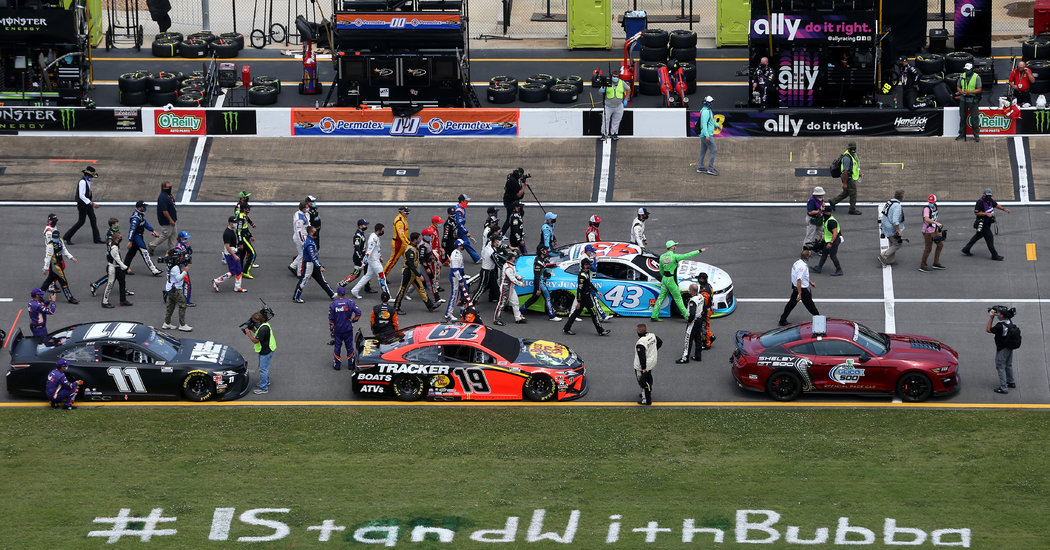
TALLADEGA, Ala. — The No. 43 car edged down pit road on Monday afternoon, its NASCAR rivals unusually close at hand just minutes before a race.
Top drivers and their crews, wearing masks for one of the first races of the coronavirus era, were on the march with the Chevrolet Camaro that Darrell Wallace Jr., the lone black racer in NASCAR’s premier series, would soon drive around one of the most fearsome courses in motor sports.
But at that very moment on Monday, the Justice Department and NASCAR officials were investigating whether one of the people on pit road — or someone else who had gained access to the garage at Talladega Superspeedway — had placed a noose in Wallace’s stall a day earlier.
“We don’t have a lot of answers at this moment,” Steve Phelps, the NASCAR president, said before the race on Monday. “Obviously, this is a very, very serious act. We take it as such.”
The episode cast a distressing shadow over the Geico 500, which was postponed from Sunday because of lightning and heavy rain, less than two weeks after NASCAR banished the Confederate flag from its races and properties. Wallace, who is known as Bubba, had pressed for the policy change, which amounted to a drastic denouncement of decades of NASCAR culture, and drove a car with a Black Lives Matter message in the race after the ban.
After the Geico 500’s emotional start — Wallace laid his head on the top of his car, while the owner of his team, Richard Petty, patted him on the back — Wallace put on a competitive race for his home-state crowd. From the 24th position, he climbed into the top 10 for much of the race’s second half and briefly took the lead near the end.
It wasn’t enough for a win, as Ryan Blaney took the top spot and Wallace fell to 14th because of fuel issues. But it was enough to bring much of the small crowd to its feet, waving T-shirts and lifting drink cans in respect.
Afterward Wallace climbed from his car and approached the stands with his right fist raised. He shook hands with fans, including several wearing Black Lives Matter T-shirts. They shouted their support in return.
“I’m sorry, I’m not wearing a mask,” he said in an interview with Fox Sports after the race. “But I wanted to show whoever it was that you’re not going to take away my smile.”
Although investigators said little on Monday about the status or course of their inquiry, NASCAR officials said the garage was fitted with surveillance cameras. Phelps declined to say how many had been installed or whether they were working at the time of the episode on Sunday.
But he said that access restrictions that officials imposed because of the coronavirus pandemic were aiding the investigation. People are largely barred from the infield, with racing teams and a handful of essential workers as the only people permitted.
In a statement on Monday, Jay E. Town, the United States attorney for the Northern District of Alabama, said federal officials were “reviewing the situation surrounding the noose that was found in Bubba Wallace’s garage to determine whether there are violations of federal law.”
“Regardless of whether federal charges can be brought, this type of action has no place in our society,” Town said.
Hours later, Wallace, who vowed on Sunday to “continue to proudly stand for what I believe in,” slipped into his car and began to drive as a painted message, “#IStandWithBubba,” graced the Talladega grass.
“I told Bubba to focus on winning and not let someone’s ignorance question his integrity or his character!” Wallace’s mother, Desiree Wallace, said in a text message on Monday. “I told Bubba that person was afraid of him because that was a cowardly act! He has to stay focused while driving his racecar! My God, how does he do that with what just happened to him! I’m so angry! But Bubba is very strong! God has him covered!”
Petty, the celebrated driver whose racing team includes Wallace, said he was “enraged” by what had happened.
“The sick person who perpetrated this act must be found, exposed and swiftly and immediately expelled from NASCAR,” Petty said before he joined Wallace at the track on Monday afternoon. “I believe in my heart this despicable act is not representative of the competitors I see each day in the NASCAR garage area. I stand shoulder to shoulder with Bubba, yesterday, today, tomorrow and every day forward.”
Despite NASCAR’s palpable fury — Phelps said that any wrongdoers would barred for life — the episode was another troubling moment for the motor sports empire, which has tried to distance itself from a past in which it cultivated ties with segregationists and harbored racists and their tropes.
For decades, the Confederate battle flag was a common sight at races, especially at Talladega, and NASCAR was closely connected to figures like George C. Wallace, the segregationist Alabama governor and an influential force in the development of the Talladega track.
The speedway, which opened in 1969, has had few professional black drivers across the decades.
Willy T. Ribbs, who drove a handful of NASCAR races and was the first black man to compete in the Indianapolis 500, recalled in an interview last week how he had received a hostile reception, including from other drivers, when he first visited Talladega in 1978.
“People were spitting all around my feet,” he said. “I was in the pits just to meet some of the drivers — only one or two would even say anything to me.”
But in recent years, NASCAR, which has seen attendance and television ratings decline, has sometimes sought to step away from its history. In 2015, after a white supremacist killed nine black churchgoers in Charleston, S.C., officials at top tracks urged people not to fly the Confederate flag at competitions, and some of the sport’s top drivers, like Dale Earnhardt Jr., spoke out about racism and their opposition to the battle flag.
It was only this month, though, after Bubba Wallace spoke out in the aftermath of the death of George Floyd while in police custody in Minneapolis, that NASCAR announced a ban of the battle flag. The decision enraged some fans, and on Sunday, hundreds of cars adorned in battle flags assembled near Talladega before forming a two-mile caravan and driving past the track entrance in protest.
Only after sundown did NASCAR announce what had happened in Wallace’s stall.
Bryan Stevenson, the executive director of the Equal Justice Initiative, a nonprofit based in Montgomery, the Alabama capital, said Monday that his group received hundreds of complaints of nooses in workplaces each year.
“I’m not surprised to see what happened happen, only because for decades we have taught a lot of people in this country that there’s nothing wrong with these symbols and icons,” said Stevenson, who led the development of a memorial to lynching victims. “I can’t think of an American symbol that is more potent and more disturbing and more objectionable in a setting like NASCAR than a noose.”
It was too soon, legal experts said, to know how prosecutors might charge anyone who had a role in placing the noose. An array of factors, including a person’s intent, would be considered. But the case could be an unusual one for prosecutors, even for officials in Alabama who have long been challenged by racist conduct.
“We had issues with graffiti, we had issues with threats, we had issues with church burnings,” said Joyce White Vance, one of Town’s predecessors as the U.S. attorney in the area. “Nooses were occasionally reported, but I cannot recall a prosecution involving a noose.”
On Monday, though, there was open disdain and embarrassment in Alabama over what had happened inside Talladega’s gates.
Gov. Kay Ivey, a Republican who in 2018 campaigned on her record of having protected Confederate monuments, said Monday that she was “shocked and appalled” by the episode, which she described as a “disgusting display of hatred.”
“Bubba Wallace is one of us,” the governor said in a statement. “He is a native of Mobile and on behalf of all Alabamians, I apologize to Bubba Wallace as well as to his family and friends for the hurt this has caused and regret the mark this leaves on our state.”
Matthew Teague reported from Talladega, and Alan Blinder from Atlanta. Juliet Macur contributed reporting from Washington.
Related reporting
More World News →
South Sudan’s Oil Looters: How Young Elite Gatekeepers Plunder Nation While Citizens Starve
General to Private: Kiir Crushes Economic Vice President in South Sudan's $1.7 Billion Corruption Purge
Paul Biya’s Re-Election: What Cameroon’s Political Longevity Reveals About Leadership and Governance in Africa