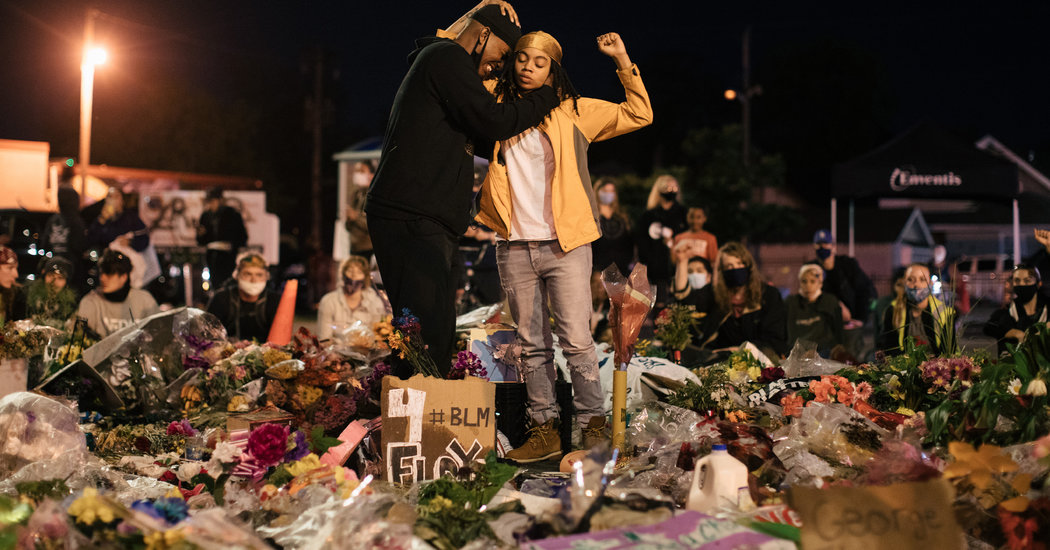
People around the world — in Australia, Britain, France, Germany and beyond — have defied cold weather and public health rules against mass gatherings to show solidarity with American protesters, who have now taken to the streets in more than 150 cities.
Activists and scholars who have studied the crest and fall of other upwellings over police killings, school shootings, women’s rights and immigration detentions say that the widespread outrage over economic and racial injustices may give the new movement a greater durability.
“There was a wash, rinse, repeat cycle, a standard script,” said Jody David Armour, a law professor at the University of Southern California who studies racial justice. “Convene a commission, hold some hearings, have community members vent and testify, and here come some policymakers saying, ‘Here’s a fix.’ ”
The result, he said: “Look where we are.”
Nekima Levy Armstrong, another organizer in Minneapolis, changed her life to be able to march on the streets. Ms. Armstrong, a civil rights lawyer and former president of the Minneapolis chapter of the N.A.A.C.P., was an associate professor of law at the University of St. Thomas in Minneapolis. But she quit in 2016 to be able to fully devote herself to the civil-rights movement and protesting. She even ran unsuccessfully for mayor.
“My entire life has changed since taking to the streets,” she said.
On Wednesday, shortly after charges against the four officers in the Floyd case were announced, she rallied more than 500 people, carrying placards with slogans like “Black Lives Matter More Than Windows” and “4 Killer Cops 4 Convictions.” She said the officers could be tried by an all-white jury; they could be acquitted.
“We have to continue to be vigilant. We can’t rest,” she told the crowd, her voice rising. She added: “We got to keep marching. Keep demonstrating. Keep speaking the truth. Keep protesting.”
Related reporting
More World News →
Saudi Prince Found Dead in Hotel Bathroom as Inquest Rules Death Was Misadventure
South Sudan at the Brink: How Corruption Tightens Its Grip on a Rare Working Institution
South Sudan’s Oil Looters: How Young Elite Gatekeepers Plunder Nation While Citizens Starve