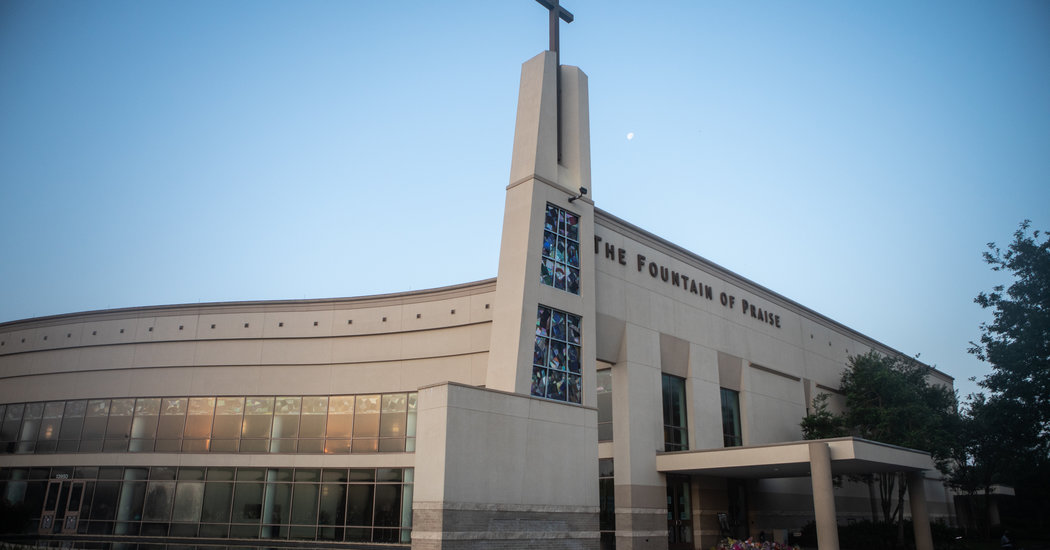
A final goodbye to George Floyd is underway in Houston, where he will be buried.
After more than two weeks of demonstrations and anguished calls for racial justice, the man whose death gave rise to an international movement, and whose words — “I can’t breathe” — have become a rallying cry, is being laid to rest on Tuesday at a private funeral in Houston.
George Floyd, 46, will be buried in a grave next to his mother.
Hundreds of mourners filled the Fountain of Praise church as the service got underway on Tuesday, capping five days of public memorials in Minneapolis, North Carolina and Houston more than two weeks after his death powered sprawling protests across America.
Mr. Floyd, who was pinned under the knee of a Minneapolis police officer and died in custody on May 25, was remembered as a star student-athlete and father who, in death, became an emblem of national change. A singer, Dray Tate, gave a rendition of “A Change Is Gonna Come” as an artist onstage painted Mr. Floyd’s face in white paint on a black canvas. A reading from the Old Testament included a passage from the Book of Amos: “Wailing shall be in all the streets.”
Delivering the eulogy, the Rev. Al Sharpton highlighted the long history of black men killed in America and admonished the country’s political and business leaders for belatedly saying they were sorry for the mistreatment of African Americans.
“Don’t apologize — give Colin Kaepernick a job back,” he said, referring to the N.F.L. and the professional football quarterback. “We don’t want an apology. We want him repaired.”
One by one, he named the relatives of other black men who have been killed by the police or neighborhood vigilantes, and asked them to stand in the church. Other mourners stood too, until everyone in the sanctuary was on their feet and clapping.
“The mother of Trayvon Martin, will you stand?” he said. “The mother of Eric Garner, will you stand? The sister of Botham Jean, will you stand? The family of Pamela Turner, here in Houston, will you stand? The father of Michael Brown from Ferguson, Mo., will you stand? The father of Ahmaud Arbery, will you stand?”
“All of these families came to stand with this family,” he said, “because they know better than anyone else the pain they will suffer from the loss that they have gone through.”
In a video played at the funeral, former Vice President Joseph R. Biden Jr., the presumptive Democratic nominee for president, offered his condolences to the family, saying that grieving in public was a burden — “a burden that is now your purpose, to change the world for the better.”
Mr. Biden has often connected with people through grief, after suffering deep losses in his own life, including the death of his first wife and a daughter in a car crash and the more recent loss of his son Beau to cancer. Speaking directly to Mr. Floyd’s youngest daughter, Gianna, he said:“No child should have to ask the question that too many black children have had to ask for generations: ‘Why? Why is Daddy gone?’” he said, adding:“When there is justice for George Floyd, we will truly be on our way to racial justice in America.”
Mr. Floyd’s relatives took emotional turns at the microphone, remembering him as a “pesky rascal” who was endearing to an aunt and a big man beloved as “Superman” by his brothers.
Brooklyn Williams, a young niece, directly invoked the president. “Someone said ‘Make America great again,’ but when has America ever been great?” she asked. “America, it is time for a change.”
Mayor Sylvester Turner of Houston announced at the funeral service for George Floyd that he would sign an executive order later on Tuesday to prohibit the city police from using chokeholds or strangleholds. The order would also require the police to give a warning before shooting, among other measures.
Mr. Turner, a Democrat, said he had spoken with business leaders about investing in underserved neighborhoods so that the city would not have to spend so much on policing there.
“We honor him today,” Mr. Turner said of Mr. Floyd, “because when he took his last breath, the rest of us will now be able to breathe.”
The announcement, a significant policy change for Mr. Floyd’s hometown, reflects a growing movement around the country to ban or limit the use of neck restraint, and to redirect money from police budgets to other purposes. In New York State, legislative leaders moved on Monday to ban chokeholds, in defiance of law enforcement groups, including police unions. Washington also outlawed chokeholds by police in all circumstances in a reform package approved unanimously by the City Council on Tuesday.
Growing up in one of Houston’s poorest neighborhoods, Mr. Floyd enjoyed a star turn as a basketball and football player, with three catches for 18 yards in a state championship game in his junior year.
He was the first of his siblings to go to college, and did so on an athletic scholarship. But when he returned to Texas after a couple of years, he lost nearly a decade to arrests and incarcerations, mostly on drug-related offenses. By the time he left Houston for good a few years ago, moving 1,200 miles to Minneapolis for work, he was ready for a fresh start.
After working as a security guard at a Salvation Army homeless and transitional housing shelter and as a bouncer at a restaurant, though, he had a fatal encounter with police officers who were investigating a complaint about a purchase made with a counterfeit $20 bill. Pinned to the ground by the officers, he pleaded that he could not breathe and cried out for his mother.
“His crime was that he was born black — that was his only crime,” said Representative Al Green, a Democrat who represents southwest Houston in Congress.
The congressional delegation at the funeral brought a flag from Speaker Nancy Pelosi and promised that the family would be receiving letters from former presidents Barack Obama and Bill Clinton, according to Representative Sheila Jackson Lee, Democrat of Texas, who brought mourners to their feet.
“I want to acknowledge those young marchers in the streets,” she said. “Many of them could not be in this place. They are black and brown. They are Asian. They are white. They are protesting and marching, and I’m saying, as a mama, I hear your cry.”
President Trump took to Twitter on Tuesday to go after a 75-year-old demonstrator who suffered a head wound when Buffalo police officers knocked him over. Mr. Trump advanced, without any evidence, a conspiracy theory that the incident could have been “a set up.”
“Buffalo protester shoved by Police could be an ANTIFA provocateur,” Mr. Trump wrote. “75 year old Martin Gugino was pushed away after appearing to scan police communications in order to black out the equipment. @OANN I watched, he fell harder than he was pushed. Was aiming scanner. Could be a set up?”
Mr. Trump evidently was watching the One America News Network, a channel aimed at viewers who think Fox News is not supportive enough of the president. The network aired a segment referring to the incident as “so-called police brutality” and suggesting without evidence that it was a “false flag” staged by antifa, a loose movement of anti-fascists.
The reporter who aired the segment on One America was Kristian Rouz, a Russian-born broadcaster who according to One America has also worked as a freelance contributor to Sputnik, a propaganda arm of the Russian government that produces English language content aimed at sowing doubt about the United States and the West.
Senator Chris Murphy, Democrat of Connecticut, assailed Mr. Trump for relying on the report. “The story Trump is referencing was written by a Russian working for the Kremlin’s propaganda agency,” Mr. Murphy wrote on Twitter. “Get ready - this is the next 5 months. Russia and the Trump campaign openly collaborating to spread lies and manipulate the election.”
Two Buffalo officers were charged with felony assault after a widely viewed video taken by WBFO, a local radio station, showed them shoving Mr. Gugino, who fell to the pavement.
The president’s tweet drew immediate condemnation.
“He should apologize for that tweet,” said Gov. Andrew M. Cuomo of New York. “Show some humanity.”
“You think the blood coming out of his head was staged?” he asked, incredulously.
Senator Mitt Romney, Republican of Utah, said of the president’s tweet, “It was a shocking thing to say, and I won’t dignify it with any further comment.”
Jeff Flake, a former Republican senator from Arizona and a Trump critic, wrote on Twitter: “Trafficking in conspiracy theories like this are beneath your office, Mr. President.”
Senator John Thune of South Dakota, the No. 2 Republican in the Senate, said of Mr. Trump’s tweet, “It’s a serious accusation — which should only be made with facts and evidence — and I haven’t seen any.”
“Most of us up here would rather not be political commentators on the president’s tweets, because that’s a daily exercise,” he added.
Many Republicans on Capitol Hill were reluctant to address Mr. Trump’s claim at all, with several senators refusing to comment, claiming not to have seen the tweet, and demurring even after reporters showed it to them.
After reading a copy of the tweet, Senator Kevin Cramer, Republican of North Dakota, said he did not want to comment because he had not seen the video of the protester being pushed by a police officer.
He said he had bigger worries than the president’s comments, adding, “I don’t think Donald Trump’s going to change his behavior.”
A New York City officer who shoved a protester surrenders to face charges.
A New York City police officer surrendered to face criminal charges on Tuesday, 11 days after he was recorded on video shoving a woman to the ground and cursing at her during a protest against police brutality, law enforcement officials said.
The Brooklyn district attorney’s office charged the officer, Vincent D’Andraia, with misdemeanor assault, criminal mischief, harassment and menacing over the May 29 incident, according to a statement.
The district attorney, Eric Gonzalez, said in announcing the charges that he could not tolerate the use of excessive force against people exercising their right to peacefully protest. “This is especially true of those who are sworn to protect us and uphold the law,” he added.
Cellphone video showed Officer D’Andraia, 28, knocking the victim, Dounya Zayer, 20, to the ground and swearing at her after she asked him why he told her to get out of the street. Ms. Zayer said she suffered a concussion and seizures.
The decision to charge Officer D’Andraia seemed to reflect the growing political pressure on the police and prosecutors to hold officers accountable for misconduct, including for actions at protests across the country, where bystander video has played a crucial role in documenting police aggression.
Two Buffalo police officers were charged with felony assault after a video showed officers shoving a 75-year-old activist to the ground. In Philadelphia, a police inspector who used his baton to strike a Temple University student in the head at a protest was charged with aggravated assault.
Ms. Zayer’s lawyer, Tahani Aboushi, said she was disappointed that prosecutors were not charging Officer D’Andraia with a felony, given the seriousness of her client’s injuries and the severity of the conduct captured on the video.
Philonise Floyd, a brother of George Floyd, will testify before Congress on Wednesday during a House hearing on police accountability and racial bias in law enforcement, according to a memo obtained by The New York Times.
Mr. Floyd will testify before the House Judiciary Committee, alongside more than half a dozen civil rights experts and activists, at a hearing designed to examine measures that Democrats unveiled on Monday, intended to reduce police misconduct and racial discrimination in law enforcement.
House Republicans invited Dan Bongino, the conservative political commentator and former Secret Service agent, to testify. They also invited Angela Underwood Jacobs, whose brother, Dave Patrick Underwood, a Federal Protective Services officer, was shot and killed late last month during a night of unrest in Oakland, Calif.
Ms. Underwood Jacobs recently was an unsuccessful Republican candidate for Congress.
National Guard troops who helped quell protests in Washington D.C. test positive for coronavirus.
National Guard troops who were deployed to the streets of Washington, D.C., during recent protests against police brutality have tested positive for the coronavirus, according to a spokesperson for the District of Columbia National Guard.
The Guard would not say how many, and it was not clear whether they were infected at the protests.
The spokesperson said the troops have practiced social distancing and worn protective gear as much as was practical during the deployment. But public health experts have warned that large crowds at the protests in Washington and around the country risk accelerating the spread of the virus, which has killed more than 110,000 Americans.
According to Army Secretary Ryan McCarthy, around 5,000 National Guard troops who were deployed to the Washington area will begin to withdraw over the next three days, but around 1,200 troops from the District of Columbia National Guard will remain on duty.
The presence of the troops in the nation’s capital had become a source of local tension, particularly after top Pentagon officials ordered pilots of Black Hawk helicopters to fly low over groups of protesters in a “show of force” maneuver intended to disorient and disperse crowds.
Mayor Muriel E. Bowser of Washington also publicly clashed with President Trump, saying the use of troops to patrol the city was an inappropriate response to the protests.
It’s not just big cities. Protests are reaching small towns across America.
Rick Rojas reporting in Petal, Miss.
In what has become a morning routine, Lorraine Bates walks the seven-tenths of a mile to City Hall from her house in Petal, Miss. In the first days of demonstrations, she joined some 200 other protesters, many of them white, chanting and waving “Black Lives Matter” posters. But there were also times when it was just her and a groundskeeper who mowed around her.
She would keep coming, she said, until the mayor of Petal resigned, or at least exhibited something like genuine remorse for what he said about George Floyd after his fatal encounter with the Minneapolis police, including, “If you can say you can’t breathe, you’re breathing.”
“As long as I’ve got my health and my strength, I’ll be out here every day,” Ms. Bates, 70, said as she sat on her rolling walker on the front lawn of City Hall, recalling the stamina of the activists who had influenced her years earlier as a young black woman rooted in the Deep South.
As demonstrations over the death of Mr. Floyd grip major cities across America, the wave of fury and sorrow has also spread to small towns, including Petal, a city of about 10,000 where the population is 85 percent white.
The local protests began after the white mayor, Hal Marx, wrote on Twitter that he “didn’t see anything unreasonable” in the video showing Mr. Floyd pinned to the ground by a police officer’s knee. Soon, protesters were gathering outside the mayor’s house and calling attention to a local case of a black man killed by a white police officer in 2017.
The tensions in Petal illustrate how the protests have played out in many smaller communities across America, where demonstrations have by and large not been as explosive as those in big cities dominating the media’s attention. But the tension is still there, subtle and more concentrated as a national conversation over police brutality and systemic racism plays out in the confines of tight-knit communities.
Jacksonville, Fla., a possible host for the Republican National Convention, removes a Confederate monument.
Mayor Lenny Curry of Jacksonville ordered the removal overnight of a bronze Confederate soldier monument in Hemming Park and said other similar statutes would also come down.
Hundreds of protesters had marched in the city over the weekend demanding that the monuments go down. Mr. Curry, a Republican, walked with more demonstrators on Tuesday morning and pledged to bring legislation to the City Council to bring independent community voices into discussions about policing. “We hear your voices,” Mr. Curry said.
The city is considered a leading contender to host the Republican National Convention in August.
The order follows similar moves to remove symbols of the Confederacy in other cities in recent days, as the death of George Floyd and calls for racial justice reignited a movement that has been gaining traction — and meeting resistance — for years.
The mayor of Birmingham, Ala., ordered the removal of a contentious Confederate statue from a park last week on Jefferson Davis Day, the state holiday in Alabama honoring the Confederate leader.
Leopold II, the King of the Belgians from 1865 to 1909, is widely reviled today for the brutal way he ruled a vast colonial empire in the Congo region of Africa. That has made likenesses of him a target for protesters against racism in Belgium, much the way American protesters have assailed Confederate monuments.
On Tuesday, the local authorities removed a statue of Leopold II from a square in Antwerp, where it had been spray-painted and set on fire last week. But they were at pains to signal that they had not done so to appease protesters.
“We removed the statue because it is severely damaged as a result of vandalism and poses a public safety issue,” said a spokesperson for Mayor Bart De Wever, the leader of a rightwing political party that advocates cracking down on immigration. The statue was taken to a museum, where it will be restored and retained, the spokesperson said, because the square was scheduled for a redesign in 2023 that would leave no room for it.
In the global outpouring of protest after the death of George Floyd, more than 63,000 Belgians have signed a petition to remove all statues and busts of Leopold II from the country. Supporters see the petition as part of an overdue reckoning with Belgium’s bloody colonial past.
Millions of Congolese were enslaved, maimed or killed after Leopold II declared the territory his private property in the 1880s and imposed a stunningly violent rule to extract ivory, rubber and mineral wealth. Colonial rule persisted until 1960.
In Brussels on Sunday, protesters climbed on another statue of Leopold II, chanting “Murderer!” and “Reparations!” in support of demands for the Belgian state to pay damages to the Democratic Republic of Congo, the independent nation that succeeded the colony. Earlier in the week, another statue of Leopold II in the city of Ghent was covered in red paint and its mouth was gagged.
Reporting was contributed by Peter Baker, Katie Benner, Audra D.S. Burch, Alexander Burns, Julie Hirschfeld Davis, Catie Edmondson, John Eligon, Tess Felder, Luis Ferré-Sadurní, Manny Fernandez, Katie Glueck, Russell Goldman, Maggie Haberman, Astead W. Herndon, Thomas Kaplan, Annie Karni, Jonathan Martin, Jeffery C. Mays, Patricia Mazzei, Jesse McKinley, Sarah Mervosh, Richard Pérez-Peña, Rick Rojas, Giovanni Russonello, Marc Santora, Dionne Searcey, Ashley Southall and Farah Stockman.
Related reporting
More World News →
South Sudan’s Oil Looters: How Young Elite Gatekeepers Plunder Nation While Citizens Starve
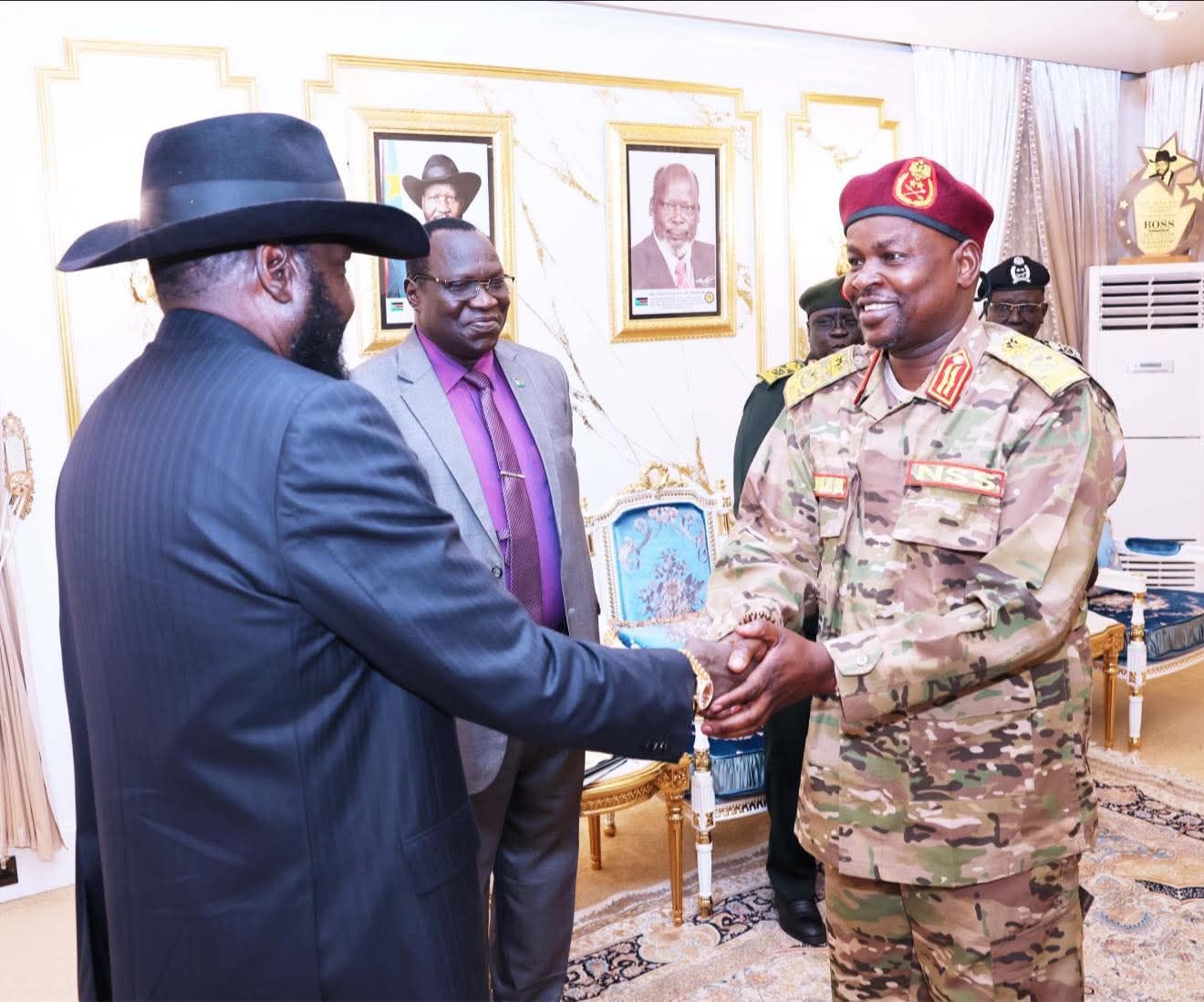
General to Private: Kiir Crushes Economic Vice President in South Sudan's $1.7 Billion Corruption Purge
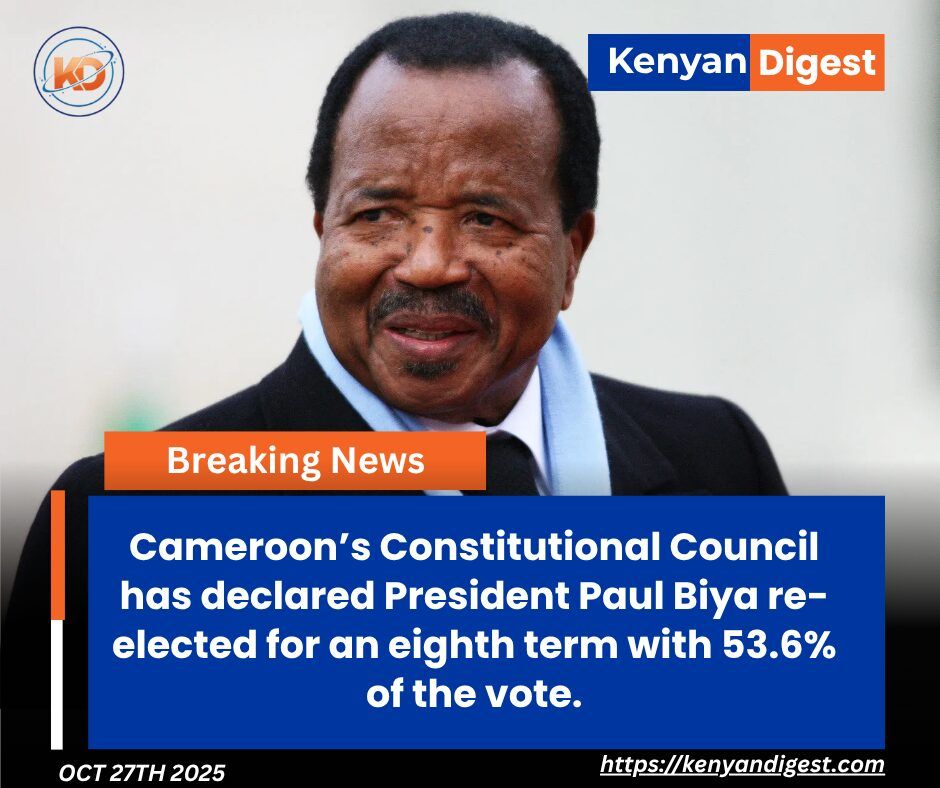
Paul Biya’s Re-Election: What Cameroon’s Political Longevity Reveals About Leadership and Governance in Africa