Iran’s show of influence in Iraq
A two-day standoff at the U.S. Embassy in Baghdad involving thousands of pro-Iranian protesters demonstrated how much power Tehran wields within Iraq.
The protesters dispersed on Wednesday at the urging of the leaders of the Iranian-backed militias who had organized the demonstration. The leaders later said the withdrawal was conditioned on a commitment from the Iraqi prime minister, Adel Abdul Mahdi, to move ahead with legislation to force American troops to withdraw.
Catch up: In retaliation for a rocket attack that killed an American contractor, the U.S. launched airstrikes against an Iraqi militia that’s supported by Iran, killing at least 24 people. Iraqis’ anger then turned back on the U.S., leading to the siege at the embassy compound.
What’s next: Secretary of State Mike Pompeo canceled a trip to Ukraine and four other nations in order to monitor the tensions in Iraq.
Defiance and caution from Kim Jong-un
North Korea’s leader vowed on Wednesday to expand his country’s nuclear force and threatened to show off a “new strategic weapon.” He also warned that North Korea would no longer be bound by a self-imposed moratorium on tests of nuclear and long-range ballistic missiles.
But his threats lacked specifics, and he didn’t explicitly say that he was terminating diplomacy with the U.S., reflecting a wait-and-see approach that leaves room for more negotiations.
News analysis: “Both the Iranians and the North Koreans seem to sense the vulnerability of a president under impeachment and facing re-election, even if they are often clumsy as they try to play those events to their advantage.” Read more from our national security correspondent.
Unexplained drones swarm over the prairie
Since mid-December, sheriff’s departments in eastern Colorado and western Nebraska have received reports of drones flying in precise formations over rural towns and open fields at night.
The drones have prompted a federal investigation — and may be perfectly legal — but they remain unexplained. Some have suggested that they might be part of a mapping operation or a land survey conducted by an oil and gas company.
Background: Operators of all but the smallest drones have been required to register with the federal government since 2015, but state and local officials aren’t able to easily identify a drone’s owner or to track its location.
Quotable: “It’s creepy,” said Missy Blackman, who saw three drones over her farm in Nebraska. “I have a lot of questions of why and what are they, and nobody seems to have any answers.”
Black students say the video, which was produced by the student homecoming committee, highlights why they feel unwanted on campus. The university has far fewer African-Americans per capita than the state, where 6.7 percent of residents are black.
How we know: As part of a project about life on a college campus, The Times began interviewing Wisconsin students on the first day of classes, before the video was released. Afterward, the topic dominated our conversations with students, offering a window into their complicated and evolving views on race.
Another angle: A group of students of color at Harvard say that, even as the university defends its use of race in admissions, it devalues their experiences and fails to retain professors who support them.
If you have 20 minutes, this is worth it
Millennial anxiety, 20 years on
For millennials, Y2K felt like an apocalypse. People wondered whether clocks would know which year to turn to, whether bank accounts would still work and whether planes would fall from the sky. Above, a survivalist store in Allegany, N.Y, in May 2000.
Two decades later, our Styles desk looked at the legacy of Y2K panic — and how it left behind a bunch of nervous 30-year-olds.
Here’s what else is happening
Israeli leader seeks immunity: Prime Minister Benjamin Netanyahu asked Parliament to grant him immunity from prosecution in three graft cases. Critics said the rare request violated the principle of equality before the law.
Snapshot: Above, in New South Wales, Australia, this week. At least 15 people have been killed in fires across the country since September, and we looked at the extent and cause of the blazes.
In memoriam: David Stern, the N.B.A.’s commissioner for 30 years, helped transform the league into a multibillion-dollar global industry. He died on Wednesday at 77.
Don Larsen also died on Wednesday, at 90. The former New York Yankees pitcher threw the only perfect game in World Series history, in 1956.
Preview of 2020 gadgets: Expect more wearables and 5G service, our tech columnist writes. Alexa, Siri and Google Assistant may even start cooperating.
52 Places traveler: In his latest dispatch, our columnist visited the final stops on his list: the sunny islands of French Polynesia, and wintry Calgary, Alberta.
What we’re reading: Your briefing writer, Chris, recommends The Washington Post’s list of what’s out and what’s in for 2020: “Since 1978, my former employer has compiled an annual scorecard of the cultural zeitgeist. It includes helpful links for the unhip, like me, who can’t make sense of most entries.”
Now, a break from the news
Read: Two books by the Polish fantasy writer Andrzej Sapkowski, whose work is the basis of the Netflix series “The Witcher,” debut on our monthly audio fiction best-seller list.
Smarter Living: One of the best things you can do for your health is to cut back on added sugar. Our 7-Day Sugar Challenge shows the way.
And now for the Back Story on …
When to start (and end) a decade
Over the last few weeks, The Times has published many an article marking the end of the decade. However, several readers have written us arguing passionately that the decade has another year to go.
In the sixth century, a Christian scholar named Dionysius Exiguus invented the anno Domini numbering system, in which 1 A.D. was supposed to indicate the year of Jesus’ birth. There was no year zero, so the beginning of the first decade of the Common Era started with 1 and ended with 10.
Like language, time is socially constructed. People celebrated the end of the century in 2000 because the dramatic change in numerals served as a convenient marker, and also because humans are drawn to round numbers. But the first year in the third millennium is — technically — 2001. That being said, someone born in 2000 was not alive in the ’90s.
Let’s have it both ways. Welcome to the final year of the 202nd decade, and also the start of the 2020s.
That’s it for this briefing. See you next time.
— Chris
Thank you
Mark Josephson, Eleanor Stanford and Chris Harcum provided the break from the news. Will Dudding, an assistant in the standards department, wrote today’s Back Story. You can reach the team at [email protected].
P.S.
• We’re listening to “The Daily.” Today’s episode revisits an interview with President Trump that included the publisher of The Times, A. G. Sulzberger.
• Here’s today’s Mini Crossword, and a clue: Half of 2020 (four letters). You can find all our puzzles here.
• A weekly column about the technology that Times journalists use found that, unsurprisingly, the smartphone was their most vital work tool.
Related reporting
More World News →
South Sudan’s Oil Looters: How Young Elite Gatekeepers Plunder Nation While Citizens Starve

General to Private: Kiir Crushes Economic Vice President in South Sudan's $1.7 Billion Corruption Purge
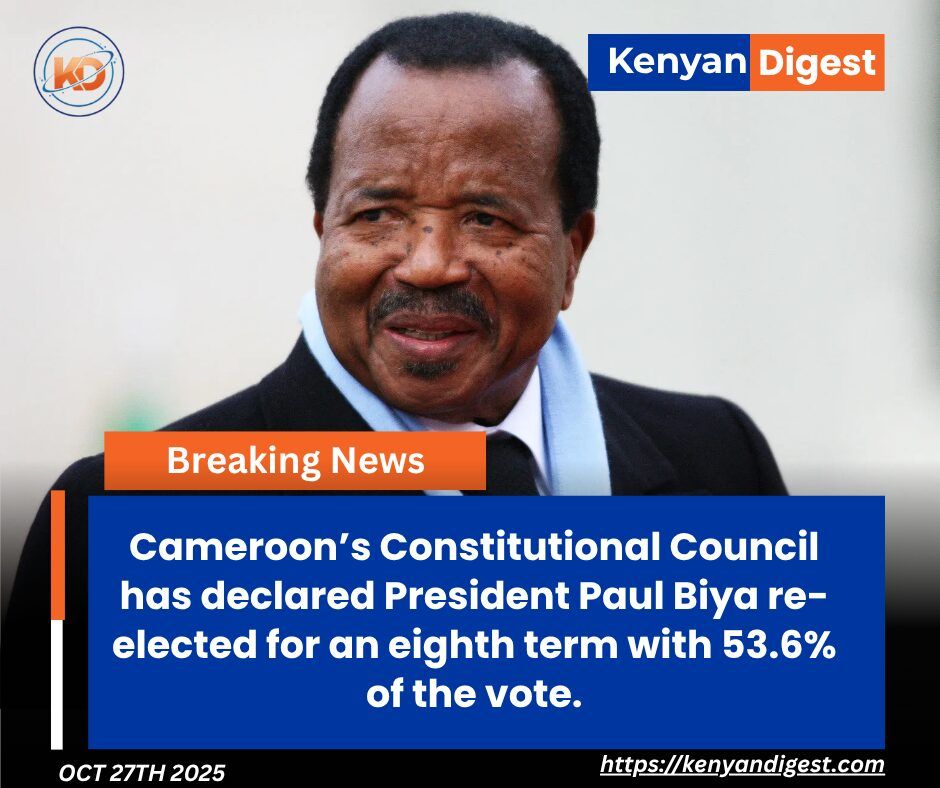
Paul Biya’s Re-Election: What Cameroon’s Political Longevity Reveals About Leadership and Governance in Africa