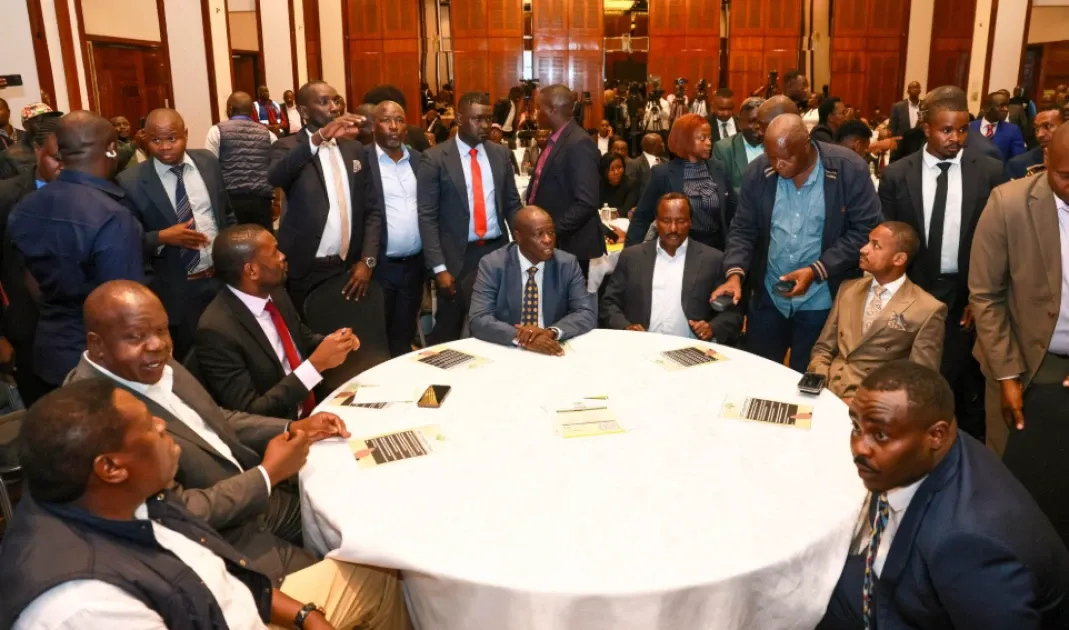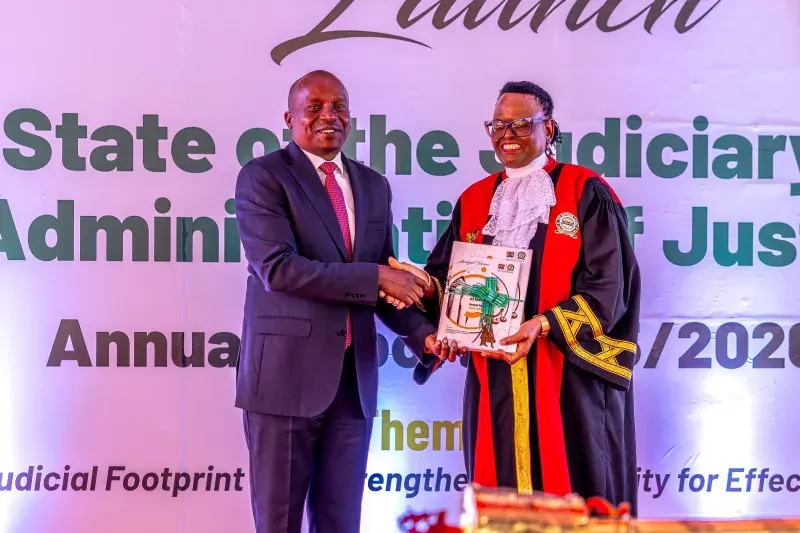
Deputy President Kithure Kindiki told a Nairobi audience on Friday, November 20, 2026, that the government will allocate roughly KSh30.4 billion to the Judiciary for the 2026/27 financial year, reaffirming the administration’s pledge to protect judicial independence.
Speaking at the launch of the State of the Judiciary and Administration of Justice Annual Report for the 2025/26 financial year, Kindiki said the latest allocation follows a rise from KSh27.1 billion in the previous cycle, a growth of about 19 percent.
He highlighted that the executive has acted on Judicial Service Commission requests by signing the Judges’ Retirement Benefits Act, 2026 in March, a law that improves judges’ welfare and tenure security.
Lands Cabinet Secretary Alice Wahome then handed over two title deeds covering the Supreme Court precinct and its parking area, together with a deed for a proposed court in Kapsabet, ending long-standing uncertainty over the land.
“The government recognises that a strong, independent and effective Judiciary is indispensable to constitutional democracy, economic development and social progress,” Kindiki said, adding that “The Judiciary plays a central role in protecting rights, resolving disputes, upholding the rule of law and ensuring that public power is exercised within constitutional limits.”
He announced the appointment of 53 additional judges to expand adjudicative capacity and urged the courts to speed up the clearance of more than 341,000 cases that have remained pending for over a year.
The Deputy President noted that the Judiciary resolved 576,702 cases against 561,580 newly filed, delivering a case clearance rate of 103 percent for the second consecutive year.
Despite that achievement, Kindiki pointed out that 190,779 cases have been outstanding for more than one year, including 37,757 cases older than five years, and called for stronger commercial dispute resolution.
“I am glad that we have covered a lot of ground on the promises by the President, including presentation today of title deeds for Supreme Court precincts and the parking area,” he observed.
He referred to the KSh26 billion Judicial Performance Improvement Project Phase II, approved in June with World Bank support, which will modernise the Supreme Court and Court of Appeal, consolidate tribunal infrastructure and establish a permanent Kenya Judiciary Academy.
“Just as we invest in roads, energy and digital connectivity to support economic activity, we must invest in a justice system that provides legal certainty, protects rights and facilitates investment and enterprise,” Kindiki reiterated.
“These investments will be critical in addressing infrastructure deficiencies, improving working conditions and strengthening the institutional capacity necessary for effective justice delivery,” he added.
He also said that legislative reforms such as the Tribunals Bill, the Kenya Judiciary Academy Bill and a review of the Small Claims Court Act are being fast-tracked.
Chief Justice Martha Koome warned that the Judiciary is staffed at about 66 percent of its authorised complement, with 8,017 employees out of an approved 12,079, and said an additional KSh12.95 billion is required to meet operational needs.
“This commitment is reflected in the progressive increase in the Judiciary’s budgetary allocation, which rose by 19 percent to KSh27.15 billion in the 2025/2026 Financial Year and further to approximately KSh30.4 billion in the 2026/2027 Financial Year,” Kindiki said.
Related reporting
More Politics →
Deputy President Kindiki Announces KSh15 Billion Development Drive in Siaya, Says Nyanza Marginalisation Ended
Attorney General Seeks Stay of High Court Ruling on Cabinet Gender Balance
President William Ruto Says Opposition Set to Blame IEBC for 2027 Election Loss