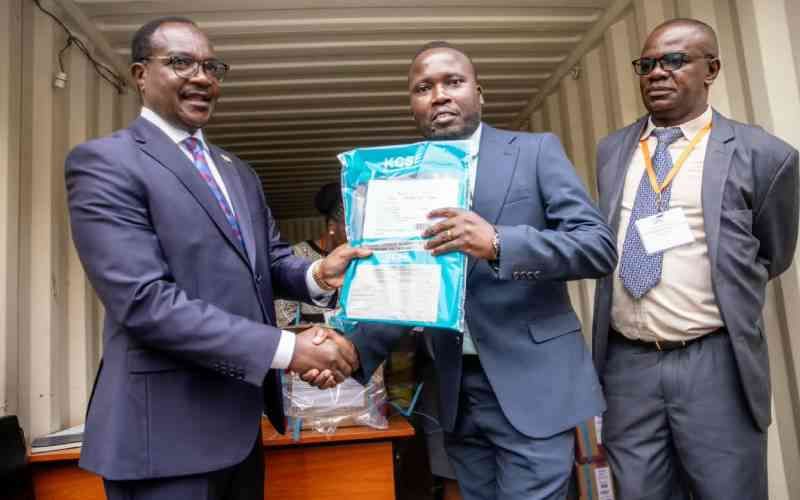
The Kenya National Examinations Council (KNEC) is confronting a funding shortfall of about KSh7.2 billion as it prepares to administer this year’s national examinations for more than 3.6 million learners.
Documents presented to the National Assembly Education Committee on May 13, 2026 by then Basic Education Principal Secretary Julius Bitok indicated that the council requires KSh14.72 billion to run examinations and assessments, against an estimated annual cost of KSh9.9 billion, leaving a deficit of roughly KSh4.82 billion; when last year’s arrears of approximately KSh2.38 billion are added, the shortfall rises to about KSh7.2 billion, an amount the Ministry of Education is seeking from the National Treasury.
The required budget breaks down into KSh3.92 billion for the Kenya Junior School Education Assessment, KSh9.496 billion for the Kenya Certificate of Secondary Education, KSh1.16 billion for the Kenya Primary School Education Assessment and KSh144.69 million for stage-based and school-based assessments.
The KCSE alone has 1,048,355 candidates registered across more than 10,600 examination centres, the first time the number has exceeded one million, increasing the need for invigilators, transport, security officers, marking staff and administrative support.
Kenya Union of Post-Primary Education Teachers chairman Omboko Milemba warned that without swift Treasury release of the budget, teachers cannot provide services for free, urging the Treasury and the Minister of Education to act.
KUPPET Secretary General Akelo Misori questioned how the council could deliver the expanding examination exercise with a lean allocation, saying the council is struggling with huge responsibilities and inadequate financial support.
Teso South MP Mary Emaase asked why examination financing has become an annual crisis despite exams being a predictable part of the education calendar, calling it a yearly crisis.
National Parents Association chairman Silas Obuhatsa cautioned that shifting examination costs to parents would burden households, asserting that national examinations remain a government responsibility.
Heavy rains have caused flooding in Tana River, destroying roads and hampering access to centres; Education Cabinet Secretary Julius Ogamba said contingency measures include pre-positioning materials, standby helicopters and alternative transport to reach cut-off areas.
Insecurity forced the relocation of at least 220 candidates in Moyale after stray bullets struck Sessi Mixed Secondary School, highlighting safety concerns for examinees.
To safeguard exam integrity amid reports of impersonation, cheating and suspected paper-distribution syndicates, KNEC has introduced digital smart padlocks on storage containers that log opening and closing times and are linked to the council’s command centre.
The council has also expanded storage to more than 653 decentralised centres, packed morning and afternoon papers separately with afternoon papers sealed during morning collection, and instituted twice-daily material collection under strict schedules.
Examination booklets now carry personalised candidate details and unique random identification numbers, with identification sections detached and handled separately to protect marking integrity.
Police officers, internal security personnel, education officials and multi-agency surveillance teams reinforce these technological safeguards.
KNEC Chief Executive Officer Dr David Njengere said the enhanced surveillance and tracking features enable investigators to trace materials and identify individuals suspected of malpractice.
Ogamba attributed the financial constraints to limited budget allocations and delayed Treasury disbursements, stating the ministry has written to the Treasury for an additional budget through the supplementary budget and seeks a disbursement to fund the examination process.
He added that the Treasury provides less than the council’s actual requirements, a perennial challenge that has left the council without sufficient funds to operate.
Related reporting
More General News →
Narok Court Sentences Pascal Chacha to 50 Years or KSh50 Million for Bhang Trafficking
Law Society President Calls for Stronger Orders as Judiciary Defends Its Role
Immigration PS Belio Kipsang Announces Green Service Passport for Public Servants