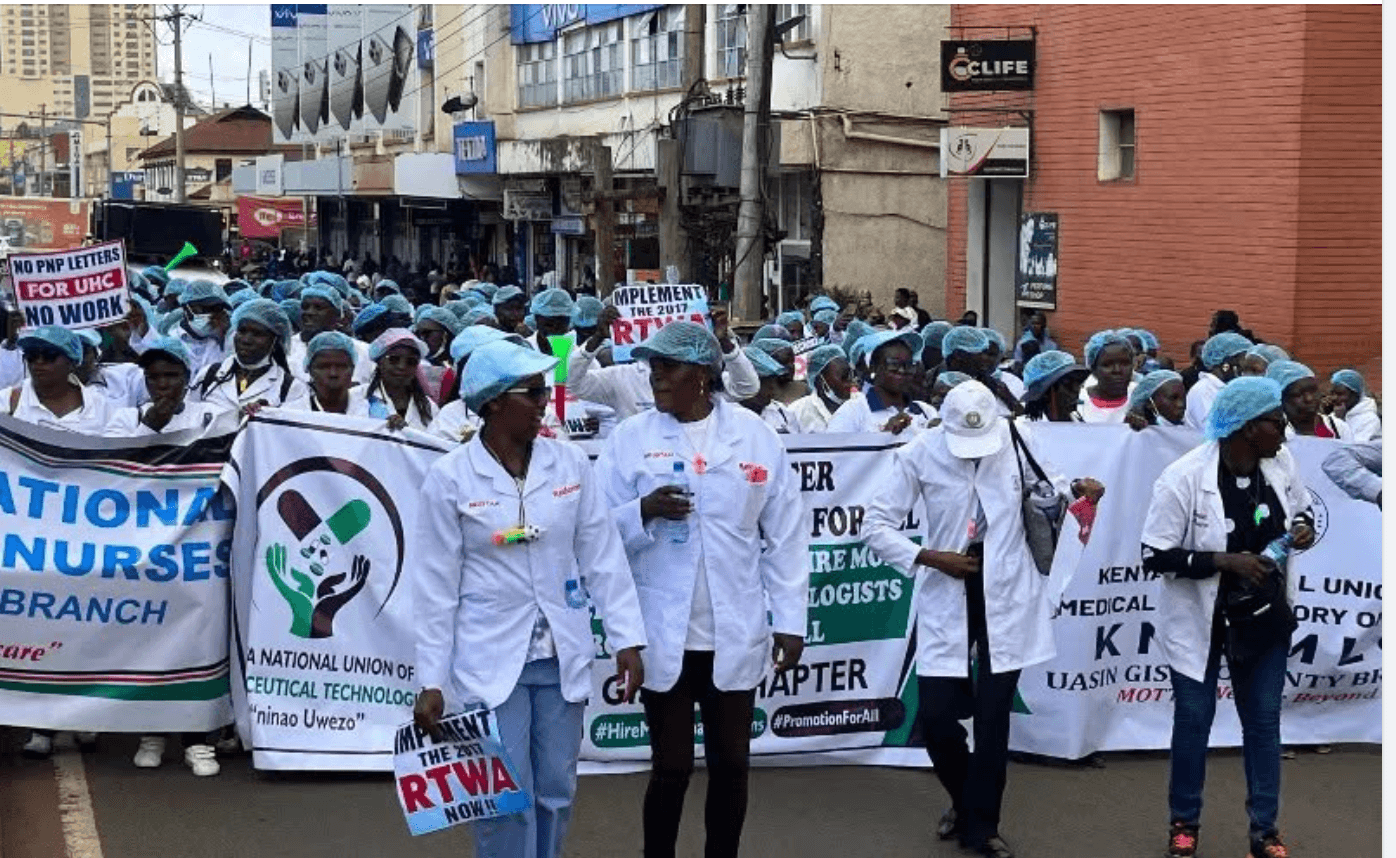
Gatundu South MP Moses Kuria has made a U-turn on the call for a referendum.
Kuria is now supporting constitutional changes to create the position of prime minister, official opposition leader and reduce the number of nominated MPs and MCAs.
The legislator has submitted a six-point proposal to the Building Bridges Task Force.
The MP now wants the executive expanded to allow for a more inclusive leadership.
He says under the 2010 Constitution, Kenyan's presidential system is structured in a sharp pyramidical structure that comprises only two senior executive members at the top tier of leadership; the president and the deputy president.
Read: Moses Kuria: 'Kenya can't hold referendum to create jobs for three old men'
"While this system may be ideal in a homogeneous society, it contributes to feelings of exclusion in diverse societies like Kenya where citizens still identify inclusion in leadership with members of their communities occupying space in the top tier of leadership," the MP says.
He further states, "It is therefore critical that Kenya’s executive framework is expanded to allow for more inclusion. While such expansion cannot accommodate every aspect of Kenya's diversity, it will, when coupled with a strong devolved government system, allow a leadership at the top that more effectively reflects the face of Kenya."
Kuria wants each party presenting candidates in a presidential election to present a team of five candidates.
The team will comprise of the president who shall not be a member of parliament, the deputy president who shall not be a member of parliament and a prime minister who may vie as a member of the national assembly and who, if not be elected, will automatically become a nominated member of the national assembly if the president wins.
Also included will be a deputy prime minister who may vie as an MP and who, if not be elected, will automatically become a nominated member of the National Assembly.
If the president wins, the second deputy prime minister may vie as a member of the Senate and who, if not be elected, will automatically become a nominated member of the Senate if the president wins.
Secondly, Kuria says not more than one candidate for the above positions should be from the same ethnic community and the prime ministers and the deputy prime ministers shall be members of the cabinet.
On reducing the burden of representation, Kuria states that in the last several decades, the public sector wage bill has continued to grow exponentially without a corresponding improvement in service delivery.
He says one of the sectors in which this is evident is the political sector where the number of representatives is unduly high.
Read also: Moses Kuria tells off Raila over Constitution change
"Under the 2010 Constitution, each Kenyan is represented by an MCA, a governor, a member of the national assembly, a senator, a woman rep, a president, and deputy president. They are also represented by about 1,000 nominated MCAs, and MPs. The effect of this over-representation is not just to expand government expenditure both in terms of salaries, allowances, supporting infrastructure and numerous other hidden costs, but it also leads to duplication of services, jurisdictional fights, and general inefficiency," Kuria says.
He proposes that there shall be no nominated members of the county assembly, there shall be no position of the woman representative in the national assembly, there shall be no position of nominated senators.
Kuria also wants only nine nominated members of the national assembly - three representing persons with disabilities, three representing the youth and three representing women.
With regards to the creation of an effective opposition to hold the state to account, Kuria said the governance framework in Kenya under the 2010 Constitution had unduly diluted the effectiveness of the opposition.
He said under article 108, the entire opposition framework is comprised solely of the Minority Leader who is not necessarily the party leader and is only a leader of the party’s representatives in Parliament.
He said the person, therefore, does not automatically command the loyalty or allegiance of the public who voted for the opposition neither does he⁄she exhibit the profile of a substantive leader of the opposition, who politically remains the losing runner-up in the presidential election.
Kuria claims the latter, who is the face of the political opposition, is left out of Parliament.
He says that person is not able to effectively oversee their party’s opposition to government inside the house.
"Furthermore, no infrastructure or financial and other resources exist that enable this office to effectively hold the government accountable," Kuria states.
The MP proposes the first runners-up in the presidential election become an automatic nominated member of the National Assembly and occupy the office of the Leader of the official Opposition.
Related reporting
More General News →
US Suspends Immigrant Visa Appointments Worldwide, Kenyan Applicants Left in Limbo
Kenya Police Set to Get New Uniform as Ruto Prepares for Kiganjo Unveiling
Ruto Announces KSh1.2 Billion University for Emurua Dikirr