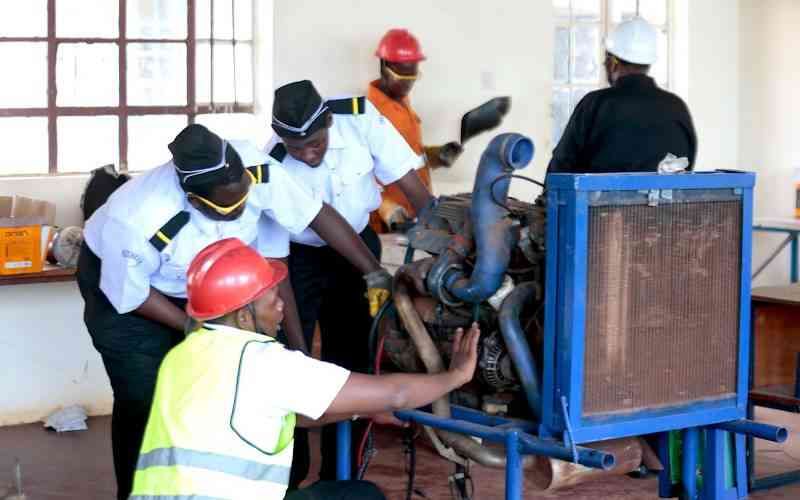
As the Competency-Based Education (CBE) curriculum is introduced in senior schools, learners are turning to technical subjects while many schools lack the equipment and specialised teachers needed for practical training.
At Pioneer Group of Schools in Murang’a, 16-year-old Grade 10 learner Trevor Mbugua is studying marine engineering and says the skills he is gaining in engine technology are of a high standard and will enable him to help build ships locally.
The new curriculum is encouraging students to consider careers in engineering, computing, agriculture and applied sciences, areas linked to innovation, entrepreneurship and employment opportunities.
However, laboratories, workshops, digital tools and specialised staff remain out of reach for many institutions, prompting schools to explore collaborative arrangements that pool resources and share expertise.
Machakos School Chief Principal Benson Manoo explained that the school is partnering with Mang’u High School to offer aviation subjects after learners expressed interest, and that such partnerships with technical colleges, universities and industry could expose students to modern technologies and workplace expectations.
He added that the challenge is to ensure a learner’s ambitions are not limited by the resources available at their own school.
Resource-sharing arrangements could allow schools to access facilities collectively rather than each investing independently in costly equipment, although the exact nature of any co-hosting agreement should be confirmed with the schools involved.
The need for practical facilities is especially acute in Science, Technology, Engineering and Mathematics, where effective teaching requires laboratories, experiments, digital tools and opportunities to design and test solutions, while social-science subjects also depend on resources for research and fieldwork.
Seventeen-year-old Form Three learner Richard Moshi at Pioneer believes the marine engineering programme could open doors to shipbuilding, engine maintenance and other maritime careers, and sees technical education as a route for young Kenyans to acquire specialised skills for the blue economy.
Engineer Titus Rotich, head of the Marine Engineering Department at Pioneer, said Kenya needs more engineers capable of designing and constructing ships to reduce reliance on foreign-built vessels, adding that developing local capacity in ship design and construction is critical if Kenya is to move beyond imported vessels.
The transition to practical learning under CBE will require schools to invest in equipment, teacher training, workshops and learning materials, and will demand educators who can guide projects and assess learner competencies.
Related reporting
More General News →
Magistrate Joy Shiundu Wesonga Sentences Two Men to Life Over Illegal Wildlife Trophies

President William Ruto Appoints Nelson Marwa to Nairobi Rivers Commission, Revokes Bishop Wanjiru

Public Service CS Geoffrey Ruku Orders 84 HR Officers to Step Aside Over KSh6.2 Billion Payroll Probe