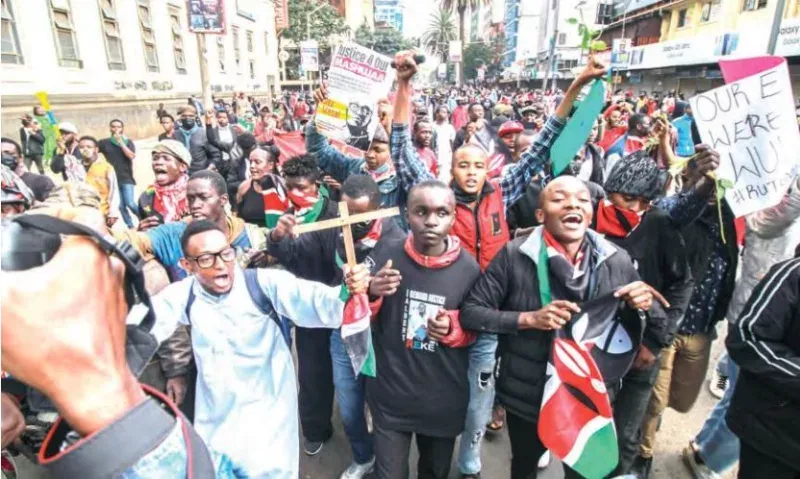
The Civic Freedoms Forum (CFF) has published a report titled Democratic Backsliding: State of Human Rights and Governance in Kenya, warning that the risk of election-related violence stands at 84.1 percent as the country approaches the 2027 General Election.
The assessment, covering the period from September 2025 to October 2026, says Kenya is experiencing democratic backsliding characterised by increasing police brutality, political violence, corruption and restrictions on civil liberties, and notes a growing reliance on force, surveillance, arrests and intimidation to quell dissent.
International ratings cited in the report show Kenya’s Freedom House global freedom score fell from 51 to 49 in 2026, keeping the nation in the “partly free” category, while CIVICUS classified Kenya as “repressed”, its second-worst rating.
The report points to a series of violent incidents in recent by-elections, including three deaths during the November 27 2025 contests – two in Kasipul and one in a Kabuchai stampede – and ten hospitalisations after attacks on candidate-linked hotels and homes.
It also records that during the February 26 2026 by-elections, 27.3 percent of observed polling stations failed to display results forms publicly and Kenya Integrated Election Management System kits malfunctioned in 30 percent of stations, while the July 16 Ol Kalou parliamentary by-election was marked by allegations of voter bribery, intimidation, property destruction, violence and one fatality.
Police conduct is highlighted through the Missing Voices 2025 annual report, which documented 131 cases of police violence, including 125 killings and six enforced disappearances, and notes that 24 police killings were recorded in May 2026 alone.
Demonstrations over rising fuel prices injured more than 30 people and led to over 348 arrests, and the second anniversary of the June 25 2024 Gen Z protests saw further arrests and disappearances; Kenya National Commission on Human Rights data show 361 arrests across 11 counties and seven enforced disappearances during the June 25 2026 demonstrations.
The assessment adds that corruption, mounting public debt and a rising cost of living undermine service delivery, and that 64.9 percent of learners in day schools were sent home or denied classes over unpaid levies described as illegal.
The CFF concludes with ten demands, including an end to police killings and enforced disappearances, protection of journalists and human-rights defenders, credible electoral preparations, accountability for corruption and safeguarding of independent constitutional institutions, and urges the Independent Electoral and Boundaries Commission, police oversight bodies and the Judiciary to act.
Speaking at a Nairobi briefing, Kenya Human Rights Commission Executive Director David Malombe said the Kofi Annan Foundation’s 84.1 percent violence risk figure “cannot be ignored” and warned that the pattern signals democratic regression and growing impunity.
Transparency International Executive Director Sheila Masinde called for guarantees of free, fair and credible elections in 2027 through timely reforms, impartial institutions and implementation of the Campaign Finance Act.
Law Society of Kenya President Charles Kanjama urged Parliament to enact clear provisions for livestreaming polling-station results, stating that such measures are required by Articles 81 and 86 of the Constitution and that the society will seek court orders to block any law that weakens public scrutiny of election outcomes.
Related reporting
More Politics →
Gachagua Says Ruto Paid KSh20 Million for Mudavadi’s ANC Party

Governor George Natembeya Calls for Unity After Kalonzo Booed at LMM Launch

Kalonzo Musyoka Booed as He Calls for Opposition Unity Ahead of 2027 Election