
Business News
Why the Sh323.8 Billion Kenya US Health Agreement Is Raising Data Privacy Questions

President William Ruto has strongly defended the Sh323.8 billion health cooperation agreement between Kenya and the United States as public concern continues to grow over data privacy and government oversight.
The five-year framework, signed earlier this month, has been promoted as a major step toward strengthening Kenya’s health system and achieving Universal Health Coverage. However, critics argue that key details about data access and control only became clear after sustained public pressure forced the government to respond.
While addressing leaders at a recent national and county governments summit, President Ruto dismissed claims that the agreement allows foreign access to sensitive personal health data. He said the Attorney General’s office examined the document thoroughly and found no provisions that compromise the interests of Kenyan citizens.
Despite those assurances, questions remain. Digital rights advocates, health professionals, and sections of civil society continue to demand greater transparency, warning that public trust depends on more than official statements.
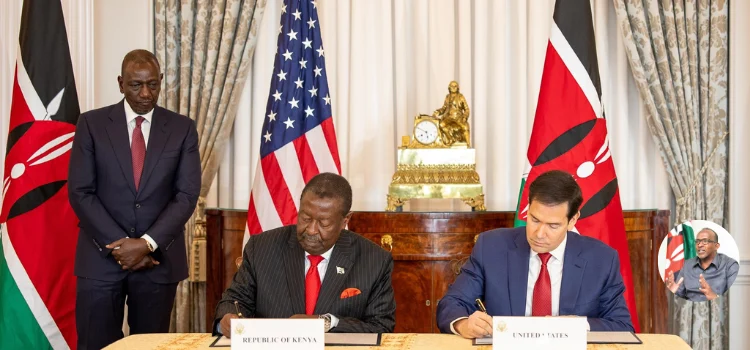
Here are some photos of William Ruto witnessing the signing of the Kenya–US health deal.
What the Sh323.8 Billion Health Framework Involves
Under the agreement, the United States has committed approximately US$1.6 billion shillings equivalent, while the Kenyan government will contribute Sh115.8 billion over the five years. The funding targets health financing reforms, digitization of health records, and expansion of national health insurance coverage.
A significant shift within the framework involves routing donor funds directly through government institutions such as the Social Health Authority and the Digital Health Agency. The government argues that this move improves efficiency and accountability by ending heavy dependence on nongovernment organizations.
President Ruto has repeatedly stated that channeling funds through state systems restores national control over health programs and reduces administrative wastage. However, critics caution that centralizing both funding and data without robust oversight may introduce new risks.
Data Privacy Concerns and Legal Safeguards
Health Cabinet Secretary Aden Duale has stated that the agreement does not permit the sharing of personally identifiable information. According to the government, Kenya will only share aggregated and anonymized health data, such as trends and system performance indicators.
Officials say the Data Protection Act of 2019 and the Digital Health Act of 2023 govern all data handling under the deal. Any data exchange requires approval from both the Digital Health Agency and the Office of the Data Protection Commissioner.
Nonetheless, analysts point to clauses on pathogen sample sharing and audit access as potential weak spots. They warn that without strict enforcement, the scope of data sharing could expand beyond what the public expects.
Accountability Will Determine the Outcome
The Health Ministry has promised to publish the full agreement and table it before Parliament. Observers say this step will determine whether the government is truly committed to openness.
For now, the Sh323.8 billion Kenya-US health deal sits at the center of a broader debate about transparency, trust, and sovereignty. Its success will depend not only on funding but also on whether data protection laws are enforced consistently and openly.
Read More: Betty Bayo’s Mother Seeks DPP Inquest Over Daughter’s Death
Comments


Benson Gethi The Man Behind the NYS Scandal: How the Gethi Family Profited from Billions Lost

Eldoret Airport Smuggling Expose: Millions Lost as Gadgets Flow Illegally to Ethiopia

How Ben Gethi Orchestrated the Ksh 6.2 Billion NYS Scandal the EACC Can No Longer Ignore

SportPesa Aviator Exposed: Why SportPesa Aviator Games Have Become a Public Danger That Kenya Can No Longer Ignore

SportyBet Kenya Bonus for January 2026 – Uncover Unique Offers!

The Two Faces of Opiyo Wandayi: The ‘Watcher’ Who Now Uses Luo Votes While Kenyans Pay the Price

The 2027 Expiry Date: Why Moses Omondi’s Term Will Be Short

EXPOSED: Court Filings Show How Cs Mbadi, Watanga and Nyawanda Approved Sh5.5 Billion Illegal Rice Imports

Paul Ndung’u Bankruptcy Exposes a Stunning Fall After SportPesa Court Defeat

Arsenal vs Manchester United Prediction: Betting Tips, Odds, and Match Preview

Securing Scholarships for International Study: A Comprehensive Guide for Students
Paul Ndung’u Bankruptcy Exposes a Stunning Fall After SportPesa Court Defeat
Arsenal vs Manchester United Prediction: Betting Tips, Odds, and Match Preview
EXPOSED: Court Filings Show How Cs Mbadi, Watanga and Nyawanda Approved Sh5.5 Billion Illegal Rice Imports
The 2027 Expiry Date: Why Moses Omondi’s Term Will Be Short
The Two Faces of Opiyo Wandayi: The ‘Watcher’ Who Now Uses Luo Votes While Kenyans Pay the Price
SportyBet Kenya Bonus for January 2026 – Uncover Unique Offers!
SportPesa Aviator Exposed: Why SportPesa Aviator Games Have Become a Public Danger That Kenya Can No Longer Ignore
How Ben Gethi Orchestrated the Ksh 6.2 Billion NYS Scandal the EACC Can No Longer Ignore
Eldoret Airport Smuggling Expose: Millions Lost as Gadgets Flow Illegally to Ethiopia
-
 Business News1 week ago
Benson Gethi The Man Behind the NYS Scandal: How the Gethi Family Profited from Billions Lost
-
 Business News1 week ago
Eldoret Airport Smuggling Expose: Millions Lost as Gadgets Flow Illegally to Ethiopia
-
 Columns And Opinions7 days ago
How Ben Gethi Orchestrated the Ksh 6.2 Billion NYS Scandal the EACC Can No Longer Ignore
-
 General News5 days ago
SportPesa Aviator Exposed: Why SportPesa Aviator Games Have Become a Public Danger That Kenya Can No Longer Ignore
-
 Entertainment5 days ago
SportyBet Kenya Bonus for January 2026 – Uncover Unique Offers!
-
 Columns And Opinions5 days ago
The Two Faces of Opiyo Wandayi: The ‘Watcher’ Who Now Uses Luo Votes While Kenyans Pay the Price
-
 General News5 days ago
The 2027 Expiry Date: Why Moses Omondi’s Term Will Be Short
-
 Columns And Opinions5 days ago
EXPOSED: Court Filings Show How Cs Mbadi, Watanga and Nyawanda Approved Sh5.5 Billion Illegal Rice Imports