Business News
The truth about Uhuru Kenyatta’s COVID19 goodies

[ad_1]
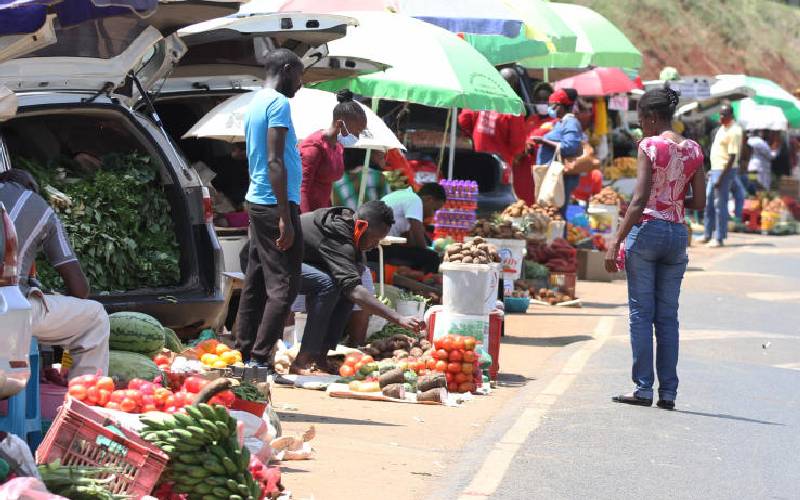
Traders convert their car boots to sell fruits, vegetables, groceries, eggs and other fresh farm products along Northern Bypass in Nairobi, June 4, 2020. [Elvis Ogina, Standard]
President Uhuru Kenyatta’s interventions are softening the economic blows for Kenyans even as some of them are set to expire a month after next year’s polls.
The interventions touching on electricity, animal and chicken feeds, fuel, school fees and loans have come to the rescue of Kenyans in a year a majority say their economic conditions have worsened.
However, economic analysts caution that the State could be using the interventions as a hiding ground for the deep-seated problems in the economy, setting up Kenyans for more setbacks in the near future.
“Most of these interventions are just kicking the can down the road. Probably it is going to be a key headache for the next government to deal with,” said Churchill Ogutu, an economist at IC Group.
For instance, the State last Tuesday rescued Kenyans from what would have been the highest ever fuel prices in the history of the country by opting to fully pay oil marketers on behalf of consumers.
The State applied a fuel subsidy to keep prices unchanged for the third month running, saving consumers from a Sh18.32 rise on a litre of petrol. The prices of diesel and kerosene were to rise by Sh21.89 and Sh23.53 respectively.
The subsidy has helped soften the pain at the pump for consumers against the backdrop of rising crude oil and weakening shilling — both of which were sure recipes for fuel price increases.
“The government will use the Petroleum Development Levy to cushion consumers from the otherwise high prices,” said Energy and Petroleum Regulatory Authority (EPRA) Director-General Daniel Kiptoo in a notice announcing the monthly pricing guide.
High fuel prices would have unleashed pricing pressure across the economy, with ramifications on the cost of living.
But sustaining the subsidy could prove difficult, especially with competing budget needs that, for instance, saw the State tap into the fund for Sh18.1 billion to support Standard Gauge Rail operations in September.
Kenyans struggling to keep up with loan repayments of below Sh5 million have also been spared being listed on credit reference bureaus (CRBs) for 12 months to September next year.
The listing freeze waiver offers a breather to individuals and small businesses but also sets them up for en masse negative listing come next year should they fail to resume repayments.
This means that borrowers who may abuse this window by slamming the brakes on loan repayments will eventually ruin their credit scores after the listing freeze ends.
This comes in a year in which the majority of Kenyans’ financial well-being has weakened, leaving only 17.1 per cent of the households able to meet their daily needs, cope with shocks such as sickness and invest in future goals.
A joint survey by the Central Bank of Kenya (CBK), Financial Sector Deepening (FSD) Kenya and Kenya National Bureau of Statistics shows the economic health of 73.6 per cent of households have worsened this year compared to 2019.
“The main drivers of the deterioration were the inability to cope with shocks and challenges in managing their day-to-day needs,” said the 2021 FinAccess Household Survey.
The survey findings could mean that a majority of Kenyans are yet to weather Covid-19 storms and return their economic status to pre-pandemic levels despite the State relaxing measures to curb the spread of the virus, such as lockdowns and curfews.
The economy lost 737,500 jobs last year.
The chief economist at Mentoria Economics, Ken Gichinga, said a series of economic sweeteners could mean the private sector is being crowded out and the State is forced to fire-fight to look like it is doing something about the shocks.
“These could actually be sweeteners to fit the season of politics. But if in the long term, it is much harder for the policies to cut people’s dependence on State handouts; it is going to be a challenge,” said Mr Gichinga.
“We can have a series of sweeteners, but fundamentally, until we have a model that is pro-private sector to address issues such as cost of doing business and interest rates, we will always be doing these things and increasing taxes and debts.”
The government in July also moved to cut annual school fees for parents on the tweaked education calendar following Covid-19 disruptions.
However, the school fees cuts — ranging between Sh10,000 and Sh21,920 annually — will only last up to March 4.
For animal and chicken farmers, the State recently rescued them from rising prices of feeds after the National Treasury granted millers a 12-month import duty waiver on materials used in the manufacture of these feeds.
The waiver will run from November 1, 2021 to the end of October next year, helping 18 millers to import the feeds tax-free.
These tax-free imports are expected to translate into reduced prices for farmers, coming on the back of President Uhuru’s declaration of the drought affecting parts of the country a national disaster on September 8. He had on October 20 directed the Agriculture Cabinet Secretary Peter Munya to work jointly with the National Treasury to develop a framework to secure a reduction in the prices of animal and chicken feeds.
“To secure a reduction in the prices of animal feeds, I order and direct the Cabinet Secretary for Agriculture, jointly with the National Treasury, to issue within seven days, a framework that will facilitate the reduction of the cost of animal and chicken feeds,” said the President.
Farmers have been incurring increased costs to sustain their livestock on the back of a rise in prices of the feeds following the generally dry conditions in the country.
For instance, the price of a 70-kilogramme bag of dairy meal rose from the average of Sh2,500 that farmers were paying in August last year to above Sh3,500 last month. The price of chick marsh has also risen by nearly Sh1,000.
The President’s intervention continued his series of giveaways that are hiding the true picture of the hardships in the economy. But the series of interventions, viewed as helpful now, set up consumers for a possible sudden setback should they expire before the economic conditions improve.
“Most of these interventions are short-lived, meaning that the government will require some fire-fighting at some point as it runs into implementation risks. I don’t see fire-proof solutions for example on the cutting of power bills,” said IC Group’s Ogutu.
President Kenyatta last week promised to cut December electricity bills by 15 per cent and deliver another 15 per cent cut by the end of March next year.
The interventions will help bring down the bills from a 40-month high that consumers are supposed to pay following an increase in the fuel surcharge levied on electricity tariffs.
Energy sector regulator, EPRA, in a Friday gazette notice, raised the fuel cost charge to Sh4.63 from Sh4.21 last month — the highest since June 2018.
The sustainability of the President’s plan, which is hinged on Kenya Power cutting system losses and independent power producers (IPPs) reducing their pricing, is not clear.
The system losses have in the last five years averaged 22.2 per cent in the last financial years — the best being 18.9 per cent in the year ended June 2017.
The President’s directive is a tall order to achieve within a short period given that the causes of system losses, which amounted to Sh39.67 billion in the year ended June 2021, require long-term interventions.
Uhuru also hopes the State will strike a deal with IPPs to cut the pricing of their electricity, in what will pass on another 15 per cent saving to consumers by March. But the IPPs have been opposed to the unilateral push to lower the cost at which they sell electricity to Kenya Power.
“Execution risk is pegged on this intervention. The promise is relying on IPPs, but the State jumped the gun in assuming it will just be a smooth ride,” said Ogutu. Mentoria Economic’s Gichinga said weaning the country off the increasing debts, taxation and short-lived State sweeteners requires policies that can uplift the private sector.
He further observed that a fundamental shift from heavy infrastructure-driven growth to private sector-led growth could uplift the lives of Kenyans.
“It is not sustainable to apply short-term solutions to long-term problems. The moment you have a heavy government agenda that is fuelled by debt, taxation will have to be punitive. That is why cutting taxes on fuel is something the State isn’t considering,” said Gichinga.
[ad_2]
Source link
Comments


South Sudan at the Brink: How Corruption Tightens Its Grip on a Rare Working Institution

Wantam Protests Hit Ugunja as CS Opiyo Wandayi Loses Support, Youths Invite DCP Led by Rigathi Gachagua
Wantam Protests Hit Ugunja as CS Opiyo Wandayi Loses Support, Youths Invite DCP Led by Rigathi Gachagua
South Sudan at the Brink: How Corruption Tightens Its Grip on a Rare Working Institution

Chepterit Comes Alive During SportyBet Kenya Gifts Motorbike to Loyal Fans

Nest Lounge Narok Under Scrutiny as KRG The Don Shooting Incident Triggers Government Silence and Maasai Community Outcry

Why the Sh323.8 Billion Kenya US Health Agreement Is Raising Data Privacy Questions

Betty Bayo’s Mother Seeks DPP Inquest Over Daughter’s Death

Ugunja Women Cry Foul After MP Appointments Snub Them Despite Campaign Support

KSh4M Serve! SportyBet Kenya Title Sponsors for Kipchumba Karori Eldoret International Volleyball Tournament

Shadrack Maritim Resurfaces in Uganda After Two-Month Disappearance