General News
Bulgaria president Radev headed for 2nd term » Capital News

[ad_1]
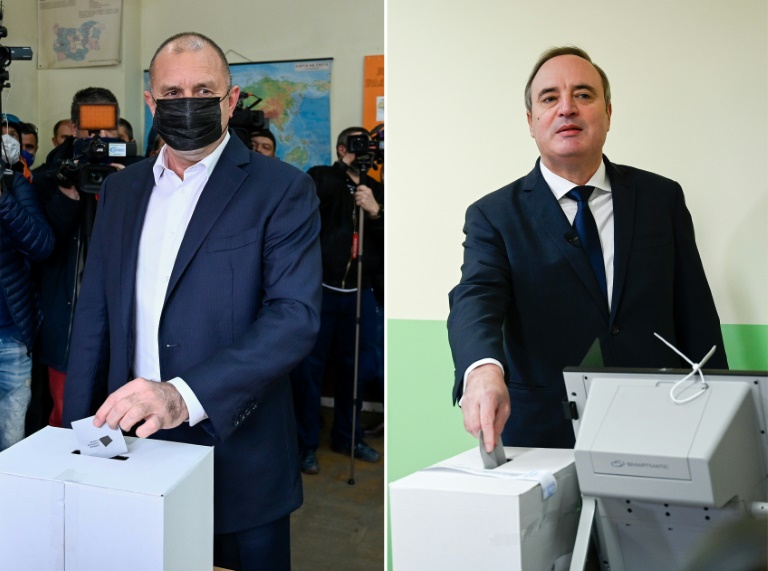
Incumbent President Rumen Radev (L) faced off against academic Anastas Gerdjikov in the poll © AFP / Nikolay DOYCHINOV
Sofia (AFP), Nov 21 – Bulgaria’s outgoing president Rumen Radev was headed for a comfortable re-election win in the second round of Sunday’s presidential election, according to exit polls.
Backed by several parties that support the kind of change Radev pushed for in his first term, figures from three polling institutes suggested he had won between 63 and 65 percent of the vote.
Until Radev took office for his first term, the post was a largely ceremonial role, but he has transformed it, putting at the heart of the struggle against corruption in the European Union’s poorest country.
Earlier Sunday, after casting his vote, Radev said he wanted to continue his mission of “change”, adding: “Let’s take our destiny into our own hands, not let others undermine our future.”
In the lead-up to Sunday’s run-off, Radev was already the frontrunner having garnered 49 percent of the vote in last weekend’s first round.

Voters quarantining at home with coronavirus were able to cast ballots at mobile polling stations © AFP / Nikolay DOYCHINOV
But having missed an outright majorityt, he faced off against academic Anastas Gerdjikov, who won 23 percent of the vote.
Radev, a former fighter pilot, is the country’s most popular politician, but Bulgaria itself is riven by fractious political parties. They have failed to deliver the stable government needed to tackle deep-seated graft and the worsening coronavirus pandemic.
“Everything’s going wrong. I want that to change for my children, grandchildren and former pupils,” retired teacher Dobrinka Nakova told AFP in the capital Sofia while out to vote.
New Bulgarian University political science professor Antoniy Todorov described the vote as “a clash between two visions” in the eastern European country.
It is one between “the soft tolerance of endemic corruption and the firm opposition to a model of governance that uses public power for private purposes”, he wrote in a recentblog post.
– Turnout down –
A clear win for Radev, 58, may usher in a period of political stability after a new anti-corruption party won a surprise victory last weekend in the country’s third general election this year.
We Continue the Change is looking for coalition partners to end six months of political deadlock that have drawn out the worst political crisis since the end of communism three decades ago.
Gerdjikov, 58, was backed by the GERB party of former conservative prime minister Boyko Borisov, which came a close second in the general election.
Analysts had speculated that voter apathy might make the win more difficult for Radev, who was backed by the Socialists for his first five-year term but now runs as an independent.

Anti-graft protests last year helped topple then premiuer Borisov, but his defeat failed to lead to a stable government © AFP / NIKOLAY DOYCHINOV
Only 40 percent of those eligible turned out for the first round, and the electoral commission said just 24 percent had voted by 1400 GMT on Sunday, down sharply from 2016.
Lacking a party machine, Radev relied on a broad spectrum of supporters.
Those include We Continue the Change, whose founders — Harvard graduates Kiril Petkov and Assen Vassilev — served as ministers in the first interim administration Radev appointed in May after an inconclusive poll in April.
Radev had supported the protests against Borisov’s 10-year rule last summer, shouting “Mafia out!” with his fist raised in the air as he briefly joined the crowd.
“On Sunday, vote for the president who started the change,” Petkov urged in a video address this week.
In a presidential debate on Thursday, Radev said he regretted most that he “didn’t manage to contribute to the toppling of Borisov’s regime sooner”.
– Pandemic failure –
But the end of Borisov’s reign also marked the beginning of the political deadlock.
And that has coincided with a coronavirus onslaught, Bulgaria having the lowest vaccination rate of any EU member and one of the world’s highest Covid-19 mortality rates.
The second caretaker administration Radev appointed after parties failed yet another attempt to form a government after polls in July was strongly criticised for its poor handling of the outbreak.
The country has struggled to roll out jabs in the face of strong anti-vaccination sentiment and prolific fake news.
Both interim administrations did, however, win plaudits for an avalanche of revelations about corruption, fraud and mismanagement under Borisov, which Gallup analyst Svetlin Tachev said “played in Radev’s favour”.
[ad_2]
Source link
Comments


South Sudan at the Brink: How Corruption Tightens Its Grip on a Rare Working Institution

Wantam Protests Hit Ugunja as CS Opiyo Wandayi Loses Support, Youths Invite DCP Led by Rigathi Gachagua
Wantam Protests Hit Ugunja as CS Opiyo Wandayi Loses Support, Youths Invite DCP Led by Rigathi Gachagua
South Sudan at the Brink: How Corruption Tightens Its Grip on a Rare Working Institution

Chepterit Comes Alive During SportyBet Kenya Gifts Motorbike to Loyal Fans

Nest Lounge Narok Under Scrutiny as KRG The Don Shooting Incident Triggers Government Silence and Maasai Community Outcry

Why the Sh323.8 Billion Kenya US Health Agreement Is Raising Data Privacy Questions

Betty Bayo’s Mother Seeks DPP Inquest Over Daughter’s Death

Ugunja Women Cry Foul After MP Appointments Snub Them Despite Campaign Support

KSh4M Serve! SportyBet Kenya Title Sponsors for Kipchumba Karori Eldoret International Volleyball Tournament

Shadrack Maritim Resurfaces in Uganda After Two-Month Disappearance