
Business News
Drought and war conspire to pinch pockets

[ad_1]
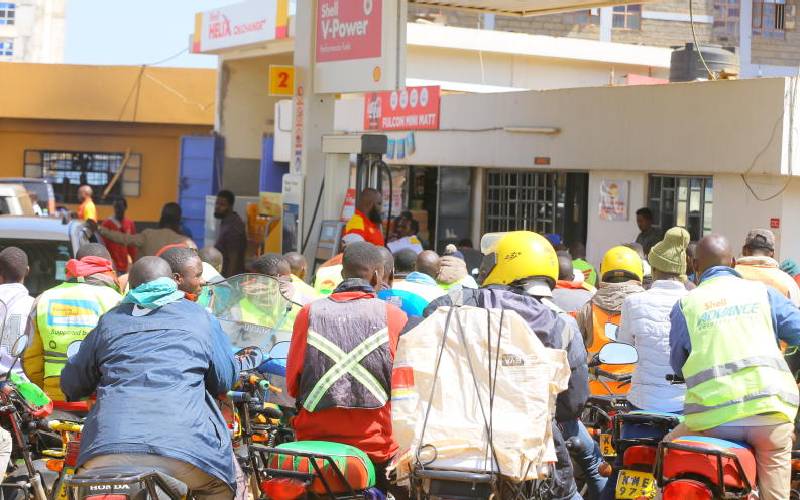
Boda boda riders and motorists line up to fuel at Shell Petrol Station in Kisii town on March 31, 2022. [Sammy Omingo, Standard]
The cost of living is becoming unbearable for most Kenyans with the prices of basic commodities rising sharply over the two last months, official data show.
Latest data from the Kenya National Bureau of Statistics (KNBS) shows that prices of critical commodities in a typical Kenyan shopping basket increased by 5.56 per cent in March compared to 5.08 per cent in February. The increase in prices of basic commodities was attributed to a jump in the retail prices of wheat flour, cooking oil, bar soap, detergents, Sukuma Wiki and Spinach. Kenyans are grappling with a restless global market owing to the war in Ukraine and a crippling drought that has depressed the harvest of critical food crops.
The overall increase in prices of goods and services in the economy, typically over a period of 12 months, is known as inflation.
The national statistician noted that the overall year-on-year inflation rate, as measured by the Consumer Price Index (CPI), or the cost of living index, rose mainly due to an increase in the prices of food and non-alcoholic beverages.
The food basket, which takes up a huge chunk of poor families’ income, rose 9.92 per cent in the review period.
Other items that contributed to the jump in inflation rate in March were furnishings, household equipment and routine household maintenance which increased by 6.44 per cent; housing, water, electricity, gas and other fuels (4.91 per cent), and transport (3.66 per cent).
“Prices of food items in March 2022 were relatively high compared with prices of food items recorded in March 2021,” said the Director-General for KNBS Macdonald Obudho in a statement released on Thursday.
The price of cooking gas experienced the sharpest increase with a 13-kilogram retailing at an average of Sh2,866, an increase of 38 per cent compared to Sh2,074 in the same month last year. In some places, the price of Liquified Petroleum Gas (LPG) has touched a high of Sh3,500.
One of the products that have really burrowed Kenyans’ pockets- and has even been a butt of jokes on social media-is cooking oil. A litre of cooking oil is retailing at an average of Sh332, an increase of 35 per cent from Sh246 in March last year.
The increase in the retail price of cooking oil locally has largely been due to a spike in global prices of palm due to depressed harvests. The limited supply of palm oil has been triggered by unfavourable weather, infrastructure issues and the Covid-19 pandemic.
Wheat flour, another critical ingredient for preparing chapati, mandazi and cakes, also experienced an increase with a two-kilogram going for Sh151 from Sh129. Kenya imports most of its wheat from Russia and Ukraine, two countries that are at war with each other.
Other products whose prices have escalated in the month under review include bar soap, with an 800 gram retailing at an average of Sh145 compared to Sh120 in March 2021.
Although pump prices increased by only nine per cent to an average of Sh135.5 per litre, it would have been higher if it was not for the fuel subsidy programme where the government pays oil marketers for their margins.
Dr Patrick Njoroge, the Central Bank of Kenya (CBK) Governor, however, raised concerns that some of the sharp increases in retail prices might have been due to unscrupulous traders who might be taking advantage of the crisis.
“It is not an issue of pricing, it is an issue of being unscrupulous,” said Njoroge in a press briefing on Wednesday, even as he admitted that a lot of Kenyans will be shocked by the sticker-price shock.
[ad_2]
Source link
Comments

UDA Politician Arrested Over Sixty Million Shilling Fake Tender Scam at the Office of the President
National Youth Service Officially Launches 2026 Nationwide Recruitment Exercise for Kenyan Youth

Why CS Opiyo Wandayi is Losing the Siaya Power War to Governor Orengo

The Absa Kenya Dossier on Extortion Cartels, Boardroom Purges, and the Million-Dollar Client Hunt

“Enough is Enough”: DP Kindiki Issues Stern Warning to Ruto Critics

The NSSF Audit Dossier on Mismanaged Billions and Stalled Housing Projects

How Interior PS Raymond Omollo and Senator Allan Chesang Ran a Sh60 Million Fake Tender Scam
How Interior PS Raymond Omollo and Senator Allan Chesang Ran a Sh60 Million Fake Tender Scam
The NSSF Audit Dossier on Mismanaged Billions and Stalled Housing Projects
The Absa Kenya Dossier on Extortion Cartels, Boardroom Purges, and the Million-Dollar Client Hunt
“Enough is Enough”: DP Kindiki Issues Stern Warning to Ruto Critics
Why CS Opiyo Wandayi is Losing the Siaya Power War to Governor Orengo
UDA Politician Arrested Over Sixty Million Shilling Fake Tender Scam at the Office of the President
National Youth Service Officially Launches 2026 Nationwide Recruitment Exercise for Kenyan Youth

Xiaomi Unveils REDMI Note 15 Series: REDMI Titan Durability Meets Advanced Imaging

SportyBet’s 1UP Early Win Is a Game-Changer for Kenyan Punters in 2026

Evidence-Based Study Strategies for Academic Success in Higher Education
-
General News4 days ago
UDA Politician Arrested Over Sixty Million Shilling Fake Tender Scam at the Office of the President
-
Jobs4 days ago
National Youth Service Officially Launches 2026 Nationwide Recruitment Exercise for Kenyan Youth
-
 Politics2 days ago
Why CS Opiyo Wandayi is Losing the Siaya Power War to Governor Orengo
-
 Business News4 hours ago
The Absa Kenya Dossier on Extortion Cartels, Boardroom Purges, and the Million-Dollar Client Hunt
-
 Politics2 days ago
“Enough is Enough”: DP Kindiki Issues Stern Warning to Ruto Critics
-
 General News3 hours ago
The NSSF Audit Dossier on Mismanaged Billions and Stalled Housing Projects
-
 General News27 minutes ago
How Interior PS Raymond Omollo and Senator Allan Chesang Ran a Sh60 Million Fake Tender Scam