General News
More than 48,000 people displaced by floods in Tana River County

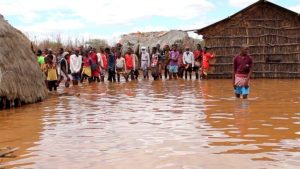
More than 48,000, residents in Tana River County have been displaced by the ongoing floods which have been described as the worst in Kenyan history.
Kenya Red Cross Society led by the Secretary-General Dr Asha Mohamed Wednesday led a delegation from Nairobi and Coast together with the County Governor Dhadho Godhana and his officials on a three-day tour of the affected areas.
Dr. @AshaMohammed_ & H.E Godhana Dhadho Gaddae, Governor of Tana River County led distribution of food and non-food items to flood victims at Baomo Village in Tana River County.
The food hampers were donated by the Last Resort & Professional Criminologists Association of Kenya. pic.twitter.com/FrW5h6M5Rb
— Kenya Red Cross (@KenyaRedCross) May 21, 2020
Reports indicate that 8153 households have been affected so far by the disaster and urgently in need of relief food and non-food items.
One household consists of up to six family members which bring the number of those affected to 48,918 people affected.
Data from the Kenya Red Cross indicate that Tana delta is the worst affected with 4659 households affected followed by Tana North with 2821 households and Galole which has 673 households affected.
In recent weeks, security forces have been moving people out by force to higher grounds.
The Kenya Meteorological Department projects that the ongoing rains will continue to June.
A series of mutually exacerbating disasters is unfolding in East Africa, on a scale rarely seen in decades, warned the International Federation of Red Cross and Red Crescent Societies (IFRC).
Ongoing heavy rain—which has killed nearly 300 and displaced about 500,000 people—has slowed down operations aimed at controlling the worst locust crisis in decades and increased the risk of the spread of Covid-19.
Dr Simon Missiri, IFRC’s Regional Director for Africa said:
“The ongoing flooding crisis is exacerbating other threats caused by Covid-19 and the invasion of locusts. Travel and movement restrictions meant to slow down the spread of Covid-19 are hampering efforts to combat swarms of locusts that are ravaging crops. Flooding is also a ‘threat amplifier’ with regards to the spread of Covid-19 as it makes it hard to implement preventive measures.”
Flooding has left thousands of people homeless, many of them now seeking shelter in temporary accommodation centres where it is not easy or not possible at all to observe physical distancing.
As a result, thousands are now at higher risk of contracting Covid-19 or waterborne diseases and need emergency food assistance.
Red Cross teams in the affected countries are rushing to respond to multi-faceted and overlapping crises.
To respond to flooding, Covid-19 and locusts, the IFRC has provided over 7 million Swiss francs to Red Cross and Red Crescent National Societies in East and Horn of Africa.
Red Cross and Red Crescent teams in Ethiopia, Kenya, Somalia, South Sudan, Tanzania, Rwanda and Uganda are helping communities mitigate the negative impacts of the triple disaster through community awareness and direct food and non-food support.
In Kenya, the Red Cross is conducting assessments in 16 counties, using drones and satellite images. Red Cross teams are also airlifting household items to families that have been marooned by floods.
Comments


South Sudan at the Brink: How Corruption Tightens Its Grip on a Rare Working Institution

Wantam Protests Hit Ugunja as CS Opiyo Wandayi Loses Support, Youths Invite DCP Led by Rigathi Gachagua
Wantam Protests Hit Ugunja as CS Opiyo Wandayi Loses Support, Youths Invite DCP Led by Rigathi Gachagua
South Sudan at the Brink: How Corruption Tightens Its Grip on a Rare Working Institution

Chepterit Comes Alive During SportyBet Kenya Gifts Motorbike to Loyal Fans

Nest Lounge Narok Under Scrutiny as KRG The Don Shooting Incident Triggers Government Silence and Maasai Community Outcry

Why the Sh323.8 Billion Kenya US Health Agreement Is Raising Data Privacy Questions

Betty Bayo’s Mother Seeks DPP Inquest Over Daughter’s Death

Ugunja Women Cry Foul After MP Appointments Snub Them Despite Campaign Support

KSh4M Serve! SportyBet Kenya Title Sponsors for Kipchumba Karori Eldoret International Volleyball Tournament

Shadrack Maritim Resurfaces in Uganda After Two-Month Disappearance