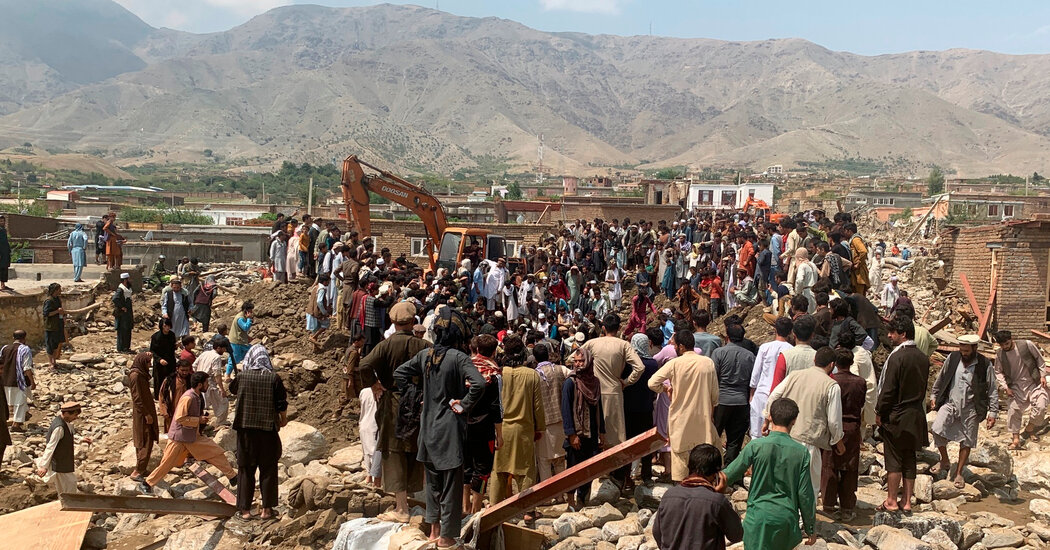
KABUL, Afghanistan — When the heavy rains came overnight, setting off flash floods in northern Afghanistan, the deluge quickly turned deadly and caught many residents off guard because they were sleeping.
By Wednesday morning, officials said, the floods had killed at least 78 people and injured scores of others in Charikar, home to nearly 200,000 people and the capital of Parwan Province, just north of Kabul.
Mahmood Samadi, a Charikar resident, said he woke to the sound of water rushing through his neighborhood and quickly decided to get his family out of the city. When he returned, nearly half his house was flooded and six homes on his street had been destroyed.
“I don’t know about the exact casualties in our street, but I know many people were killed and wounded,” Mr. Samadi said.
The flash floods left a trail of mud, toppled houses and bodies in their wake. Photos in the Afghan news media showed flattened buildings, scattered debris and mangled cars. Rescue workers sifted through the wreckage, as many residents were believed to be trapped under collapsed homes. One hospital reported receiving 78 bodies and 105 wounded people. The death toll in the city was expected to rise.
The flooding is just the latest blow for Afghanistan, which has been ravaged by the coronavirus and bloodied by Taliban attacks across the country since a Feb. 29 peace agreement between the United States and the insurgent group.
Tariq Arian, a spokesman for Afghanistan’s interior ministry, said on Tuesday that 88 civilians had been killed in the preceding two weeks, and he blamed the Taliban for most of the deaths.
That same day, a Taliban car bomb in the northern province of Balkh killed at least eight civilians, as well as two Afghan commandos whose unit was based nearby. More than 60 people were wounded, and the blast destroyed or damaged several buildings, including an agricultural center and an animal clinic.
Nearly 1,300 civilians were killed in fighting during the first six months of the year, according to the United Nations. A similar number of Afghans were reported to have died from the coronavirus, but the true number is likely to be significantly higher because of limited testing and the government’s diminished presence in more rural areas.
Since the start of the year, more than 17,000 people have been affected by heavy floods and rains across Afghanistan, with nearly 2,000 homes destroyed, according to a United Nations report released in April.
Scientists have pointed to climate change as more frequent flooding has struck Asian countries, including China, where riverbanks have been breached and waters have strained the Three Gorges Dam; North Korea, where the government declined to accept international aid for fear of letting the coronavirus in; Bangladesh, where torrential rains recently submerged at least a quarter of the country; and Indonesia, where flash floods left hundreds of thousands homeless earlier this year.
In Afghanistan, weak governance puts residents in additional peril: With little official oversight, urban planning is often neglected. Many of the houses destroyed in Charikar were built in an area prone to flooding, said Mohammad Khalil Fazli, a member of the Parwan provincial council.
Nearly the entire city was devastated, Mr. Fazli said. “There are houses destroyed by flash floods in every corner of the city,” he said.
Esmatullah Mohammadi, another member of the provincial council, said, “The government should haven’t let these people build their houses there, because everyone knows that it is a route of flash floods.”
Heavy rains in northern and eastern Afghanistan are common this time of year. On Tuesday night, three people were killed and three others wounded in a series of flash floods in eastern Wardak Province, said Mohammad Sardar Bakhtyari, a local official. Dozens of houses and acres of agricultural land were destroyed.
But the dense population and the fact that the downpour happened overnight combined to deadly effect in Charikar.
A spokesman for President Ashraf Ghani said that the Afghan government had pledged emergency support for Charikar.
Flash flooding in Charikar earlier this month affected 495 families, 152 of which needed humanitarian assistance, according to a report from the International Organization for Migration.
Related reporting
More World News →
South Sudan’s Oil Looters: How Young Elite Gatekeepers Plunder Nation While Citizens Starve

General to Private: Kiir Crushes Economic Vice President in South Sudan's $1.7 Billion Corruption Purge

Paul Biya’s Re-Election: What Cameroon’s Political Longevity Reveals About Leadership and Governance in Africa