Competing political interests and pressure from the West led by the United States were the cause of the delay in releasing the Building Bridges Initiative report.
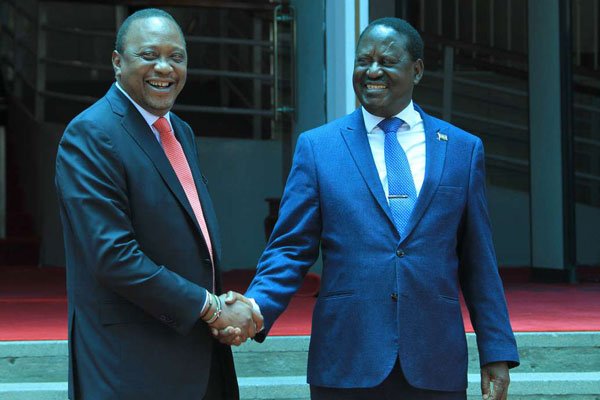
Insiders close to the presidency intimated that the head of state was forced to set up a multi-agency team comprising officials from the Attorney General’s Chambers, National Intelligence Service, National Treasury and his legal team to comb and toothpick through the report before it was handed over to him and Raila Odinga.
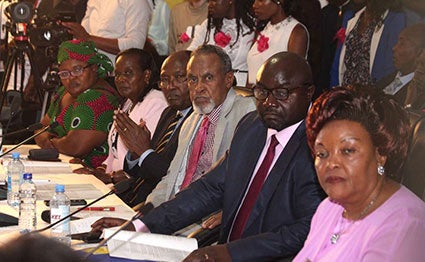
BBI Committee
The scrutiny was meant to identify the missing gaps as well as the political, economic and social ramifications were the report to be implemented.
Uhuru did not want a report that would spark political tension and divisions in the country and that is why he ordered it be handed to the multiagency team for finetuning before it would be released to the public.
Some of the recommendations the president viewed as hostile included the reduction of elective seats which would have seen the report shot down in parliament.
The other recommendation was adopting a parliamentary system where the president or prime minister would be chosen by the legislators. This recommendation was likely to be shot down during the referendum by the voters who are keen to elect their leader themselves.
Scrapping of the women representative seat was also likely to see the women leaders gang up against the report.
The president was also under pressure from US administration to halt any attempt by the BBI to make it possible for him to sneak back into power as either prime minister or any other influential position.
The Donald Trump administration which partly funded the BBI operations, is opposed to Uhuru going the Russian way like Vladimir Putin who has been musical-chairing the presidency with his prime minister Dmitry Medvedev who after 10 years became president for five years and after the five years paved way for Putin who had been prime minister, to return to the presidency.
The scheme where Uhuru would ape Putin was first brought to the public attention by controversial East Africa Legislative Assembly lawmaker Simon Mbugua, when he publicly stated that the president’s allies were planning something coded ‘KaPutin’ where Uhuru when he leaves the presidency after the end of his term in 2022, would come back as prime minister.
This plot resurfaced last week after former presidential candidate Martha Karua warned Uhuru not to accept a premiership position after the 2022 elections.
While terming the move as unconstitutional, Karua said the two-term limit set by the 2010 constitution was passed to ensure that no president stays in power for more than 10 years.
“As a good friend, I am telling the president to not be tempted to preside over an unconstitutional post. Finish your term, and let somebody else take the mantle,” Karua advised.
She was speaking at a women’s conference in Nairobi that brought together over 200 leaders including MPs, senators, MCAs, and student leaders under the umbrella #WomenAgendaKe.
Ruto
It also dawned on the president that during the compilation of the report, William Ruto got constant briefs on the progress and what direction the drafting was taking.
It was also reported that there were several Ruto loyalists in the taskforce briefing him daily on what Raila’s wing was pushing for.
Joint secretaries Martin Kimani and Paul Mwangi were responsible for briefing the president and Raila on every step of the exercise.
The team that is headed by Garissa senator Yusuf Haji hands over the final report to Uhuru and Raila this Tuesday.
Besides Haji, the other members of the taskforce are Adams Oloo, Busia senator Amos Wako, Agnes Kavindu who is Johnson Muthama’s estranged wife, Saeed Mwanguni, Florence Omose, Morompi ole Ronk, Peter Njenga and John Seii.
Also in the team are James Matundura, Lawi Imathiu, Samburu woman representative Maison Leshomo, Rose Museo and Archbishop Zacchaeus Okoth.
Apart from Wako, who has expertise in constitution-writing, the others are laymen in law.
The taskforce was required to develop policy, administrative reform proposals, and implementation modalities for each identified challenge area.
Ethnic antagonism, lack of a national ethos, inclusivity, devolution, divisive elections, security, corruption, shared prosperity and responsibility were some of the broad issues identified.
Already, Uhuru’s backyard of Mount Kenya appears to be opposed to the report.
Last week, Gatundu MP Moses Kuria issued conditions for supporting the BBI report, stating he and other concerned Kenyans would only support the report if it fulfilled the objectives he had in mind.
Among them, is an assurance that the person who will wield the executive power, will be directly elected by Kenyans, and holding the referendum alongside the general election.
The debate about the BBI team’s activity triggered a political circus, with politicians taking sides for or against the report.
Speculations were rife that Uhuru would have unveiled the report during Mashujaa Day celebrations in Mombasa. Uhuru was however reportedly prevailed not to do so by the NIS for fear of a backlash.
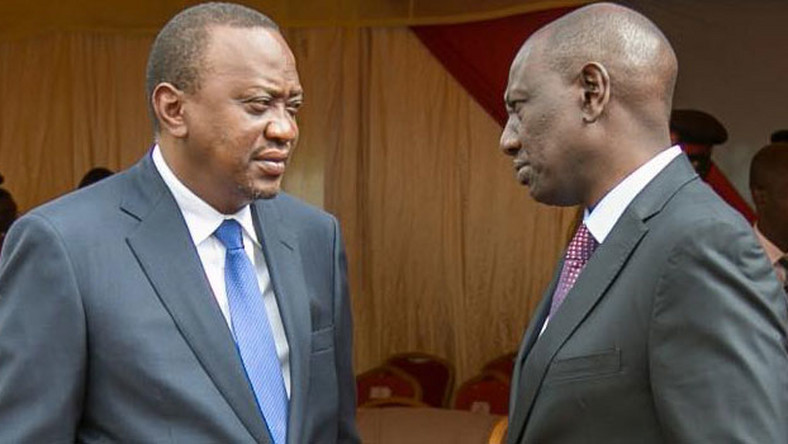
Already, Ruto has set the ground for rejecting the report going by his tweets.
Recently, he ignited a backlash from ODM leaders when he said, “As a democratic society, the proposals by BBI will be subjected to an open national conversation where every voice, the weak, the strong, the small and the big will be heard. Those working hard to create new fault lines, an us-versus -them clash will fail so miserably they will be shocked!”
Raila has been outspoken in support of major realignment of the national leadership structure to reintroduce the position of prime minister as head of government.
But unlike Raila, Uhuru has backed the BBI without going into positions and demands and has never talked of going back to a parliamentary system of government or uttered support for a referendum.
Uhuru has nevertheless indicated he will go around the country drumming up support for its recommendations, terming it as the answer to the myriad of problems that have bedevilled the country for many years.
But a large section of Central Kenya leaders, including some of his strongest defenders dating back to his days in Kanu, have been giving indications that they are ready to take a different path from the president’s political opinion.
Recently, a group of about 40 legislators from the national assembly and the senate – gave what they termed as their irreducible minimums for the region to support the BBI.
Key among their demands is that BBI addresses the inequality of the vote that they claim has seen the region underrepresented compared to other regions, and also disadvantaged in the allocation of resources under the devolved governance.
The MPs drawn from Uhuru’s Central province bedrock supported by others from the Kikuyu diaspora counties of Nakuru and Laikipia and those from the counties of Embu, Tharaka Nithi and Meru.
Meru senator Mithika Linturi said the parliamentary group was also backed by other senior leaders from the region who could not be allowed to make an address in parliament where they issued the statement. Only MPs and senators are allowed to do so.
Tellingly, they were escorted in parliament by Agriculture cabinet secretary Mwangi Kiunjuri, a man angling to be Ruto’s running mate in 2022 general election.
Related reporting
More Politics →
How the DCI and Kisumu County Officials Shield the Medprime Training College Syndicate While Students Buy Worthless Certificates

How Interior PS Raymond Omollo and Senator Allan Chesang Ran a Sh60 Million Fake Tender Scam

The NSSF Audit Dossier on Mismanaged Billions and Stalled Housing Projects
