If it was not already clear, securities regulators are giving Elon Musk, the chief executive of Tesla, a laundry list of things he cannot riff about on Twitter.
A revised agreement between Mr. Musk and the Securities and Exchange Commission, filed in federal court in Manhattan on Friday, spells out just when Mr. Musk must “obtain the preapproval of any experienced securities lawyer” employed by Tesla before posting on Twitter or other social media.
The list includes comments about the electric-car company’s financial condition, earnings forecast, proposed acquisitions and production data. But it also covers remarks about “nonpublic legal or regulatory findings or decisions” and any event that Tesla would have to disclose to the S.E.C. in a regulatory filing.
A footnote to the settlement said “this list is not intended to be an exhaustive list of topics,” meaning Mr. Musk is on notice to tread carefully when talking about anything that could move the company’s stock price.
If approved by a federal judge, the deal would resolve an attempt by regulators to hold Mr. Musk in contempt of court for violating the earlier settlement.
The agreement was changed after Judge Alison J. Nathan of Federal District Court in Manhattan said at a hearing this month that the original settlement, approved in October, had a “lack of clarity.”
Judge Nathan asked the parties to try to draft a deal that better explained how Tesla’s lawyers should vet Mr. Musk’s posts and that also included detailed procedures for dealing with posts that contained potential market-sensitive information.
Urging the two sides to “take a deep breath” and put on “their reasonableness pants,” she gave the lawyers two weeks to report back. Last week, she agreed to a request by the commission and Mr. Musk for another week to come to an agreement.
Apparently nodding to Judge Nathan’s request, the new proposed settlement said the “enhanced clarity” as to which topics Mr. Musk cannot comment on without a lawyer’s approval should “reduce the likelihood of future disputes regarding compliance.”
The latest regulatory scuffle between the S.E.C. and Mr. Musk was prompted by a Feb. 19 Twitter post from Mr. Musk that included information that had not been reviewed by a lawyer about the number of cars Tesla would produce and deliver this year.
The commission contended that the post violated the terms of the October settlement, which followed the S.E.C.’s filing of a civil fraud complaint against Tesla and Mr. Musk over his declaration on Twitter that he had “funding secured” to take the company private at $420 a share. The prospect pushed Tesla shares sharply higher. But it turned out that Mr. Musk and Tesla were not actually close to reaching such a deal.
Under the original settlement, Tesla was required to establish procedures for vetting Mr. Musk’s written communications, including Twitter posts, that might contain material information about the company.
At the court hearing this month on the S.E.C.’s request for a contempt citation, John Hueston, a lawyer for Mr. Musk, argued that the settlement was imprecise and had resulted in a “murky policy” governing when Tesla’s lawyers had to review Mr. Musk’s posts. Cheryl Crumpton, a lawyer for the S.E.C., disagreed, but Judge Nathan indicated that she was inclined to agree with Mr. Hueston.
Mr. Musk, who attended the hearing but did not speak, nodded in approval at some of the judge’s comments. He later issued a statement supporting her order directing the parties to revisit the settlement.
The Tesla chief executive has long feuded with the S.E.C., which he once derided on Twitter as the “Shortseller Enrichment Committee.’’ echoing his complaint that the bearish investors known as short-sellers for spreading damaging and false information about the company.
But putting the dispute behind him may have become more urgent in light of his company’s recent financial performance.
On Wednesday, Tesla gave even its most ardent supporters on Wall Street little to cheer about when it reported a $702 million quarterly loss. Sales of the company’s electric cars fell 31 percent compared with the fourth quarter.
Shares of Tesla have tumbled 9 percent since the earnings report. The stock, which as recently as Thursday had a bigger market capitalization than Ford Motor, closed at $235.14 on Friday, its lowest level since early 2017. The stock was up about 1 percent in extended trading after the deal between Mr. Musk and the S.E.C. was filed in court.
Some investors have complained that Mr. Musk’s battles with the commission have become an unnecessary distraction for him and the company.
Securities lawyers said the revised list of things Mr. Musk cannot discuss on Twitter without seeking a lawyer’s approval seems reasonable.
“It recognizes that investors are smart enough to distinguish between tweets that contain material information regarding the company and its securities, on the one hand, and ‘Elon being Elon,’ on the other,” said Marc Leaf, a partner at Drinker Biddle & Reath in New York, who has previously worked at the S.E.C.
Related reporting
More World News →
General to Private: Kiir Crushes Economic Vice President in South Sudan's $1.7 Billion Corruption Purge
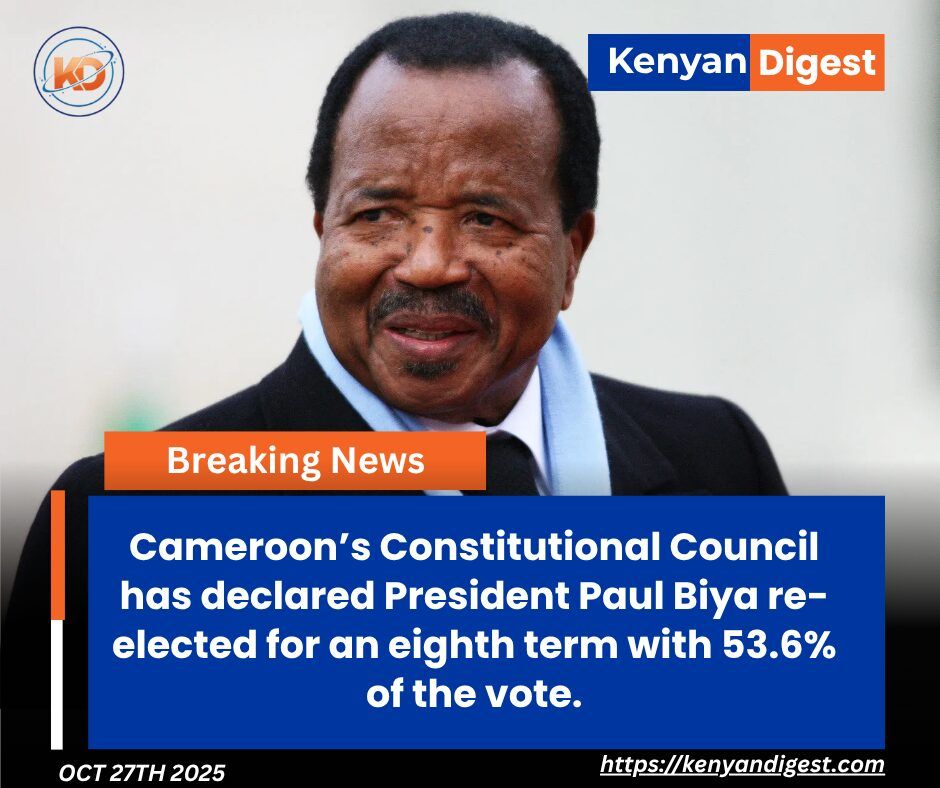
Paul Biya’s Re-Election: What Cameroon’s Political Longevity Reveals About Leadership and Governance in Africa

From Power to Prison: The Fall of France’s Former President Nicolas Sarkozy