Jobs
English Grammar Notes – Download English Grammar Lessons Free PDF

[ad_1]
Write the following phrases to show possession.
Example: teachers – pens = teachers’ pens
1. Cooks – aprons 6. Women – sports
2. Men – boots 7. Carpenters – nails
3. Countries – flags 8. Sailors – uniforms
4. Guests – coats 9. Musicians – instruments
5. Athletes – medal 10. Neighbours – pets
Exercise 10
Rewrite the following sentences changing the BOLD words to plural possessive nouns.
Example: The players on the teams practised after school.
The team’s players practised after school.
1. Each day the wealth of the couple increased.
2. There was a team of men and a team of women.
3. The uniforms that the teams were new.
4. Numbers were printed on the shirts of the athletes
5. Scores made by the team-mates were put on the scoreboard.
6. The players enjoyed the cheers of their friends.
7. The whistles of the coaches stopped the game.
8. The eyes of the children were full of tears of joy.
9. The soothing voices of their mothers calmed them.
10. However, the houses belonging to their neighbours were destroyed.
Answers on Nouns
Exercise 1
1. students, party Answers on Nouns
2. boys, songs
3. Excitement, air
4. Joyce Chepkemoi, prize
5. Otieno, house, street
Exercise 2
1. candle – thing 5. guitar – thing
2. wrestler – person 6. China – place
3. joy – idea 7. hatred – idea
4. Menengai Crater – place 8. Masanduku arap Simiti – person
Exercise 3
1. musicians, drums, trumpets
2. family, village
3. Petronilla, trip
4. festival, Kenyatta University
5. people, costumes, streets
6. Boys, Scouts, sniforms, parade
7. holiday, excitement
8. Taxi, family, airport
9. Maryanne, castle, sand
10. mother, water
Exercise 4
Proper nouns Common nouns
July book
England face
Kendu Bay crocodiles
John Hopkins student
Johannesburg life
America business
East Africa day
calendar
Exercise 5
1. Proper – Lucky Dube
Common – singer
2. Proper – London, Paris
Common – dancer
3. Proper – Mediterranean sea
Common – flight
4. Proper – Second World War
Common – nurse
5. Common – goal, students, world
6. Proper – Europe
Common – accident
7. Proper – Bill Gates, Microsoft
8. Common – pilot, woman, ocean
9. Common – kettle, water
10. Proper – Professor Wangari Maathai, Nobel Peace Prize
Exercise 6
1. tooth – teeth 9. cliffs 17. moose 25. bosses
2. wives 10. deer 18. children 26. foxes
3. giraffes 11. cliff 19. echoes 27. bunches
4. heroes 12. autos 20. babies 28. ferries
5. radios 13. studios 21. skies 29. flashes
6. potatoes 14. men 22. beaches 30. ships
7. beliefs 15. roofs 23. eyes
8. thieves 16. rodeos 24. volcanoes/volcanos
Exercise 7
1. knives 6. children
2. potatoes 7. mice
3. geese 8. roofs
4. shelves 9. stories
5. tomatoes 10. activities
Exercise 8
1. the lion’s tail
2. Cliff’s dog
3. my mother’s hat
4. Evan’s book
5. the child’s pet
6. the doll’s name
7. Lucy’s mobile phone
8. Kimani’s shoes
9. the fox’s teeth
10. my friend’s rabbit
Exercise 9
1. cook’s aprons 6. women’s sports
2. men’s boots 7. carpenter’s nails
3. countries’ flags 8. sailors’ uniforms
4. guests’ coats 9. musicians’ instruments
5. athlete’s medals 10. neighbours’ pets
Exercise 10
1. The couple’s wealth
2. a men’s team, a women’s team
3. The teams’ uniforms
4. the athletes’ shirts
5. The team-mates’ scores
6. their friends’ cheers
7. The coaches’ whistles
8. The children’s eyes
9. Their mothers’ soothing voices
10. their neighbours’ house
PRONOUNS
A pronoun is a part of speech that takes the place of a noun. They include such words as I, we, he, she, thy, me and us.
Pronouns enable you to avoid repeating the same names (nouns), when writing or speaking, which would otherwise make you sound very awkward and wordy.
By using pronouns effectively, you can make your writing and speaking flow smoothly.
Pronouns can be classified into 6 types.
These are personal, indefinite, demonstrative, interrogative, reflexive and intensive pronouns.
2.1 Personal pronouns
A personal pronoun is a word that is used in place of a noun or another pronoun.
They are used to refer to nouns that name persons or things.
Example:
Awkward Kamau put on Kamau’s gum boots. Then Kamau went to the shamba.
Improved Kamau put on his gum boots. Then he went to the shamba.
In the above example, the personal pronoun his helps the writer avoid repeating the same noun.
The pronoun he acts as a bridge to connect the two sentences.
Personal pronouns are further classified in terms of person and gender.
Person
In terms of person, personal pronouns can be divided into three classes.
(i) First person – I, my, me, we, our and us.
These ones refer to the person(s) speaking.
Example: I always ride my bike to school.
(ii) Second person – you, your, yours
These refer to the person(s) spoken to.
Example: I will call you tomorrow.
(iii) Third person – he, his, him, she, hers, her, it, its, they, their, them.
These ones refer to another person(s) or thing(s) that is being spoken of.
The personal pronoun it usually replaces a noun that stands for a thing or an animal. It is never used in place of a person.
Gender
Personal pronouns can also be classified by gender. Gender can either be masculine (referring to male people), feminine (referring to female people) or neuter (referring to animals or things).
Examples:
Joseph cleaned his car. (His is the third person, masculine gender).
Isabel said the dress was hers (Hers is the third person, feminine gender).
The dog wagged its tail. (Its is the third person, neuter gender).
Forms of Personal Pronouns
In English, personal pronouns have three forms: the subject form, the object form and the possessive form.
Examples:
She is a painter (subject form)
He praised her. (Object form)
It is her best painting. (Possessive form)
Subject Pronouns
A subject pronoun takes the place of a noun as the subject of a sentence.
These pronouns are:
(i) Singular forms – I, you, he, she, it
(ii) Plural forms – we, you, they
Examples:
Noun Subject Pronoun
The housegirl takes care of the baby She takes care of the baby
The dog guards the house It guards the house
Mark and Francis love swimming They love swimming
Subject pronouns also appear after forms of the linking verbs be.
Examples:
The watchman today is he.
The composers were they.
Exercise 1
Underline the subject pronouns in the following sentences.
Example: She ate a water melon
1. They ate fish and chips.
2. We like Italian food.
3. It is delicious.
4. The biggest eater was he.
5. You helped in the cooking.
6. The cooks were Tom and I.
Exercise 2
Replace the underlined words with subject pronouns.
Example: Pio and Gama are friends – They
1. The glasses were under the table.
2. Emma fed the chicken.
3. The pears were juicy.
4. Uncle Ben and Lillian visited the orphans.
5. The new waitress is Jane.
6. The fastest runners were Tecla and Kirui.
7. Lisa went to the hall.
8. The chicken was slaughtered.
9. Lucky Dube and Brenda Fasie were South African Singers.
10. Samuel Wanjiru has won many athletics medals.
Object pronouns
Object pronouns can replace nouns used after action verbs.
These pronouns are:
(i) Singular – me, you, him, her, it
(ii) Plural – us, you them
Examples:
The driver drove him. (direct object)
The parents thanked us. (direct object)
The reporters asked him many questions. (indirect object)
In the above examples, the personal pronouns are the direct or indirect objects of the verbs before them.
Object pronouns can also replace nouns after prepositions such as to, for, with, in, at or by. That is, they can be objects of prepositions.
Examples:
Gladys waved to them. (object of a preposition)
The delivery is for me.
Ben went with them to the theatre.
Exercise 3
Choose the correct pronoun in the brackets in the following sentences.
Example: Irungu photographed (us, we). = us
1. Lisa asked (he, him) for a picture.
2. Adam sketched Lisa and (I, me).
3. He gave a photo to (us, we).
4. Ann and (she, her) saw Dave and Bob.
5. Adam drew Lisa and (they, them).
6. Mark helped (I, me) with the packing.
7. Loise praised (him, he) for his good work.
8. Everyone spotted (they, them) easily.
9. That night Mike played the guitar for (us, we).
10. (We, Us) drove with (they, them) to the mountains.
A possessive pronoun shows ownership.
Example: My pen is black.
There are two kinds of possessive pronouns:
(i) Those used as adjectives to modify nouns.
These possessive pronouns are:
Singular: My, your, his, her, its
Plural: Our, your, their
Examples: My shirt is yellow.
Your food is on the table.
His bag is green.
This is her dress.
Its fur is soft.
These are our parents.
Pay your bills.
They removed their bats.
The above possessive pronouns always appear before nouns to modify them.
Hence, they are called modifiers.
(ii) Those that stand alone and replace nouns in sentences.
These possessive nouns are:
Singular: mine yours his, hers, its
Plural: ours yours, their
Examples: The yellow shirt is mine.
The food on the table is yours.
The green bag is his.
This dress is hers.
Its is the soft fur.
These crops are ours.
These bills are yours.
Those hats are theirs.
Exercise 4
Complete the following sentences by choosing the correct possessive pronoun from the brackets.
Example: The lazy girl completed (her, hers) home work.
= her.
1. (My, mine) journey to Mombasa was enjoyable.
2. Florence said (her, hers) was the best.
3. Are the pictures of Fort Jesus (your, yours)?
4. (Her, Hers) were taken at Jomo Kenyatta Beach.
5. Tomorrow we will make frames for (our, ours) pictures.
6. (My, mine) class is planning a trip to Mt.
Kenya.
7. (Our, ours) trip will be taken on video.
8. Micere is excited that the idea was (her, hers).
9. Koki and Toti cannot hide (their, theirs) excitement.
10. (My, mine) dream is to climb to the highest peak of the mountain.
Points to Note
1. The pronoun I is used as a subject or after forms of the linking verb be.
Examples:
Subject: I travel by bus
After the linking verb be: Yesterday, the prefects on duty were Victor and I
2. The pronoun me is used object after action verbs or words (prepositions) such as to, for, with, in, or at.
Examples:
Object: Rose met me at the gate.
After prepositions: Rose waited for me at the gate.
You are coming with me.
3. When using compound subjects and objects (i.
e.
subjects and objects comprising of a pronoun and a noun or another pronoun), always name yourself last.
Examples:
Diana and I visited our grandmother yesterday.
Who appointed Chege and me?
Rose waited for her and me at the gate.
Contractions With Pronouns
A contraction is a shortened form of two words.
One or more letters are omitted and an apostrophe (’) is used in place of the letters left out.
A contraction is formed by combining pronouns and the verbs am, is, are, will, would, have, has, and had.
Pronoun + verb Contraction Pronoun + verb Contraction
I am I’m I have I’ve
He is he’s he has he’s
It is it’s it has it’s
You are you’re you have you’ve
They are they’re they have they’ve
I will I’ll I had I’d
You will you’ll you had you’d
We would we’d we had we’d
Note:
(1) Some contractions look the same but are formed from different words.
Examples: he is, he has = he’s
we had, we would = we’d
(2) Some possessive pronouns sound like contractions.
Because the words sound alike, they are sometimes confused.
Examples:
Possessive pronouns Contractions
its it’s
your you’re
their they’re
whose who’s
Incorrect: The team celebrated it’s victory.
Correct: The team celebrated its victory.
Incorrect: Your late for the preps.
Correct: You’re late for the preps.
Incorrect: Whose the fastest runner in the world?
Correct: Who’s the fastest runner in the world?
Rules of using possessive pronouns and contractions correctly
1. If the word you want to use stands for two words, it is a contraction and needs an apostrophe.
2. Never use an apostrophe in a possessive pronoun.
Exercise 5
Write the contractions for the following word pairs.
Example: It has = it’s
1. You will 3. He had 5. You have
2. We would 4. I am 6. they will
Exercise 6
What pronoun and verb make up each of the following contractions?
Example: It’s = it is, it has
1. I’ll 3. you’d
5. they’re
2. we’re 4. he’s
6. she’d
Exercise 7
Choose the correct word given in brackets in the following sentences.
1. The Kenyan government has worked hard to improve (its, it’s) educational system.
2. (Whose, Who’s) going to decide where the guests will sleep?
3. (Their, they’re) learning French their school.
4. Only students (whose, who’s) scores are excellent will join national schools.
5. (Its, It’s) been estimated that about 8 million Kenyans are living with HIV AIDS.
Indefinite Pronouns
An indefinite pronoun is a pronoun that does not refer to a specific person or thing.
In English, there are singular indefinite pronouns, plural indefinite and both singular and plural indefinite pronouns.
Singular Indefinite Pronouns
another anything everybody neither one
anybody each everyone nobody somebody
anymore either everything no one someone.
An indefinite pronoun must agree with its verbs and in number with its possessive pronoun.
The above indefinite pronouns are used with singular verbs.
They are also used with singular possessive pronouns.
Examples:
Agreement with verbs
Correct: Everyone has heard of Lake Turkana.
InCorrect:Everyone have heard of Lake Turkana.
Correct: Nobody knows what happened to Samuel Wanjiru.
InCorrect:Nobody know what happened to Samuel Wanjiru.
Correct: Everything about the old man remains a mystery.
InCorrect:Everything about the old man remain a mystery.
Agreement in number with possessive pronouns
Correct: Neither believed his/her eyes.
InCorrect:Neither believed their eyes.
Correct: Each strained his/her neck to see.
InCorrect:Each strained their neck to see.
Plural indefinite pronouns
both many few several
These indefinite pronouns use plural verbs and possessive pronouns.
Examples:
Plural verbs
Correct: Few know about Lake Olbolsat.
InCorrect:Few knows about Lake Obolsat.
Correct: Both stand by what they believe.
InCorrect:Both stands by what they believe.
Plural possessive pronouns
Correct: Several reported their findings.
InCorrect:Several reported his/her findings.
Both singular and plural indefinite pronouns
all some any none
These indefinite pronouns may be singular or plural, depending on their meaning in the sentence.
Examples:
All of my story is true – singular
All of the guests are here – plural
None of the lake is foggy – singular
None of the photos are spoiled – plural.
Exercise 8
Underline the indefinite pronouns in the following sentences and then write the correct form of the verb or possessive pronoun in the brackets.
1. All the photographs of the killer (is, are) unclear.
2. (Has, Have) anybody seen my camera?
3. Many (believes, believe) a monster lives in the lake.
4. Each of the photographs (make, makes) people want more.
5. All of the evidence (indicates, indicate) that he was killed by his wife.
6. Everyone has taken (his, their) payment.
7. Several eyewitnesses volunteered to give (his, their) accounts.
8. Anyone can lose (her, their) eyesight.
9. Another reported (his, their) case to the police.
10. Somebody left (her, their) handbag in the lecture hall.
Demonstrative Pronouns
A demonstrative pronoun is used to single or point out one or more persons or things referred to in the sentence.
These pronouns are this, that, these, and those.
This and these point to persons or things that are near.
Examples:
This is a gazelle.
These are the students of Kianjege West Secondary School.
That and those point to persons or things that are farther away.
Examples:
That is the city square.
Those are the lodging rooms.
This and that are used with singular nouns.
These and those are used with plural nouns.
Exercise 9
Pick the correct demonstrate pronouns from the choices given in the brackets in the following sentences.
1. (This, That) is the canteen we are entering now.
2. (This, That) is the dispensary across the street
3. (These, Those) are beautiful flowers on the counter over there.
4. Are (those, these) chocolate bars on the far counter?
5. I think (these, those) are called vuvuzelas.
Interrogative Pronouns
An interrogative pronoun is used to ask a question.
These pronouns are who, whose, whom, which and what.
Examples:
Who is the mayor of this town?
Whose is the red car?
Which is her blouse?
What did she ask you?
Whom should I trust with my secret?
USING WHO, WHOM, AND WHOSE
Who, whom, and whose are often used to ask questions.
Hence, they are interrogative pronouns.
WHO is the subject form.
It is used as the subject of a verb.
Examples:
Who taught you how to play the guitar? (Who is the subject of the verb taught.
)
WHOM is the object form.
It is used as the direct object of a verb or as the object of a preposition.
Examples:
Whom did you meet? (Whom is the object of the verb did meet).
For whom is this trophy? (whom is the object of the preposition for).
WHOSE is the possessive form.
It can be used :
(i) To modify a noun
Example:
Whose is umbrella is this? (whose modifies the noun umbrella)
(ii) Alone as the subject or object of a verb
Examples:
Whose are those water melons? (whose is the subject of the verb are)
Exercise 10
Pick the correct interrogative pronouns from the brackets in the following sentences.
1. (Who, Whom) owns that shop?
2. (Who, Whom) can we ask the way?
3. (Which, What) did they ask you?
4. (Which, What) are the objects on the table called?
5. To (who, whom) does the boutique belong?
Exercise 11
Complete the following sentences with who, whom, or whose.
1. ________________ knows the origin of the Luos?
2. ________________ did you ask about it?
3. To _______________ did you give the letter?
4. _________________ is the most attractive painting?
5. _________________ is likely to receive the Chaguo la Teeniez award?
6. For ______________ did you buy this doll?
7. _________________ skill in dancing is the best?
8. _________________ is the officer-in-charge here?
9. _________________ are you looking at?
10. _________________ are those healthy Merino sheep?
Reflexive and Intensive Pronouns
Reflexive and intensive pronouns end in -self or -selves.
These are myself, yourself, herself, himself, itself, ourselves, and themselves.
There is, however, one difference between reflexive and Intensive pronouns.
A reflexive pronoun refers to an action performed by the subject of the sentence.
The meaning of the sentence is incomplete without the reflexive pronoun.
Examples:
Monicah bought herself a new dress.
(The meaning of the sentence is incomplete without the reflexive pronoun because we do not know for whom Monicah bought the dress).
An Intensive pronoun is used to emphasise a noun or a pronoun.
It does not add information to a sentence, and it can be removed without changing the meaning of the sentence.
I myself pulled the boy out of the river.
(If you remove myself, the meaning of the sentence does not change)
Exercise 12
Identify the Reflexive and Intensive pronouns in the following sentences, labelling them accordingly.
1. I myself have never tried mountain climbing.
2. He himself was taking the cows to graze in the forest.
3. My sister Annastasia mends her clothes herself.
4. She often challenges herself by doing strenuous activities.
5. You may ask yourself about the sanity of beer drinking competition.
Special Pronouns Problems
1. Double subjects
We all know that every sentence must have a subject.
Sometimes we incorrectly use a double subject – a noun and a pronoun – to name the same person, place, or thing.
Incorrect Correct
Jane she is my cousin. Jane is my cousin.
She is my cousin.
Her scarf it is pretty. Her scarf is pretty.
It is pretty.
Jane and she should not be used as subjects together.
The subject her scarf should not be used together with it.
Use only a noun or a pronoun to name a subject.
2. Pronouns and their Antecedents
The antecedent of a pronoun is a noun or another pronoun for which the pronoun stands.
A personal pronoun, you will remember, is used in place or a noun.
The noun is the word to which the pronouns refer and it is therefore its antecedent.
The noun usually comes first, either in the same sentence or in the sentence before it.
Examples:
We met Mureithi.
He is the medical doctor.
(He stands for Mureithi.
Mureithi is the antecedent).
The students had come to school with their mobile phones.
(Their stands for students.
Students is the antecedent).
Pronouns may be the antecedents of other pronouns.
Examples:
Does everybody have his booklet?
(everybody, which is a singular indefinite pronoun, is the antecedent of his).
All of the students have brought theirs.
(All, which is a plural indefinite pronoun, is the antecedent of theirs).
Now, a pronoun must agree with its antecedent in number.
Agree here means that the pronoun must be the same in number as its antecedent.
The word number means singular or plural.
If the pronoun is singular, the word that it stands for must be singular, and it must be plural if the word it stands for is plural.
Examples:
Correct: The scientists tested their new discovery
(Scientists is plural; their is plural.
)
InCorrect: The scientists tested his new discovery.
Correct: Mr.
Kiama turned on his TV.
(Mr Kiama is singular; his is singular)
Correct: Nobody left her workstation
(Nobody is singular, her is singular)
NB: When the antecedent refers to both males and females, it is best to use the phrase his or her.
3. Use of we and us with nouns.
Phrases such as we students and us girls are often incorrectly used.
To tell which pronoun to use, drop the noun and say the sentence without it.
Problem: (We, Us) boys study hard.
Solution: We study hard = We boys study hard.
Problem: The DC praised (us, we) students.
Solution: The DC praised us = The DC praised us students
4. Using the pronoun Them
The word them is always a pronoun.
It is always used as the object of a verb or a preposition, never as a subject.
Examples:
Correct: The president greeted them (direct object of the verb greeted)
Correct: She gave them a Sandwich (Indirect object of the verb gave)
Correct: The information was useful to them (object of the preposition to)
InCorrect:Them they arrived late.
5. Using Those
Although we previously said that those is used as a demonstrative pronouns, it is sometimes used as an adjective i.e. a word that modifies a noun or a pronoun.
If a noun appears immediately after it, those is now an adjective, not a pronoun.
Examples:
Those are the new desks that were bought.
(Those is a pronoun, the subject of the verb are).
Those desks are attractive.
(Those is an adjective modifying the noun desks).
Exercise 13
Each of the following sentences has a double subject.
Write each correctly.
1. Papa Shirandula he is a good actor.
2. Many people they find him funny.
3. The show it was on television for many years.
4. Their daughter she is also in that show.
5. The shoes they are beautiful.
6. People they like our hotel.
7. My brother he drives a matatu.
8. Our hotel it is open seven days a week.
9. The TV it is very clear today.
10. My brother and sister they work in Nairobi.
Exercise 1
Pick the correct pronoun in the brackets in the following sentences.
1. (We, Us) students started a school magazine last month.
2. Many careers are unpromising.
(Them, Those) are the ones to avoid.
3. One of (them, those) motivational speakers was especially interesting.
4. A financial analyst told (we, us) students about his work.
5. Finding jobs was important to (we, us) graduates.
Answers on Pronouns
Exercise 1
1. They ate fish and chips.
2. We like Italian food.
3. It is delicious
4. The biggest eater was he.
5. You helped in the cooking.
6. The cooks were Tom and I.
Exercise 2
1. They were under the table.
2. She fed the chicken.
3. They were juicy.
4. They visited the orphans.
5. The new waitress is she.
6. The fastest runners were Tecla and she.
7. She went to the hall.
8. It was slaughtered.
9. Lucky Dube and she were South African singers.
10. He has won many athletics medals.
Exercise 3
1. Lisa asked him for a picture.
2. Adam sketched Lisa and me.
3. He gave a photo to us.
4. Ann and she saw Dave and Bob.
5. Adam drew Lisa and them.
6. Mark helped me with the packing.
7. Loise praised him for his good work.
8. Everyone spotted them easily.
9. That night Mike played the guitar for us.
10. We drove with them to the mountains.
Exercise 4
1. My journey to Mombasa was enjoyable.
2. Florence said hers was the best.
3. Are the pictures of Fort Jesus yours?
4. Hers are about Jomo Kenyatta Beach.
5. Tomorrow we will make frames for our pictures.
6. My class is planning a trip to Mt.
Kenya.
7. Our trip will be taken on video.
8. Micere is excited that the idea was hers.
9. Koki and Toti cannot hide their excitement.
10. My dream is to climb to the highest peak of the mountain.
Exercise 5
1. You will = You’ll
2. we would = we’d
3. he had = he’d
4. I am = I’m
5. you have = you’ve
6. they will = they’ll
Exercise 6
1. I’ll = I will
2. we’re = we are
3. you’d = you would, you had
4. he’s = he is, he has
5. they’re = they are
6. she’d = she would, she had
Exercise 7
1. its 3. They’re
5 it’s
2. who’s 4. whose
Exercise 8
1. All – are 6. Everyone – his
2. Anybody – has 7. Several – their
3. Many – believe 8. Anyone – her
4. Each – makes 9. Another – his
5. All – indicates 10. Somebody – her
Exercise 9
1. This 3. Those 5. these
2. That 4. those
Exercise 10
1. Who 3. What
5. whom
2. Whom 4. What
Exercise 11
1. Who 6. whom
2. Whom 7. Whose
3. whom 8. Who
4. Whose 9. Who
5. Who 10. Whose
Exercise 12
1. myself – intensive
2. himself – intensive
3. herself – reflexive
4. herself – reflexive
5. yourself – reflexive
Exercise 13
1. Papa Shirandula is a good actor.
2. Many people find him funny.
3. The show was on television for many years.
4. Their daughter is also in that show.
5. The shoes are beautiful.
6. People like our hotel.
7. My brother drives a matatu.
8. Our hotel is open seven days a week.
9. The TV is very clear today.
10. My brother and sister work in Nairobi.
Exercise 1
1. We 3. those 5. us
2. Those 4. us
Verbs
A verb is a word that:
(i) expresses an action
(ii) expresses the state that something exists, or
(iii) links the subject with a word that describes or renames it.
Hence, there are two kinds of verbs.
These are action verbs and linking verbs.
Action Verbs
Action verbs express actions.
They show what the subject does or did.
Most verbs are action verbs.
Examples:
Cats drink milk.
The ball flew over the goal post.
The farmer tills the land.
Robert ran to the house.
The action may be one that you can see.
Example:
They crowned their new King.
The action may be one that you cannot see.
Example:
She wanted recognition.
Whether the action can be seen or not, an action verb says that something is happening, has happened, or will happen.
Linking Verbs
A linking verb links the subject of a sentence with a word or words that :
(i) express(es) the subject’s state of being
Example:
She is here.
(expresses state of being)
She seems ready.
(state of being)
(ii) describe(es) or rename(es) the subject.
Examples:
Anna is a nurse (a nurse, describes Anna)
Joyce is cheerful (cheerful describes Joyce)
The road is bumpy.
A linking verb does not tell about an action.
Common linking verbs
am look grow
are feel remain
is taste become
was smell sound
were seem
will be appear
NB: Some verbs can be either linking verbs or action verbs.
Examples:
The crowd looked at the mangled car – Action
The driver of the car looked shocked – LINKING
The chef smelled the food – Action
The food smelled wonderful – Linking
Exercise 1
Identify the verb in each of the following sentences.
Then label each verb Action or Linking.
1. Queen Elizabeth of England seems an interesting historical figure.
2. We watched the Olympic games on television.
3. The crowd cheered loudly.
4. She seems calm.
5. PLO Lumumba is a quick thinker.
6. The hunter aimed the arrow at the antelope.
7. The referee blew the whistle to start off the game.
8. She was very tired after the journey.
9. She is careful when crossing the road.
10. The country seems prosperous.
Verb Phrases
In some sentences, the verb is more than one word.
It is in form of a phrase, which is called a verb phrase.
A verb phrase consists of a main verb and one or more helping verbs.
The main verb shows the action in the sentence.
The helping verb works with the main verb.
Helping verbs do not show action.
Examples:
Mark Francis has passed the examinations
H.V. M.V.
He will be admitted to a national school.
H.V.
H.V. M.V.
His parents are happy with him.
H.V. M.V.
Common helping verbs
am will can would
is shall could must
are have may
was has should
were had might
Some verbs, such as do, have and be, can either be used as main verbs or as helping verbs.
Examples:
As main verbs As helping verbs
I will do the job I do like the job.
Who has a pen? He has lost his pen.
They are my friends They are coming today.
Sometimes helping verbs and main verbs are separated by words that are not verbs.
Examples:
I do not ride bicycle any more.
Can we ever be friends again?
We should definitely apologise for the mistakes.
Exercise 2
Indicate H.V. under the Helping verb and M.V. under the Main verb in the following sentences.
1. The school choir is singing a new song.
2. The football season has finally begun.
3. This car just can travel very fast.
4. He had waited for this chance for years.
5. My parents will be visiting us soon.
6. Our friends have come for a visit.
7. You must buy your ticket for the game.
8. Sarah has chosen Kenyatta University for her degree course.
9. She is hitting her child with a rubber strap.
10. I will go for the game next week.
Verbs Tenses
The time of an action or the state of being is expressed by different forms of the verb.
These forms are called the tenses of the verb.
There are three main forms of a verb: the present, the past, or the future.
The Present Tense
A verb which is in present tense indicates what the subject of the sentence is doing right now.
Example:
The teacher sees the students.
The verb sees tells that the teacher is seeing the students now.
To show the present tense, an -s or -es is added to most verbs if the subject is singular.
If the subject is plural, or I or You, the -s, or -es is not added.
Example:
The bird hatches in the nest.
The stream flows down the hill.
The boys rush for their breakfast.
We talk a lot.
Rules for forming the Present Tense with Singular Subjects
1. Most verbs: add –s get – gets
play – plays
eat – eats
2. Verbs ending in s, ch, sh, x, and z: add-es pass – passes, mix – mixes
punch-punches,
buzz – buzzes
push – pushes
3. Verbs ending with a consonant and y:
change the y to i and add -es try – tries
empty – empties
Exercise 3
Write the correct present form of each verb in the brackets in the following sentences.
1. She carefully ________________ the map (study)
2. A fish _______________ in the water near me.
(splash)
3. She _______________ her hands.
(wash)
4. He ______________ to the classroom.
(hurry)
5. Bryan and I ____________ the assignment.
(discuss)
The Past Tense
A verb which is in past tense shows what has already happened.
Example:
Tito liked his grandmother’s story.
The verb liked tells that the action in the sentence happened before now.
Rules for forming the Past Tense
1. Most verbs: Add -ed play – played
talk – talked
climb – climbed
2. Verbs ending with e: Add -d praise – praised
hope – hoped
wipe – wiped
3. Verbs ending with a consonant and -y: bury – buried
the y to i and add -ed carry – carried
study – studied
4. Verbs ending with a single vowel and stop – stopped
a consonant: Double the final consonant man – manned
and add-ed trip – tripped
Exercise 4
Write the past tense forms of each of the verbs in brackets in the following sentences.
1. John _____________ his house burn into ashes.(watch)
2. The baby _____________ loudly. (cry)
3. The teacher ______________ at the naughty student. (yell)
4. The chef ______________ a delicious cake. (bake)
5. We ______________ for a present for our grandmother. (shop)
The Future Tense
A verb which is in future tense tells what is going to happen.
Examples:
Evans will take his car to the garage.
She will probably come with us.
The verbs will take and will come tell us what is going to happen.
Hence, they are in future tense.
To form the future tense of a verb, use the helping verb will or shall with the main verb.
Exercise 5
Write the future tense forms of the verbs in the following sentences.
1. We write in exercise books.
2. The train stopped at the station.
3. He decides what he wants to do.
4. They practise in the football field.
5. Rats multiply very fast.
More Tenses
The above three forms of tenses can further be divided into:
1. The simple tenses – Present simple tense
– Past simple tense
– Future simple tense
2. The perfect tenses – Present perfect tense
– Present perfect progressive
– Past perfect tense
– Future perfect
– Future perfect progressive
3. The progressive tenses – Present progressive tense
– Past progressive tense
– Progressive tense
– Future perfect progressive tense.
The simple Tenses
The most common tenses of the verb are the simple tenses.
You use them most often in your speaking and writing.
1. Present simple tense.
Look at the following sentences.
(a) I know Kisumu
(b) He goes to school everyday.
(c) The sun rises from the east.
All the above sentences contain a verb in the present simple tense.
This tense is used for different purposes.
(i) To state a personal fact
Example: I know Kisumu.
(ii) To point out a regular habit.
Example: He goes to school everyday.
(iii) To state known a scientific fact
Example: The sun rises from the east.
Exercise 6
Complete the following sentences putting the verbs in brackets in the present simple tense.
1. They _________ their new principal.(like)
2. Every morning, she ______________ her teeth.(brush)
3. The earth ______________ on its own axis.(rotate)
4. Twice a year, he _______________ his family.(visit)
5. Air ____________ when heated.(rise)
2. Past Simple Tense
The past simple tense is used when an action has been completed .
Examples:
We cleaned our classrooms yesterday.
He drove the car this morning.
She planned the whole incident.
Exercise 7
Write down the past simple tense of the following words and then use each of them in sentences of your own.
start breathe
add roam
trap obey
annoy worry
pity fit
3. Future Simple Tense
The future simple tense places the action or condition in the future.
It is formed by using the word shall or will before the present form of the main verb.
Examples:
We shall need help with her load.
She will eat the bananas alone
The dancers will entertain them.
Exercise 8
Use the following words in future simple tense in sentences of your own.
see develop
go begin
exist consume
introduce hunt
bring become
The Perfect Tenses
The perfect tenses are used to show that an action was completed or that a condition existed before a given time.
The perfect tenses are formed using has, have, or had before the past participles i.e.
verb forms ending in -ed.
Examples:
1. Present Perfect Tense:
Ceasar has just finished his homework.
Kamau and Njoroge have now agreed to meet.
2. Present Perfect Continuous Tense
Kibet has been working in his shamba for two hours.
We have been swimming in this pool for ten minutes.
3. Past Perfect Tense
We had completed the work by the time the supervisor came.
Nobody knew that she had already remarried.
4. Past Perfect Continuous Tense
I had been trying to contact him for two hours before he finally appeared.
Mrs.
Masumbuko had been feeling unwell the whole week before she decided to visit a doctor.
5. Future Perfect Tense
Agege will have sold his goats by two p.m.
By next term, twenty students will have dropped from this school.
6. Future Perfect Continuous
The players will have been playing for twenty minutes by the time the President arrives.
By the end of this term, she will have been living with her aunt for five years.
Exercise 9
Rewrite the following sentences changing the verb into present perfect, present perfect progressive, past perfect, past perfect progressive, future perfect and future perfect progressive tenses.
Make any necessary changes to make the sentences meaningful.
John comes here every year.
The Progressive Verb Forms
The progressive form of the verb shows continuing action.
Examples:
I am singing
She was dancing.
The progressive form is formed using various forms of the verb be plus the present participle i.e a verb form that ends in -ing.
Examples:
1. Present Progressive Tense
I am reading a book about Red Indians.
Her mother is preparing dinner.
2. Present Perfect Progressive
He has been cleaning his car since morning.
They have been exercising for a week now.
3. Past Progressive Tense
She was cooking supper when I arrived.
They were fighting fiercely when the police arrived.
4. Past Perfect Progressive Tense
Sonko had been wearing an earing for years before he removed it.
Onyancha had been killing children before he was finally discovered.
5. Future Progressive
He will be tilling the land next week.
Joyce and Joan will be washing clothes all morning.
6. Future Perfect Progressive
The children will have been sleeping for two hours by the time their parents arrive.
John will have grown a beard by the time he is twelve.
Exercise 10
Rewrite the following sentence changing the verb into present progressive, present perfect progressive, past progressive, past perfect progressive, future progressive and future perfect progressive tenses.
Make any necessary changes to make the sentences meaningful.
Jane plays the guitar well.
Subject – Verb Agreement
Present tense
A verb and its subject must agree in number.
To agree means that if the subject is singular, the verb must be in singular form.
If the subject is plural, the verb form must be plural.
Examples:
The baby cries every morning – Singular
The babies cry every morning – Plural
Rules for subject-verb Agreement
1. Singular subject The man drives a bus.
Add -s or -es to the verb She teaches in a primary school.
He studies his map.
2. Plural subject: The men drive buses.
Do not add -s or -es They teach in primary schools.
to the verb We study our maps.
3. For I or You I hate books.
Do not add -s or -es to the verb You like dogs.
I admire actors.
When a sentence has a compound subject i.e.two subjects joined by and, the plural form of the verb is used.
Examples:
John and James work at Naivas Supermarket.
The teachers and the students respect one another a lot.
Subject-verb Agreement with be and have
The verbs be and have change their forms in special ways in order to agree with their subjects.
Various ways in which be and have change in order to agree with their subjects.
Subject Be Have
1.
Singular subjects:
I
You
He, she, it
Singular Noun
am, was
are, were
is, was
is, was
have, had
have, had
has, had
has, had
2. Plural subjects:
We
You
They
Plural Noun
are, were
are, were
are, were
are, were
have, had
have, had
have, had
have, had
Exercise 11
Put appropriate Present tense verbs in the blank spaces in the following sentences.
Ensure that the subject agrees with the verb and that the sentence makes sense.
1. The dogs _______________ their owners.
2. She ______________ at the door.
3. They ______________ the road at the Zebra-crossing.
4. Many blind people ___________________ dogs as guides.
5. We ________________ dogs every day.
6. Mark always _______________ his house.
7. I often _______________ with June.
8. Mr. Mwangi __________________ his aunt in Mombasa.
9. He and Jane ________________ next month.
10. The directors ______________ the company.
Regular and Irregular Verbs
We have learned in previous chapter how to form the past tense and how to use helping verbs to show that something has already happened.
We saw that for most verbs, we form the past tense and participles by adding -d or -ed to the verb.
Verbs that follow this rule are called Regular Verbs.
Examples:
The framer planted his crops last month.
– past tense
The crops have been planted recently.
– past participle.
For all regular verbs, the past and the past participles are spelled alike.
They are made up by adding -d or -ed to the present form of the verb.
Examples:
Present Past Past Participles
help
rescue
rush
support
play
talk
live
helped
rescued
rushed
supported
played
talked
lied had helped
had rescued
had rushed
had supported
had played
had talked
had lied
The spelling of many regular verbs changes when -d or -ed is added i.
e.
the last consonant is doubled before adding -d or -ed.
For those ending -y, it is dropped and replaced with –i:
Examples:
Present Past Past Participles
hop
drug
permit
knit
cry
carry hopped
drugged
permitted
knitted
cried
carried (had) hopped
(had) drugged
(had) permitted
(had) knitted
(had) cried
(had) carried
Exercise 12
Write the present, past and past participles of the following verbs.
Remember to change the spelling appropriately where necessary.
1. prevent 6. aid
2. donate 7. relieve
3. hurry 8. share
4. worry 9. enrol
5. train 10. save
Irregular Verbs
Some verbs do not form the past by adding -d or -ed.
These verbs are called irregular verbs.
There are only about sixty frequently used irregular verbs.
For many of these, the past and the past participles are spelled the same but some are different.
Examples:
He saw great misery all around him – past
He has seen great misery all round him – past participle
Common irregular Verbs
Verb Past tense Past participles
begin
choose
go
speak
ride
fight
throw
come
sing
steal
swim
make
run
grow
write
ring
drink
lie
do
eat
know began
chose
went
spoke
rode
fought
threw
came
sang
stole
swam
made
ran
grew
wrote
rang
drank
lay
did
ate
knew
( had) begun
(had) chosen
(had) gone
(had) spoken
(had) ridden
(had) fought
(had) thrown
(had) came
(had) sung
(had) stolen
(had) swum
(had) made
(had) run
(had) grown
(had) written
(had) rung
(had) drunk
(had) lain
(had) done
(had) eaten
(had) known
For a few irregular verbs, like hit and cut, the three principal parts are spelled the same.
These ones offer no problems to learners.
Most problems come from irregular verbs with three different forms.
For example, the irregular verbs throw and ring.
Throw threw had thrown
Ring rang had rung
If you are not sure about a verb form, look it up in the dictionary.
Exercise 13
Write the past tense and past participles of the following irregular verbs and then use each of them in sentences of your own.
1. arise 6. fall
2. tear 7. blow
3. wear 8. freeze
4. lay 9. fly
5. see 10. write
ACTIVE AND PASSIVE VERB FORMS
Active Voice
A verb is in active voice when the subject of the sentence performs the action.
Examples:
Our teacher punished us for making noise in class.
Subject action
Players arrived for their first match early in the morning.
Subject action
In the above sentences, the subject is who performed the action.
Hence, the verbs of these sentences are in active voice.
Passive voice
The word passive means “acted upon”.
When the subject of the sentence receives the action or expresses the result of the action, the verb is in passive voice.
Examples:
We were punished by the teacher for making noise.
Subject action
He was helped by a passer-by.
Subject action
In the above sentences the subjects we and he receive the action.
When we do not know who or what did the action, or when we do not want to say who or what did it, we use the passive voice.
The passive form of a verb consists of some form of be plus the past participle.
Examples:
Active Passive
Baabu explored the sea.
The sea was explored by Baabu.
Be + past participle
The captain helped him.
He was helped by the captain.
Be+past participle
Exercise 1
Write the verbs from the following sentences and then label each one Active or Passive.
1. The guest of honour presented prizes to the best students.
2. The cattle were taken home by the herders.
3. The health officer ordered the slaughter house closed.
4. Peace and order has been restored in the area by the youth wingers.
5. The workers cleared the farm.
6. The crop was harvested by the hired workers.
7. The government stressed the importance of unity among tribes.
8. The farmers were urged to redouble their efforts in food production.
9. The KIE is developing support materials for the 8-4-4 system of education.
10. A fishing pond was started by the Wildlife Club in the school.
Transitive and Intransitive Verbs
Some sentences express a complete thought with only a subject and an action verb.
Example:
The sun shines.
Subject Active verb
In other sentences, a direct object must follow the action verb for the sentence to be complete.
A direct object is a noun or a pronoun that receives the action of the verb.
Example:
The goalkeeper caught the ball.
Subject action verb direct object
Transitive verbs
A Transitive verb is an action verb that must take a direct object for the sentence to express a complete thought.
A direct object answers the question what? or whom?
Examples:
The captain steered the ship.
(Steered what? the ship)
The teacher praised the students.
(Praised whom? The students)
Transitive verbs cannot be used alone without direct objects in sentences; they would not have complete meanings.
Exercise 15
What are the action verbs and the direct objects in the following sentences?
1. He carried his bag with him.
2. The two friends discussed the examination paper.
3. We took a trip to Nakuru last month.
4. The water splashed me.
5. He gave interesting facts about whales.
6. We searched the house for rats.
7. They cheered the team noisily.
8. My brother bought a camera.
9. Njoroge admires Papa Shirandula.
10. We viewed the shouting star at midnight.
Intransitive verbs
An Intransitive verb is an action verb that does not require a direct object for the sentence to have complete meaning.
Examples:
The ship sailed.
Subject action verb
The child smiled.
Subject action verb
They do not answer the questions what? or whom? Sometimes they answer the questions how? or how often?
Examples:
The ship sailed smoothly.
(How did it sail? Smoothly)
The child smiled repeatedly.
(How often did the child smile? Repeatedly)
Both transitive and intransitive verbs
Some verbs can be used both transitively and intransitively.
Examples:
We cheered our team noisily.
(Transitive)
We cheered noisily.
(Intransitive)
He broke the window pane.
(Transitive)
The glass broke.
(Intransitive)
NB: Only transitive verbs can be changed from active to passive voice.
Examples:
Active Passive
He kicked the ball The ball was kicked by him
She bought a new dress A new dress was bought by her.
She wailed loudly ??
They danced well ??
Exercise 16
Indicate at the end of each of the following sentences whether the underlined verb is Transitive or Intransitive.
1. Some whales sing songs.
2. We gave our books to the gatekeeper.
3. She cried bitterly.
4. He made a sketch of the giraffe.
5. John danced to the music.
6. The bird flew in the air.
7. They located the lost ship.
8. She pleaded with him mercifully.
9. The children heard the sound from the cave.
10. It rained heavily.
Troublesome Pairs of Verbs
Some pairs of verbs confuse learners of English because their meanings are related but not the same.
Others confuse them because they sound similar, but their meanings are different.
Others are similar in appearance but different in meanings.
The pairs Meaning Present tense Past tense Past participle Examples of its usage
1 Sit
set To be in a seated position
To put or place Sit
set Sat
set Sat
set Sit on that chair.
Set the cage down.
2. Lie
lay To rest in a flat position
To put or place Lie
lay Lay
laid lain
laid The cat lies on the table.
Lay the cloth on the table.
3. rise
raise To move upward
To move something upward or to lift rise
raise rose
raised risen
raised The children rise up early in the morning.
The scout raised the flag.
4. let
leave To allow or permit
To depart or to allow to remain where it is let
leave let
left let
left Let the bird go free.
Leave this house now!
Leave the door closed.
5. Learn
Teach To gain knowledge or skill
To help someone learn or to show how or explain Learn
teach Learned
taught Learned
taught I learned a lot in school.
That teacher taught me in Biology.
6. Can
may To be able
To be allowed I can ride my bike well.
You may go out.
Exercise 17
Pick the correct verb from the ones given in brackets in the following sentences.
1. Studying spiders closely can (learn, teach) us how they get their food.
2. An insect that (lays, lies) motionless on a leaf can become prey to some other animal.
3. The lion will (lay, lie) there waiting for its prey.
4. The monster spider (sits, sets) patiently near its web.
5. Experience has (taught, learned) me not to take things for granted.
6. A bird (raises, rises) its body using its wings.
7. This (raises, rises) another question,
8. Nature has (learned, taught) spiders new tricks.
9. The watchman instantly (raises, rises) the alarm when there is danger.
10. The trappers have (lain, laid) fresh traps for the porcupines.
Answers on Verbs
Exercise 1
1. seems – Linking verb
2. watched – Action verb
3. cheered – Action verb
4. seems – Linking verb
5. is – Linking verb
6. aimed – Action verb
7. blew – Action verb
8. was – Linking verb
9. is – Linking verb
10. seems – Linking verb
Exercise 2
Helping verb Main verb
1. is singing
2. has begun
3. can travel
4. had waited
5. will be visiting
6. have come
7. must buy
8. has chosen
9. is hitting
10 will go
Exercise 3
1. studies
2. splashes
3. washes
4. hurries
5. discuss
Exercise 4
1. watched
2. cried
3. yelled
4. baked
5. shopped
Exercise 5
1. will write
2. will stop
3. will decide
4. shall practice
5. will multiply
Exercise 6
1. like
2. brushes
3. rotates
4. visits
5. rises
Exercise 7
1. started 6. breathed
2. added 7. roamed
3. trapped 8. obeyed
4. annoyed 9. worried
5. pitied 10. fitted
Exercise 8
1. will/shall see 6. will/shall develop
2. will/shall go 7. will/shall begin
3. will/shall exist 8. will/shall/consume
4. will/shall introduce 9. will/shall hunt
5. will/shall bring 10. will/shall become
Exercise 9
1. John has come here every year.- present perfect
2. John has been coming here every year. – present perfect progressive
3. John had come here every year. – past perfect
4. John had been coming here every year.– past perfect progressive
5. John will have come here every year. – future perfect
6. John will have been coming here every year. – future perfect progressive.
Exercise 10
1. Jane is playing the guitar. – present progressive
2. Jane has been playing the guitar. – present perfect progressive
3. Jane was playing the guitar. – past progressive
4. Jane had been playing the guitar. – past perfect progressive
5. Jane will play the guitar. – future progressive
6. Jane will have been playing the guitar. – future perfect progressive
Exercise 11
1. guard 6. cleans
2. stands 7. study
3. cross 8. visits
4. use 9. wed
5. feed 10. run
Exercise 12
Present Past Past participle
1. prevent prevented prevented
2. donate donated donated
3. hurry hurried hurried
4. worry worried worried
5. train trained trained
6. aid aided aided
7. relieve relieved relieved
8. share shared shared
9. enrol enrolled enrolled
10. save saved saved
Exercise 13
Present Past Past participle
1. arise arose arisen
2. tear tore torn
3. wear wore worn
4. lay laid lain
5. see saw seen
6. fall fell fallen
7. blow blew blown
8. freeze froze frozen
9. fly flew flown
10. write wrote written
Exercise
1. presented – active 6. was harvested – passive
2. were taken – positive 7. stressed – active
3. ordered – active 8. were urged – passive
4. restored – passive 9. is developing – active
5. cleared – active 10. was started – passive
Exercise 15
Action verbs direct object
1. carried his bag
2. discussed the examination paper
3. took a trip
4. splashed me
5. gave interesting facts
6. searched the house
7. cheered the team
8. bought a camera
9. admires Papa Shirandula
10. viewed the shooting star
Exercise 16
1. Transitive 6. Intransitive
2. Transitive 7. Transitive
3. Intransitive 8. Intransitive
4. Transitive 9. Transitive
5. Intransitive 10. Intransitive
Exercise 17
1. teach 6. raises
2. lies 7. raises
3. lie 8. taught
4. sits 9. raises
5. taught 10. laid
Adjectives
An adjective is a word that describes or modifies a noun or a pronoun.
To describe or modify means to provide additional information about nouns or pronouns.
To modify further means to change something slightly.
Writers and speakers modify an idea or image by choosing certain describing words, which are called adjectives.
Hence, these adjectives are also called modifiers.
Adjectives are like word cameras.
They are words that describe colours, sizes and shapes.
Adjectives help you capture how the world around you looks and feels.
Adjectives tell:
1. what kind?
Examples:
The powerful gorilla knocked down the hunter.
The old man walked slowly.
2. how many?
Examples:
Three zebras were resting.
He has few friends.
3. which one(s)?
Examples:
This painting is attractive.
These farmers are clearing the field.
There are 4 main kinds of adjectives, namely
1. Descriptive adjectives
2. Definite and indefinite adjectives
3. Demonstrative adjectives
4. Interrogative adjectives
5. Articles and possessive adjectives
Descriptive adjectives
Descriptive adjectives tell us the size, shape, age, colour, weight, height, make, nature and origin of the nouns they are describing.
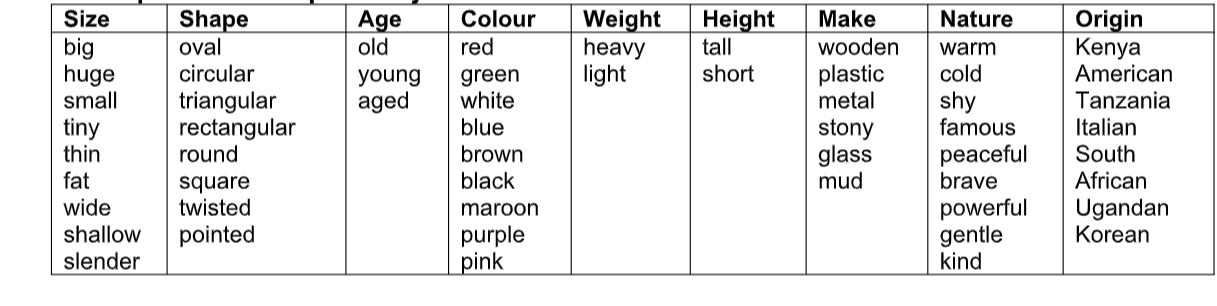
Descriptive adjective are of two types.
1) Common descriptive adjectives – these are adjectives that give general features of somebody or something.
They are the adjectives of size, shape, age, colour, weight, height, make and nature.
Refer to the examples in the diagram above.
2) Proper adjectives – These ones are formed from proper nouns.
They are always capitalized.
They always appear last in a string of adjectives modifying the same noun, just before the noun itself.
Examples of proper adjectives:
The Japanese ambassador
A Mexican carpet
An Italian chef
Note that when a proper adjective comprises of two words, both are capitalized.
Examples:
A South African farmer
A North American cowboy
Exercise 1
Find the adjectives in the following sentences and indicate what types they are.
1. Alaska is the largest state in the USA.
2. The Alaskan Senator is Lord John Mc Dougal.
3. Mt.
Kenya is the tallest mountain in Kenya.
4. Alaska has a tiny population of one and a half million people.
5. Northern Province has small, scattered towns.
6. A trip to Northern Kenya will take you across vast wilderness.
7. American tourists are fond of wild animals.
8. There is a huge lake in the Rift Valley Province.
9. I sent a letter to my Australian pen pal.
10. I have a beautiful Egyptian robe.
Demonstrative Adjectives
A demonstrative adjective tells which one or which ones.
They are used before nouns and other adjectives.
There are 4 demonstrative adjectives in English: This, that, these and those.
This and these are used to refer to nouns close to the speaker or writer.
That and those refer to nouns farther away.
This and that are used before singular nouns while these and those are used before plural nouns.
Examples:
This picture is very beautiful.
Singular noun
That one is not as beautiful.
Singular noun
These drawings are very old.
Plural noun
Those ones were painted in Uganda.
Plural noun.
Exercise 2
Choose the word in brackets that correctly completes each of the following sentences.
1. My bus left the station before (that, those) matatus.
2. (Those, These) chairs behind me were occupied.
3. My seat has a better view than (this, that) one over there.
4. (Those, That) man should fasten his seat belt.
5. (This, That) car is old, but that one is new.
6. (These, Those) clouds are far away.
7. (This, That) window next to me has a broken pane.
8. (That, This) chair near me is broken.
9. My car is moving faster than (these, those) buses over there.
10.(These, Those) goats grazing over there are my uncle’s.
Definite and indefinite adjectives
These are adjectives which tell how many or how much.
They give the number or the quantity, either specific or approximate, of the noun in question.
They are also referred to as numerals
Examples:
Three elephants were killed by the game rangers.
He bought several houses in Kileleshwa.
Don’t put much sugar in the tea!
More examples of numerals
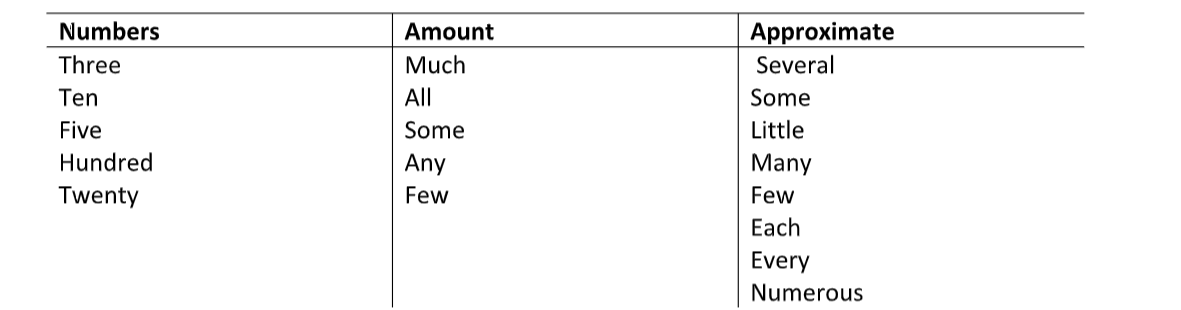
Adjectives that are in form of numbers are used with countable nouns:
Examples:
Two calves were born yesterday.
Five chimpanzees performed funny tricks.
Many children like dinosaurs.
A definite or indefinite adjective may look like a pronoun, but it is used differently in a sentence.
It is an adjective used to modify a noun.
Adjectives that are in farm of quantity are used with uncountable nouns.
Examples:
Do you have any water in the house?
How much flour did you buy?
Interrogative Adjectives
The interrogative adjectives are used with nouns to ask questions.
Examples are what, which, and whose.
Examples:
What movie do you want to see?
Which leaves tern colour first?
Whose son is he?
An interrogative adjective may look like an interrogative pronoun but it is used differently.
It is an adjective, used to modify a noun.
Exercise 3
Underline the adjectives in the following sentences.
1. Twenty bulls were slaughtered for wedding.
2. Few people know the name of our president.
3. They stole all the money in the safe.
4. There isn’t much sugar in the dish.
5. Numerous disasters have hit China this year.
6. What game is playing on TV tonight?
7. Whose car is that one over there?
8. Which house was broken into?
9. I don’t know what misfortune has faced him.
10. Nobody knows which table was taken.
Articles and Possessive Pronouns
Two special kinds of adjectives are the articles and the possessive pronouns.
Articles
Articles are the words a, an and the.
A and an are special adjectives called indefinite articles.
They are used when the nouns they modify do not refer to any particular thing.
Examples:
A student rang the bells (no specific student)
An orange is good for you health. (no specific orange)
A is used before a noun that begins with a consonant sound.
An is used before a noun that begins with a vowel sound.
Note that it is the first sound of a noun, not the spelling, that determines whether to use a or an.
Examples:
An hour an heir
A hall
The is a special adjective known as the definite article.
It is used to refer to particular things.
Examples:
The tourist was robbed.
(a particular tourist).
The team began practising at 8 o’clock (a particular team).
All articles are adjectives.
The is used with both singular and plural nouns, but a and an are used with singular nouns
Examples:
The tourist, the tourists, a tourist
The adjective, the adjectives, an adjective
Exercise 4
Choose the correct article from the choices given in brackets in the following sentences.
1. (A, An) mountain climber climbed Mt.
Elgon.
2. He went up a cliff and was stranded on (a, an) jagged rock.
3. No one knew (a, the) route he had taken.
4. (The, An) climber’s friend called the local police.
5. The police began the search within (a, an) hour.
6. A police dog followed (a, an) climber’s scent.
7. A helicopter began (a, an) air search of the mountain.
8. The dog followed the climber’s scent to (a, the) jagged edge of the cliff.
9. A climber from (a, the) police team went down the jagged rock.
10. (A, An) rope was tied to the climber and he was pulled to safety.
Possessive Pronouns
The words my, her, its, our and their are possessive pronouns, but they can also be used as adjectives.
These modifiers tell which one, which ones or whose?
Examples:
My brother likes Sean Paul, but his sister does not.
Of his songs, ever blazing is his favourite.
Our school produces heroes, its fame is widespread.
Exercise 5
Write the adjectives from the following sentences and the nouns they modify.
1. In her lifetime, Brenda Fasie composed many songs.
2. Her early songs entertained her fans all over the world.
3. Our first performance was successful.
4. Her coughing grew worse with time.
5. They agreed that it was their best goal in ten years.
Position of adjectives in sentences
1. Most adjectives appear immediately before the nouns they are modifying e.g.
Descriptive: The beautiful house belongs to my uncle.
Demonstrative: That house belongs to my uncle.
Numerals: Two houses were burned down.
Articles: The house on fire belongs to her sister.
Possessive pronouns: Their house was burned down.
2. Predicate Adjectives
Some adjectives appear after the nouns that they are modifying.
These adjectives are always used after linking verbs that separate them from the words they modify.
An adjective that follows a linking verb and that modifies the subject is called a predicate adjective.
Examples:
Joyce seemed lonely.
Her brother was upset.
He became concerned.
Exercise 6
Identify the predicate adjectives in the following sentences.
1. Her early songs were often quiet and serious.
2. One of her songs, Vulindlela, is very popular.
3. The dark city below the sky seems calm and peaceful.
4. Her performance in K.C.S.E.
was brilliant.
5. The West African singer Kofi Olominde is extraordinary.
Comparing With Adjectives
We have seen that adjectives describe nouns.
One way in which they describe nouns is by comparing people, places or things.
To compare two people, places or things, we use the comparative form of an adjective.
To compare more than two, we use the superlative form of the adjective.
Examples:
One Person: Kimenju is tall.
TwoPerson: Kimenju is taller than James.
Three Person: Kimenju is the tallest of all.
The comparative
The comparative form of the adjective is used to compare one thing, person or place with another one.
It is formed in two ways.
1. For short adjectives, add -er.
Examples:
great + er = greater sweet + er = sweeter
big + er = bigger light + er = lighter.
2. For longer adjectives, the comparative is formed by using the word more before them.
Examples:
More handsome more remarkable
More attractive more hardworking
Most adjectives ending in -ful and -ous also form the comparative using more.
Examples:
More successful more curious more ferocious
More beautiful more generous more prosperous
The superlative
The superlative form of the adjective is used to compare a person, a place or a thing with more than one other of its kind.
Examples:
Elephants are the largest animals in the jungle.
However, they are the most emotional animals.
The superlative form of an adjective is formed in two ways.
1. By adding -est to the short adjective
Examples:
great + est = greatest sweet + est = sweetest
big + est = biggest light + est = light
2. For longer adjectives, use most before them.
Examples:
most mysterious most awkward
most successful most attractive
The ending -er in the comparative becomes -est in the superlative while more becomes most.
Adjective comparative superlative
strong stronger strongest
quick quicker quickest
adventurous more adventurous most adventurous
co-operative more co-operative most co-operative
Summary of rules comparing with adjectives:
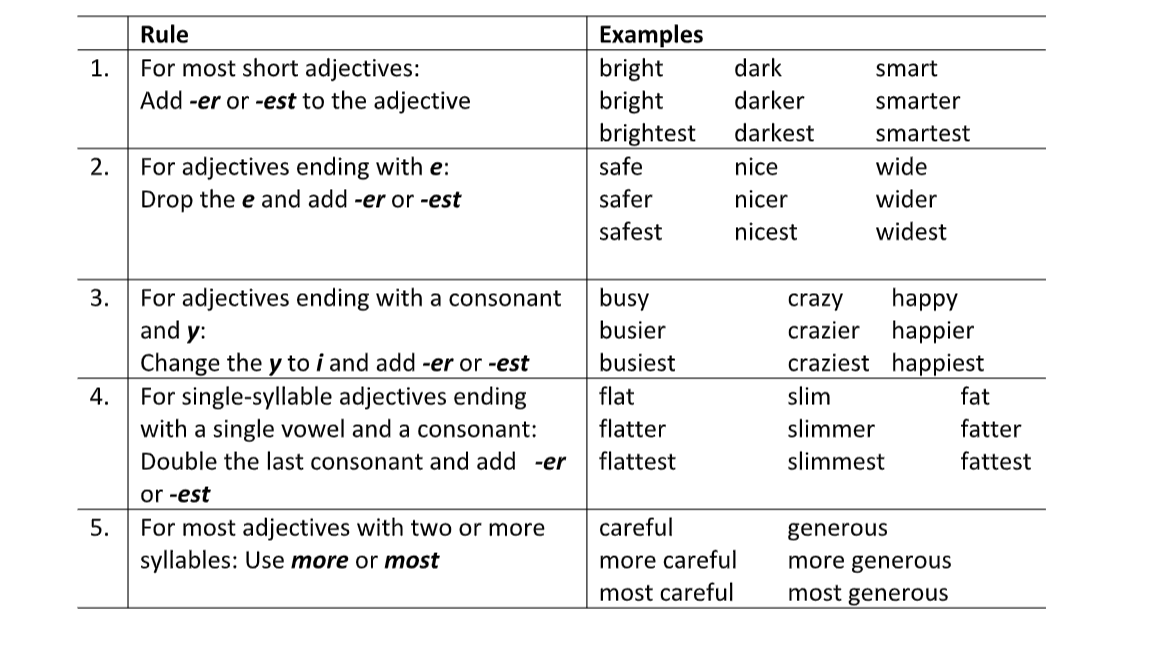
Points to Note
about Adjectives:
1. A comparative is used to compare two persons, or things or two groups of persons or things.
Examples:
A rat is smaller than a mouse.
Buffaloes are larger than domestic cows
2. A superlative is used to compare a thing or a person to more than one other of its kind.
Examples:
Lions are the bravest of all animals.
Elephants are the largest of all herbivores.
3. You must use the word other when comparing something with everything else of its kind.
Examples:
Leopards are more ferocious than any other cat.
4. Do not use both -er and more or -est and most.
InCorrect:Men die more earlier than women.
Correct: Men die earlier than women.
InCorrect:My father is the most oldest of the three brothers.
Correct: My father is the oldest of the three brothers.
Exercise 7
Write the adjectives in brackets in the following sentences correctly.
1. My next sculpture will be even ___________________ (beautiful).
2. That was the ________________ cartoon I have ever watched (funny).
3. English is my ____________ subject of all (enjoyable).
4. Job is the ______________ person in his family.(energetic)
5. She is the ______________ of the three nurses. (helpful)
6. That story sounds ____________ than fiction. (strange)
7. He is _______________ than a cat. (curious)
8. Her school grades are ______________ than mine. (high)
9. You are _______________ than Maria. (creative)
10. My next test will be _______________ than this one. (simple)
Irregular comparisons
Some adjectives have special forms for making comparisons.
i.e. they do not form their comparatives by use of -er or more, or their superlatives by use of -est or most.
Instead, these adjectives change the words completely to form comparatives and superlatives.
Examples:
Adjectives Comparative Superlative
good better best
well better best
bad worse worst
ill worse worst
little less or lesser least
much more most
many more most
far farther farthest
Example of use in sentences:
The presentation of our play was good.
Our second performance was better.
But our last performance was the best.
Exercise 8
Write the correct forms of the adjectives in brackets in the following sentences.
1. The comedy was the ________________ show of the three. (good)
2. Mary had a _________________ cold yesterday.(bad)
3. It was her ____________ performance this year.(good)
4. Her illness is getting _____________ every day.(bad)
5. The old woman received the _____________ amount of money from the MP. (little)
6. Smoke your cigarette _______________ away from the children.(far)
7. There was ______________ noise in the classroom than yesterday.(little)
8. The musician said that that was a very ______________ year for him.(good)
9. This year’s songs were much ______________ than last year’s.(good)
10. He has the _____________ pairs of shoes in the school. (many)
Special Problems With Adjectives
1. Those and Them
Those is an adjective if it followed by a noun.It is a pronoun if it is used alone.
Examples:
Those thieves are daring! (adjective modifying thieves)
Those are thieves! (pronoun)
Them is always a pronoun.
It is used only as the object of a verb or as the object of a preposition.
It is never used as an adjective.
Examples:
We followed them.(object of a verb)
They caught one of them.(object of a preposition)
We heard them thieves breaking the door.(incorrect)
2. The extra Here and There with demonstrative adjectives
It is incorrect to use the demonstrative adjectives this, that, those, and these with here and there before the nouns they modify.
Examples:
“This here job”
“That there house”
“These here books”
“Those there carpets”
The adjectives this and these include the meaning of here whereas the adjectives that and those include the meaning of there.
Saying this here is like repeating oneself.
3. Kind and sort with demonstrative adjectives
Kind and sort are singular and hence should be used with singular demonstrative adjectives this and that.
Examples:
I like this kind of story.
She likes that sort of food.
Kinds and sorts are plural and should be used with plural demonstrative adjectives these and those.
Examples:
Those sorts of horror movies scare me.
These kinds of sports are for strong people.
Exercise 9
Choose the correct adjectives from the ones given in brackets in the following sentences.
1. A robot is one of (those, them) machines that looks and acts human.
2. (These, This) sorts of machines are very strange.
3. (This, This here) church was built in 1921.
4. (Them, Those) mushrooms are very delicious.
5. (Them, Those) soldiers won the battle.
6. People call (these, this) kinds of songs Soul.
7. John needed a name for (them, those) songs.
8. (This, this here) play is called Aminata.
9. Human beings have a fascination with (those, that) kind of machine.
10. (These, This) sort of a car is meant for ministers.
Answers on Adjectives
Exercise 1
1. largest 6. vast
2. Alaskan 7. American, wild
3. tallest 8. huge
4. tiny 9. Australian
5. small, scattered 10. beautiful, Egyptian
Exercise 2
1. those 6. Those
2. Those 7. This
3. that 8. This
4. That 9. those
5. This 10. Those
Exercise 3
1. Twenty 6. What
2. Few, our 7. Whose
3. all 8. Which
4. much 9. what
5. Numerous, this 10. which
Exercise 4
1. A 6. the
2. a 7. an
3. the 8. the
4. The 9. the
5. an 10. A
Exercise 5
1. many – songs
2. Her, early – songs, her – fans
3. Our, first – performance
4. Her – coughing
5. their, best – goal, ten – years
Exercise 6
1. quiet, serious
2. popular
3. calm, peaceful
4. brilliant
5. extraordinary
Exercise 7
1. more beautiful 6. stranger
2. funniest 7. more curious
3. most enjoyable 8. higher
4. most energetic 9. more creative
5. most helpful 10. simpler
Exercise 8
1. Best 6. Farther
2. Bad 7. Less or lesser
3. Best 8. Good
4. Worse 9. Better
5. Least 10. Most
Exercise 9
1. those 6. these
2. These 7. those
3. This 8. This
4. Those 9. that
5. Those 10. This
Adverbs
An adverb is a word that describes a verb, an adjective, or another adverb.
Adverb tell how, when, or where, or to what extent an action happens.
Examples:
HOW: The man walked quickly.
WHEN: It will rain soon.
WHERE: We shall meet here at 2 p.
m.
TO WHAT EXTENT: He is extremely rude.
Other Examples:
HOW WHEN WHERE TO WHAT EXTENT
happily sometimes underground fully
secretly later here extremely
together tomorrow there quite
carefully now inside very
sorrowfully finally far rarely
painfully again upstairs
fast often downstairs
hard once somewhere
slowly first forward
hurriedly next behind
quietly then above
Adverbs used to describe verbs
Adverbs that describe verbs tell how, when, where and to what extent an action happened.
Examples:
HOW: John waited patiently for his turn.
WHEN: He is now walking into the office.
WHERE: He will eat his lunch there.
TO WHAT EXTENT: He is very pleased with himself.
Adverbs make the meaning of the verb clearer.
Example:
He will eat his lunch.
(without adverb)
He will eat his lunch there.
(The adverb makes it clear where the action of eating will take place.)
Exercise 1
Write the adverbs in the following sentences and then indicate whether the adverb tells how, when, where, or to what extent.
1. The tourist travelled far.
2. They cheerfully greeted their grandmother.
3. Tina hurried downstairs when she heard the knock.
4. He worked carefully and skilfully.
5. She was extremely agitated.
6. The scientist looked curiously at the creature.
7. Soon the bell was rung.
8. The hall was fully occupied.
9. They hugged their grandmother adorably.
10. He brought the cake down.
Adverbs used to describe adjectives
Adverbs that tell to what extent can be used to describe adjectives.
Examples:
The cave was very dark.
adv adj
The tea was extremely hot.
Adv adj
Other adverbs used with adjectives
just nearly somewhat most
These adverbs make the adjectives they are describing more understandable and precise.
Example:
The tomb was dark.
(without adverb)
The tomb was fully dark.
(The adverb fully describes the extent of the darkness).
Exercise 2
Identify the adverb in each of the following sentences and then indicate the adjective it describes.
1. He is a highly successful businessman.
2. The extremely cold weather made me shiver.
3. They are quite difficult to deal with.
4. The house is barely visible from here.
5. He is a very old man by now.
6. She is mysteriously secretive about her activities.
7. Jackline is horribly mean with her money.
8. The book was totally exciting.
9. The secretary was completely mad when the money was stolen.
10. The boss is never punctual for meetings.
Adverbs used to describe other adverbs
Some adverbs that tell to what extent are used to describe other adverbs.
Examples:
The student spoke very softly.
adv adv
The cold subsided very gradually.
adv adv
These adverbs make the adverbs they are describing more understandable and clear.
Examples:
She spoke rudely.
(without adjective modifier)
She spoke extremely rudely.
(extremely describes the extent of her rudeness).
Exercise 3
Identify the adverbs modifying other adverbs in the following sentences.
1. The mourners covered the casket with earth very gradually.
2. He appeared on her surprisingly quickly.
3. The sun appeared somewhat closer that day.
4. He drinks extremely irresponsibly.
5. The driver sped the car totally carelessly.
Specific categories of Adverbs
1. Adverbs of time – These answer the question when?
Examples:
He joined the class yesterday.
Today, I will go to the cinema.
2. Adverbs of place- These answer, the question where?
Examples:
Mrs. Kilome has gone out.
The bus stop is near the post office.
3. Adverbs of frequency: These answer the question how often?
Examples:
She often leaves without permission.
He always works hard.
4. Adverbs of manner: These answer the question how?
Examples:
Many ran fast to catch the bus
He painted the house badly.
5. Adverbs of degree.
These answer the question how much?
Examples:
Luka is extremely intelligent.
She is very ill.
FORMATION OF ADVERBS
Many adverbs are formed by adding -ly to an adjective.
Examples:
Slow + -ly = slowly quiet + -ly = quietly
Sometimes the addition of -ly to an adjective may require changing the spelling in the adjective.
Examples:
Easy + -ly = easily (y changes to i)
Full + -ly = fully (ll changes to l)
Other adverbs are complete words on their own.
That is, they are not formed from other words.
Examples:
fast tomorrow soon first later
next inside somewhere quite
Note:
1. Soon and quite can be used only as adverbs.
Examples:
The school will soon open.
The holiday was quite well spent.
2. Some other modifiers, like late or first, can either be used as adverbs or adjectives.
Examples:
The visitors arrived late.
(adverb)
The late arrivals delayed the meeting (adjective)
The robbers had gotten there first.
(adverb)
The first house was already broken into.
(adjective)
3. When you are not sure whether an adjective or an adverb has been used in a sentence, ask yourself these questions.
(i) Which word does the modifier go with?
If it goes with an action verb, an adjective or another adverb, it is an adverb.
Examples:
The story teller spoke quietly.
– used with an action verb.
The story teller was very interesting.
– used with an adjective.
The story letter spoke extremely slowly.
–used with another adverb.
But if it goes with a noun or a pronoun, it is an adjective.
Examples:
The quiet story teller spoke.
– used with a noun.
He was quiet.
– with a pronoun.
(ii) What does the modifier tell about the word it goes with?
If the modifier tells when, where, how, or to what extent, it is an adverb.
Examples:
He will come tomorrow. – when
He will come here. – where
He will come secretly. – how
He will be very cautious. – to what extent
But if it tells which one, what kind, or how many, it is an adjective.
He will steal this cow. – which one
He will carry a sharp spear.– what kind
He will be joined for ten years. – how many
4. Adverbs and predicate adjectives
You will recall that we said that an adjective appears after a linking verb and modifies the subject.
Examples:
He became successful. (successful modifies he)
You seem tired. (tired modifies you)
You appears sick. (sick modifies she)
You look great! (great modifies you)
They sound bored.(bored modifies they)
It feels wet.(wet modifies it)
The oranges taste sweet.(sweet modifies oranges)
The baby grows big. (big modifies baby)
She smells nice. (nice modifies she).
Sometimes the verbs in the sentences above are used as action verbs.
In this case, they are followed by adverbs, not adjectives.
They modify the verbs and tell how, when, where, or to what extent.
Examples:
The singer looked up.
v adv
We tasted the chocolate eagerly.
v adv
The principal appeared suddenly.
v adv
5. Good and well
Good and well have similar meanings, but differ in their use in a sentence.
Example:
InCorrect:He narrates the story good.
Correct: He narrates the story well.
Good is always an adjective and modifies nouns or pronouns.
It is never used to modify a verb.
Example:
He is a good narrator.
(adjective modifying the noun narrator)
Well can be used as either an adjective or an adverb.
Examples:
I feel well.
(as an adjective)
He drives well.
(as an adverb)
Exercise 4
Choose the correct form of the words in brackets in the following sentences.
1. Luos tell you (quick, quickly) that they are not Bantus.
2. Over the months, the snow (gradual, gradually) melted.
3. Rice tastes especially (good, well) with avocado.
4. The popularity of video games has grown.
(rapid, rapidly)
5. The name of the town may sound (strange, strangely) to some people.
6. These puppies look a little (odd, oddly).
7. The idea of breaking the door does not sound (reasonable, reasonably).
8. Visitors eat Nyama Choma very (rapid, rapidly).
9. If Nyama Choma has been prepared (good, well), it tastes even better than chicken.
10. Since fish is high in proten and low in fat, it is bound to keep you (good, well).
Comparing With Adverbs
We have seen that we can use adjectives to compare people, things or places.
Adverbs can also be used to compare actions.
And like adjectives, we use the comparative form of an adverb to compare two actions and the superlative form of an adverb to compare more than two actions.
Examples:
ONE ACTION: Maree swims fast.
TWO ACTIONS: Maree swims faster than Ciku.
THREE OR MORE: Maree swims fastest of all.
Just like adjectives, adverbs have special forms or spelling for making comparisons.
The comparative form
The comparative form of the adverb is used to compare one action with another.
It is formed in two ways:
1. For short adverbs, add -er.
Examples:
The bird flew higher than the helicopter.
The president arrived sooner than we expected.
2. For most adverbs ending in -ly, use more to make the comparative.
Examples:
She visited him more frequently than Martin.
The tractor towed the lorry more powerfully than the bull-cart.
The superlative form
The superlative form is used to compare one action with two or more others of the same kind.
Examples:
Of the three athletes, Kipruto runs the fastest.
The lion roars the loudest of all the big cats.
Adverbs that form the comparative with -er form their superlative with -est.
Those that use more to form comparative use most to form superlative.
Examples:
Adverbs Comparative Superlative
long longer longest
fast faster fastest
softly more softly most softly
politely more politely most polite
Points to Remember
1. Use the comparative to compare two actions and the superlative to compare more than two.
Examples:
Comparative: He sat nearer to the window than him
Superlatives: He sat nearest to the window than all the others.
2. Do not leave out the word other when comparing one action with every other action of the same kind.
Examples:
InCorrect:The lion roared louder than any lion.
Correct: The lion roared louder than any other lion.
3. Do not use both -er and more or -est and most.
InCorrect:The dancer moved more faster than before.
Correct: The dancer moved faster than before.
Summary of rules for comparing with Adverbs
1. For most adverbs
Add -er or -est to the adverb hard late deep
harder later deeper
hardest latest deepest
2. For most adverbs comprising of two or more syllables: Use more or most with the adverb skilfully firmly rudely
more skilfully more firmly most rudely
most skilfully most firmly most rudely
Exercise 5
Write each of the following sentences using the correct form of the adverb.
1. Does she cry ______________ (often) than the baby does?
2. She crosses the river _____________ (slowly) than her son does.
3. James jumps into the swimming pool _____________ (quickly).
4. Charles swims _____________ (skilfully) than all of us.
5. Of all the athletes, Tecla Lorupe is ____________ (fast).
6. The antelope disappeared _____________ (swiftly) than the gazelle.
7. Chicharito scored the goal _____________ (accurately) of all.
8. Mange and Marto stayed in the hall ______________ (long) of all.
9. Sarah walks _____________ (gracefully).
10. Ng’ang’orito sang ____________ (sweetly) of all participants.
Answers on Adverbs
Exercise 1
Adverb What it indicates
1. far where
2. cheerful how
3. downstairs where
4. carefully, skilfully how
5. extremely how
6. curiously how
7. soon when
8. fully to what extent
9. adorably how
10. down where
Exercise 2
Adverb Adjective
1. highly successful
2. extremely cold
3. quite difficult
4. barely visible
5. very old
6. mysteriously secretive
7. horribly mean
8. totally exciting
9. completely mad
10. never punctual
Exercise 3
Adverb adverb
1. very gradually
2. surprisingly quickly
3. somewhat closer
4. extremely irresponsibly
5. totally carelessly
Exercise 4
1. quickly 6. odd
2. gradually 7. reasonable
3. good 8. rapidly
4. rapidly 9. well
5. strange 10. well
Exercise 5
1. more often 6. more swiftly
2. more slowly 7. most accurately
3. quickly 8. the longest
4. more skilfully 9. gracefully
5. the fastest 10. the most sweetly
Prepositions
A preposition is a word that shows the relationship between other words in a sentence.
Examples:
The cat lay under the table.
The preposition under connects the verb lay with table.
Under points out the relationship between lay and table.
Hence a preposition is a word that links another word or word group to the rest of the sentence.
The noun or pronoun after the preposition is called the object of the preposition.
The table is the object of the preposition under in the above sentence.
The preposition under relates the verb lay to the noun table.
More Examples:
She gave it to me.
(The preposition to relates the pronoun me with the action gave).
I liked the bike with the metal handles.
The preposition with relates the noun handles with the noun bike.
Common prepositions
about before except on toward
above behind for onto under
aboard below from out underneath
across beneath in outside until
after beside inside over up
against between into past upon
along beyond like since with
among by near through within
around down of throughout without
at during off to
From the above list of prepositions, you will note that some of them tell where, others indicate time, others show special relationships like reference or separation.
Changing one preposition with another in a sentence changes the meaning of the sentence.
Example:
The cat lay under the table.
The cat lay on the table.
Lying under the table means below the surface of the table but on means above the surface.
Exercise 1
Write the preposition in each of the following sentences and say what relationship it indicates.
1. Sometimes they lie on the ground.
2. They have grown maize for food.
3. The children played with the dolls.
4. A man found some treasure in the cave.
5. They make clothes from cotton.
Exercise 2
Use the most appropriate preposition to complete the sentences below.
1. Driving had been my dream ________________ years.
2. _____________ 1990, I bought a second-hand car.
3. ______________ that year, I learned how to drive.
4. I rolled the car ________________ the road _____________ more than two kilometres.
5. I was really thrilled ______________ the experience.
Preposition Phrases
A prepositional phrase consists of a preposition, its object and any words that modify the object.
Examples:
The school children waited for the green light.
In this sentence, the preposition is for, its object is light, and the modifier, or adjective, is green.
The entire preposition phrase modifies the verb waited.
Sometimes two or more nouns or pronouns are used as objects in a prepositional phrase.
Example:
He needs a worker with diligence and a good character.
The preposition with has two objects: diligence and character.
Exercise 3
Identify the prepositional phrase in each of the following sentences.
Underline the preposition once and its objects twice.
1. Donkeys help people in many ways.
2. They bring happiness to the people around them.
3. In large cities, they help to carry water.
4. On farms, they carry heavy loads.
5. How could you travel across a river?
6. You might swim to the other side.
7. You might cross at a shallow place.
8. You can cross by boat.
9. Bridges are a better solution to the problem.
10. Most bridges are built over water.
Types of prepositional phrases
Prepositional phrases can either be:
(i) Adjective prepositional phrases – these prepositional phrases, just like adjectives, modify nouns and pronouns.
Example:
A scout leader wears a uniform with many badges.
In this sentence, with many badges is an adjective prepositional phrase modifying the noun uniform.
(ii) Adverb prepositional phrases – these ones, just like adverbs, modify verbs, adjectives or other adverbs.
Examples:
Scouts rain for many hours.
The adverb prepositional phrase for many hours modifies the verb train.
They are active in all public functions.
The adverb prepositional phrase in all public functions modifies the adjective active.
The scout leader commands forcefully with a loud voice.
The adverb prepositional phrase with a loud voice modifies the adverb forcefully.
We have seen that the object of a preposition is the noun or pronoun that follows the preposition.
When the object of the preposition is a pronoun, we use an object pronoun like me, you, him, her, it, us, and them.
(And not a subject pronoun like I, he, she, we, and they).
Examples:
Correct: I gave a present to her.
InCorrect:I gave a present to she.
Correct: I gave a present to Jane and her.
InCorrect:I gave a present to Jane and she.
Exercise 4
Choose the pronoun in brackets that correctly completes each of the following sentences.
1. The dog chased after Travis and (her, she).
2. Cleaning the house was a tasking job for Evans and (I, me).
3. We planned a family picture of our parents and (us, we).
4. The victory belonged to (he, him).
5. Michael and Bernard stood behind Mom and (she, her).
6. The crowd around (we, us) started cheering.
7. My little sister ran behind Sammy and (I, me).
8. The toys belong to Karen and (him, he).
9. Johnny sat between James and (me, I).
10. I went to the cat race with Jim and (she, her).
Sometimes one prepositional phrase immediately follows another.
Examples:
The thief entered the house through the door on the right.
(through the door modifies the verb entered and tells where.
on the left modifies the noun door and tells which one.
A prepositional phrase can be at the beginning, in the middle, or at the end of a sentence.
Examples:
BEGINNING: At dusk we closed the shop.
MIDDLE: The chief of the area was helpful.
END: The path went through the village.
Preposition or Adverb?
Sometimes the same word can be used as either a preposition or an adverb.
How can you tell the difference between the two?
Examples:
PREPOSITION: He has a box inside the house.
ADVERB: They ran inside.
You can tell the difference by remembering the following:
(i) A preposition never stands alone.
It is always followed by its object, a noun or a pronoun.
Examples:
The helicopter flew past the airport.(preposition)
The aircraft was parked inside the hangar. (preposition)
(ii) An adverb is never followed by a noun or a pronoun, may be by an adverb.
Examples:
The helicopter flew past. (adverb).
The aircraft was parked inside.(adverb)
The helicopter flew past noisily (adverb).
Therefore, if a word begins a prepositional phrase, it is a preposition.
If it stands alone or is followed by an adverb, it is an adverb.
Some words that can be used either as prepositions or adverbs.
above down over
along in out
around inside outside
below near under
by off up
Exercise 5
Indicate after each of the following sentences if it has a preposition or an adverb.
1. Jack stood outside the shop.
2. He was curious and went inside.
3. He saw strange things in every corner.
4. An old coat and several sweaters lay over a chair.
5. Blue and green umbrellas stood above the fire place.
6. He looked up suddenly.
7. He sat down heavily.
8. Then he lifted the curtain and peeped outside.
9. A jogger ran by
10. Jack ran out.
Negatives
Negatives are words that mean “no” or “not”.
These words are adverbs.
Examples:
She has no more work.
There are none left.
Other common negatives
not nowhere nobody aren’t haven’t
never nothing no one doesn’t wouldn’t
The combination of a verb and not also form a contraction which is also a negative.
The letters n’t stand for not.
Examples:
They won’t be able to attend the funeral.
He couldn’t make a speech.
Double negatives:
A sentence should have only one negative.
Using double negatives in a sentence is usually incorrect.
A double negative is the use of two negative words together when only one is needed.
Examples:
Incorrect Correct
We don’t need no more problems.
We don’t need any more problems.
She hasn’t bought nothing.
She hasn’t bought anything.
Mark hasn’t no homework.
Mark hasn’t any homework.
Or
Mark has no homework.
When you use contractions like don’t and hasn’t, do not use negative words after them.
Instead, use words like any, anything, and ever.
Examples:
We don’t have any work.
He hasn’t any work.
I won’t ever respond to the summons.
Other negatives include hardly, barely, and scarcely.
They are never used after contractions like haven’t and didn’t.
Examples:
Incorrect Correct
We couldn’t hardly continue with the work.
We could hardly continue with the work.
The child can’t barely walk.
The child can barely walk.
Exercise 6
Write the following sentences choosing the correct negatives from the ones given in brackets.
1. They (have, haven’t) nothing to eat.
2. Isn’t (anyone, no one) at home?
3. Didn’t you (ever, never) swim in that river?
4. There isn’t (anybody, nobody) weeding the farm.
5. Ann and Martin haven’t (anywhere, nowhere) to sleep.
6. Our friends (had, hadn’t) none of the fun.
7. Isn’t (anybody, nobody) watching Tahidi High?
8. Hasn’t (anyone, no one) thought of washing the utensils?
9. Tabby (hasn’t, has) had no luck.
10. We haven’t (ever, never) tried.
Answers on Prepositions
Exercise 1
1. on – where
2. for – purpose
3. with – use
4. in – place
5. from – place
Exercise 2
1. for
2. In
3. In
4. down, for
5. by
Exercise 3
Preposition Object/objects
1. in ways
2. to people
3. In cities
4. On farms
5. across river
6. to side
7. at place
8. by boat
9. to problem
10. over water
Exercise 4
1. her 6. us
2. me 7. me
3. us 8. him
4. her 9. me
5. us 10. her
Exercise 5
1. outside – preposition 6. up – adverb
2. inside – adverb 7. down – adverb
3. in – preposition 8. outside – adverb
4. over – preposition 9. by – adverb
5. above – preposition 10. out – adverb
Exercise 6
1. have 4. anybody 7. anybody 10. ever
2. anyone 5. anywhere 8. anyone
3. ever 6. had 9. has
Conjunctions
A conjunction is a word that connects words or groups of words. Like prepositions, conjunctions show a relationship between the words they connect. But, unlike prepositions, conjunctions do not have objects.
There are 3 main categories of conjunctions;
(1) Coordinating conjunctions
(2) Subordinating conjunctions
(3) Correlative conjunctions
Coordinating Conjunctions
Coordinating conjunctions connect related words, groups of words, or sentences.
There are three coordinating conjunctions: and, but and or.
And is used to join words, groups of words, or sentences together.
But shows contrast while or shows choice.
Examples:
The bull and the cart are inseparable.
(connects two subjects).
The cart carries the farmer and his tools.
(connects two direct objects).
The food was hard and tasteless.
(connects two predicate adjectives).
Each night, the dancers danced in a circle or in several other patterns.
(connects two prepositional phrases).
Some people died in the fracas, but most managed to escape, alive.
(connects two sentences).
Exercise 1
Complete each of the following sentences using the most appropriate coordinating conjunction
1. Bats and insects fly, ____________ only birds have feathers.
2. Eagles build nests on cliffs ______________ in tall trees.
3. Parrots live in wild places _______________ in zoos.
4. Swallows ______________ sparrows often build nests in buildings.
5. Hummingbirds are tiny __________ very brave.
6. Many birds fly south in winter, ______________ others do not.
7. Their feathers keep them warm ____________ dry.
8. A bird can fly forward _____________ backward.
9. Many birds shed old feathers ______________ grow new ones.
10. Their legs are weak ____________ their wings are strong.
Subordinating conjunctions
Subordinating conjunctions connect two or more clauses to form complex sentences.
(Refer to Part Two of this handbook).
Subordinating conjunctions introduce subordinate clauses.
They include because, since, if, as, whether, and for.
Examples:
If I go home, my dog will follow me.
The subordinating conjunction if connects the subordinate clause I go home with the main clause my dog will follow me.
The stayed inside the church because it was raining.
He was always rude since he was a child.
The rain fell as they entered the building.
The pastor asked the congregation whether they were happy.
The man rejoiced for he had won a prize.
Exercise 2
Join the following pairs of sentences using the most appropriate subordinating conjunctions.
1. They arrived late.
It was raining heavily.
2. John worked hard.
He wanted to buy a house.
3. I won’t carry the umbrella.
You need it.
4. I drove the car madly.
I was later for the meeting.
5. He will come.
The meeting ends.
Correlative conjunctions
Correlative conjunctions are conjunctions that are used in pairs to connect sentence parts.
These include either ….
.
or, neither ….
.
nor, not only…….
but also, whether …….
or and both …… and.
Examples:
Both boys and girls attended the conference.
People brought not only food but also clothes for the victims of the floods.
The students ride either on bicycles or motorbikes.
The sailor had to decide whether to sail on or head back when the weather changed.
Neither John nor James was moved by the shocking news.
Exercise 3
Join the following pairs of sentences using the correlative conjunctions in brackets.
1. The vehicles stopped for repairs.
The vehicles stopped for fuel.
(either….
.
or)
2. The drivers knew they had to travel more than fifty kilometres.
If they did not travel more than fifty kilometres, they would have to endure harsh storms.
(either….
or).
3. Many people build their own homes.
Many people grow their own food.
(not only…but also)
4. Men wanted to buy the pictures. Women also wanted to buy the pictures.(both…. and)
5. Maize is an important part of a Kenyan’s diet.
Meat is important too.
(both… and)
Answers on Conjunctions
Exercise 1
1. but 6. but
2. or 7. and
3. or 8. or
4. and 9. and
5. but 10. but
Exercise 2
1. They arrived late because it was raining heavily.
2. John worked hard as he wanted to buy a house.
3. I won’t carry the umbrella for you need it.
4. I drove the car madly since I was late for the meeting.
5. He will come before the meeting ends.
Exercise 3
1. The vehicles either stopped for repairs or for fuel.
2. The drivers knew they had either to travel more than fifty kilometres or endure harsh storms.
3. Many people not only build their own homes but also grow their own food.
4. Both men and women wanted to buy the pictures.
5. Both maize and meat are important parts of a Kenyan’s diet.
Interjection
An interjection is either a single word or short groups of words that is used to express a feeling or emotion.
Interjections can express such feelings as urgency, surprise, relief, joy, or pain.
An interjection that expresses strong emotion is often followed by an exclamation mark.
An interjection that expresses mild emotion is usually followed by a comma.
Examples:
Let’s go! We can’t sleep before we find the missing boy (urgency).
Phew! I was afraid we would never find him.
(relief)
Oh, you have grown so big.
(surprise)
Well, I have never been so happy.
(joy)
Exercise 1
Identify the interjection in the following sentences and indicate what feeling or emotion it expresses.
1. Say, have you heard about Nameless and Jua Kali, the famous Kenyan musicians.
2. Wow! Seeing the calf being born was exciting.
3. “All right!” I yelled to him.
“This is not right thing to do.
”
4. Boy! Some people felt wonderful being in the air balloon, but I felt nervous.
5. Oh, did that boat rock back and forth for a while.
Answers to Chapter Eight
Exercise 1
1. Say – wonderment
2. Wow! – joy
3. All right! – urgency
4. Boy! – fear
5. Oh – surprise
Chapter Two
Formation and Origin of Words
Some words in the English language have unique origins and formations.
(i) Sound words (onomatopoeias)
Some of the words imitate the sounds they represent.
These words are called sound or onomatopoeic words.
For example, the words bang and crash describe a loud, sudden noise.
The word murmur describes a low, soft noise that keeps going.
Many English words imitate noises made by animals.
For example, the word chirp imitates the short, high sound made by a small bird or a cricket.
Other examples of sound (onomatopoeic) words
beep gobble neigh squeal
blast growl purr tick
buzz hiss quack zip
clang honk rip
clatter hum roar
crack meow smash
crunch moo splash
Exercise 1
Write a sound word for each of the following descriptions.
1. The sound of something breaking
2. The loud, deep sound of a lion.
3. The sound of a clock.
4. The sound of an angry dog.
5. The sound of a loud bell.
6. The sound made by a duck.
7. The sound of a bottle opening.
8. The sound of a cat drinking milk.
9. The sound of a bomb exploding.
10. The sound of a snake.
(ii) Words that come from names of people and places (Eponyms)
Some of the words in the English language come from the names of people and places.
Examples:
Word Meaning Named after
Sandwich Two or more slices of bread with meat between them.
John Montagu, the fourth Earl of Sandwich, who liked eating meat between slices of bread.
Maverick A person who breaks from conventional actions Samuel Maverick, a Texas cattle owner who refused to brand the calves of one of his herds as per the requirements.
Saxophone A musical wind instrument Adolphe Sax, the Belgian inventor of the musical instrument.
Madras A cotton cloth with a design or pattern on plain background Madras, a city in India, where it was invented.
Rugby A game Rugby school.
England, where rugby was invented.
Tarantula A large, hairy spider Taranto, a town in Italy where Tarantulas are found.
Shylock A greedy money-lender The relentless and vengeful money- lender in Shakespeare’s play, The Merchant of Venice.
Sousaphone A musical instrument John Phillip Sousa, an American composer who invented the Sousaphone.
There are many more words in the English language which originated from names of people or places.
Exercise 2
Find out from your dictionary the origins and meanings of the following English words.
1. lima bean 6. guppy 11. guillotine
2. cardigan 7. cheddar 12. macadam
3. bloomer 8. quisling 13. pasteurisation
4. canary birds 9. silhouette 14. watt
5. Ferris wheel 10. Marxism 15. ohm
(iii) Words formed from blending two or more words (portmanteau words)
Some words in the English language are a blend of two or more words or morphemes.
Examples:
Word Combination of Meaning
Smog Smoke + fog A combination of smoke and fog in the air.
Fantabulous Fantastic + fabulous Incredible, astonishing, unbelievable, wonderful
Brunch Breakfast + lunch A late breakfast taken some hours before lunch
Wikipedia Wiki + encyclopaedia A website
Comcast Communication + broadcast
Verizori Veritas + horizon
Accenture Accent + future
Spork Spoon + fork An eating utensil that is a combination of a spoon and a fork.
Skort Skirt + shorts An item of clothing that is part skirt and short.
Simulcast Simultaneous + broadcast To broadcast a programme on television and radio at the same time
Cyborg Cybernetic + organism
Motel Motor + hotel A roadside hotel
Exercise 3
Identify the words that are blended to form the following words.
Find out their meanings from your dictionary.
1. slithy 6. breathalyser
2. chortle 7. cable gram
3. galumph 8. camcorder
4. bash 9. edutainment
5. blog 10. email
(iv) Words formed by use of prefixes and suffixes
Some words are formed addition of prefixes and suffixes to other words.
Prefixes
A prefix is a word part that is added to the beginning of a word to form another word or to change its meaning.
The word to which the prefix is added is called the base word.
Examples:
Prefix Base word New word
un friendly unfriendly
pre pay prepay
A prefix changes the meaning of the base word.
For example, the prefix un-above means “not”.
Hence, unfriendly means “not friendly”.
Each prefix has its own meaning.
More examples of common English prefixes
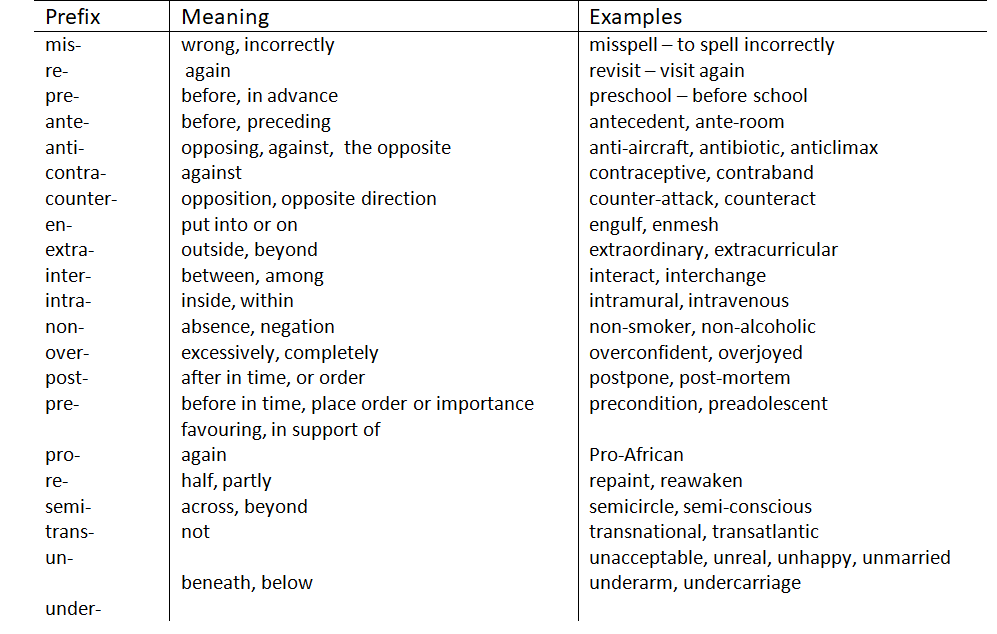
Exercise 4
Give the meaning of the following prefixes and write two examples each of words in which they are used.
Use your dictionary.
1. ultra- 6. infra-
2. hypo- 7. hypo-
3. hemi- 8. hemi
4. ex- 9. ex-
5. dia 10. dia-
Suffixes
A suffix is a word part that is added to the end of a base word to form a new word or to change its meaning.
Example:
Enjoy + able = enjoyable
Each suffix has its own meaning.
The suffix “able” means “capable of”.
Hence enjoyable means “capable of being enjoyed”.
Common English suffixes
Suffix Meaning Examples
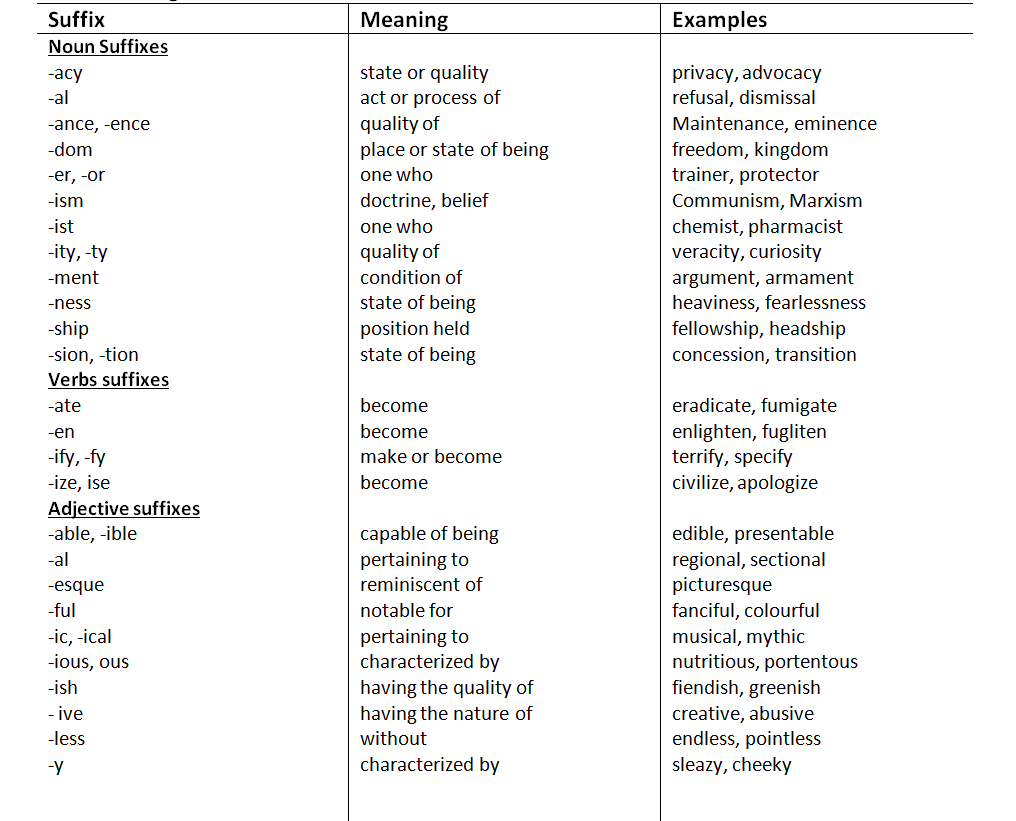
Exercise 5
Add an appropriate suffix to each of the following words and then give the meaning of the new word.
1. hope 6. green
2. read 7. wear
3. child 8. fear
4. grey 9. kind
5. play 10. wash
Words Usage
Words in English language have various meanings depending on their usage in sentences.
(i) Homographs
Homographs are words which are spelled the same but have different meanings.
They usually appear as separate entries in a dictionary.
Examples:
The man dug a well in his compound.
They worked well together.
In the first sentence, the noun well means “a spring of water”.
In the second sentence, the adverb well means “in a good manner”.
Examples of common homographs in the English Language
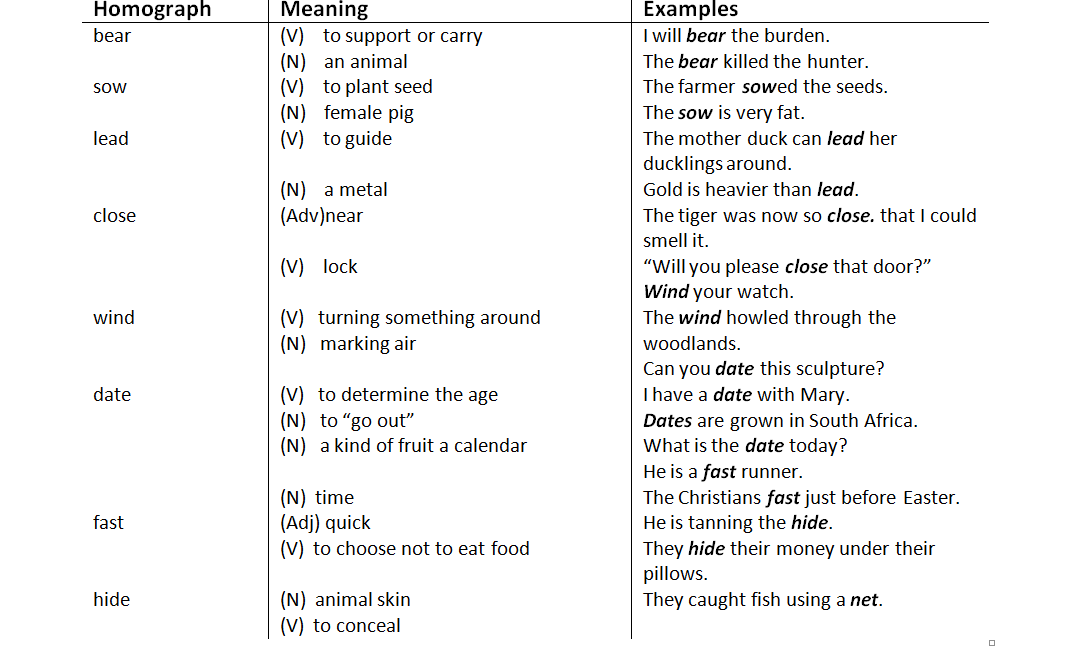
Some homographs are spelled the same but pronounced differently.
Example:
The wind is strong today.
This path winds through the hills.
Exercise 6
Write two meanings of the following homographs and use each of them in sentences of your own.
1. pen 6. act
2. tire 7. arms
3. dove 8. block
4. wound 9. box
5. mean 10. bank
(ii) Homophones
Homophones are words that sound the same but have different spellings and meanings.
Example:
She will buy music composed by my favourite artist.
Homophones are often confused when writing by many students because of similarity in pronunciation.
Examples of common homophones in English
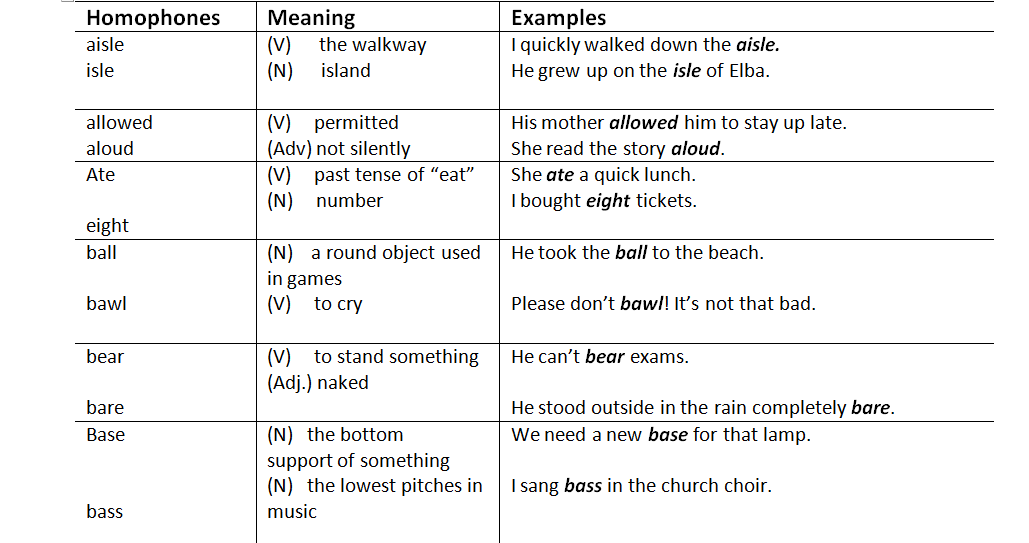
More examples of homophones
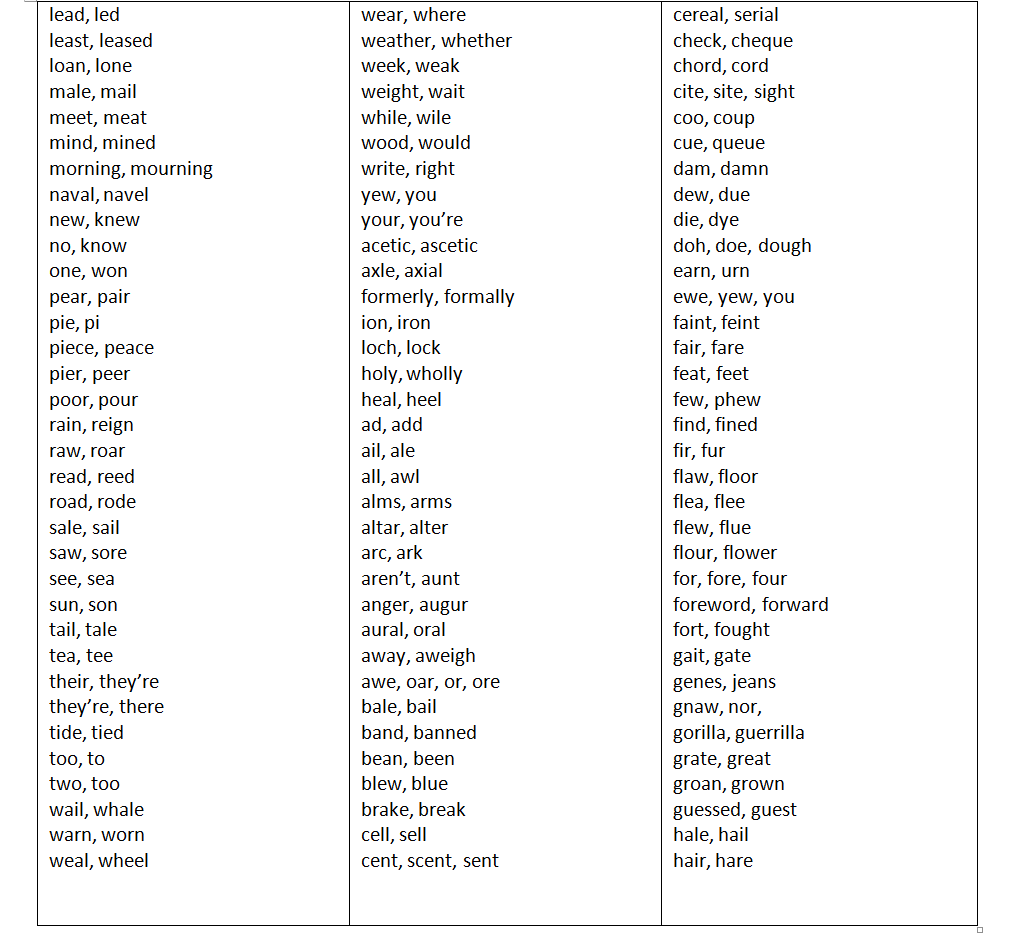
Exercise 7
Give the homophones and the meanings of the following words.
1. in 6. knight
2. heard 7. knows
3. horse 8. tick
4. hey 9. rung
5. need 10. sees
(iii) Synonyms
Synonyms are words that have almost the same meaning but different spelling and pronunciation.
Examples:
Slender – thin finish – end sick –ill
Some words have several synonyms.
For example, happy has such synonyms words like light-hearted, pleased, and cheerful.
Synonyms help vary the writing, just like pronouns do.
For example, the word happy and its synonyms help vary the writing.
Daniel felt happy – Daniel felt light-hearted.
She was happy with her grade – She was pleased with her grade.
They sang a happy song – They sang a cheerful song.
Examples of common synonyms in English
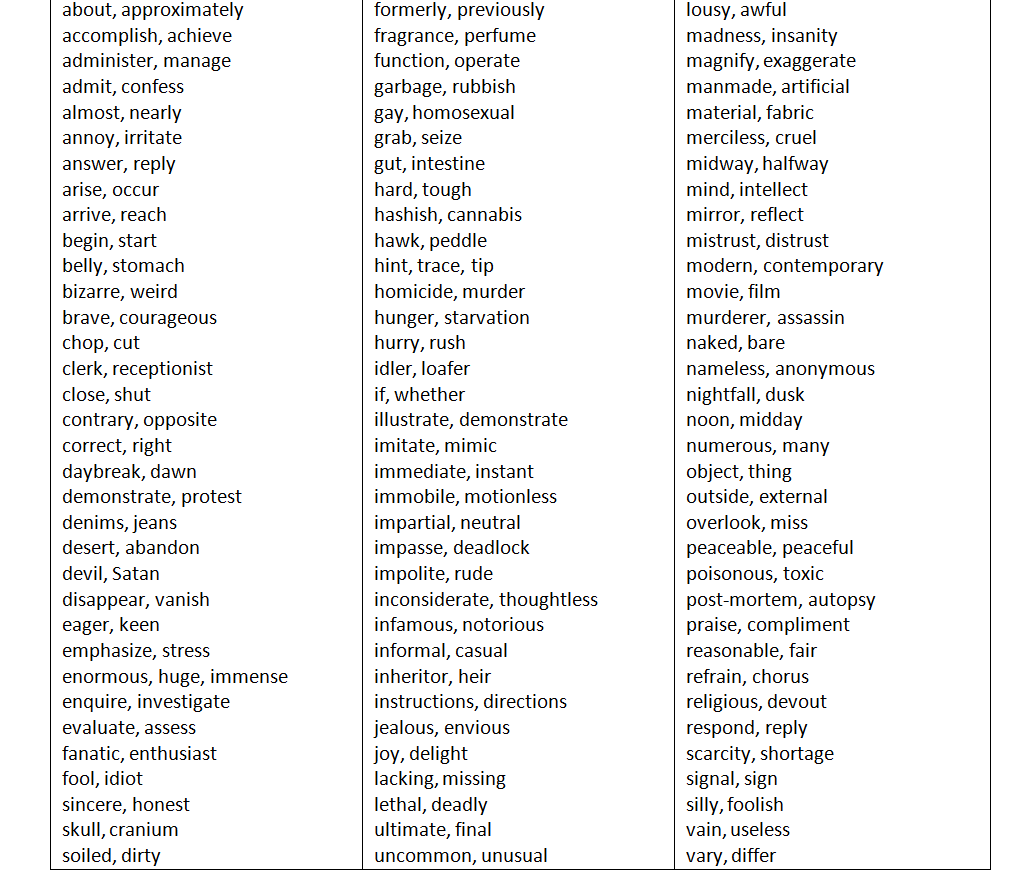
Exercise 8
Give the synonyms of the following words:
1. start 6. collect
2. come 7. assist
3. lengthy 8. build
4. shattered 9. reply
5. Fix 10. purchase
(iv) Antonyms
Antonyms are words that have opposite meanings.
Antonyms also add variety to your writing.
Examples:
Cold-hot heavier – lighter fearful – brave.
Some words have more than one antonym.
Some of these antonyms can be formed by adding a prefix to a base word.
Examples:
Kind – cruel, unkind like – hate, dislike
Examples of common antonyms in English
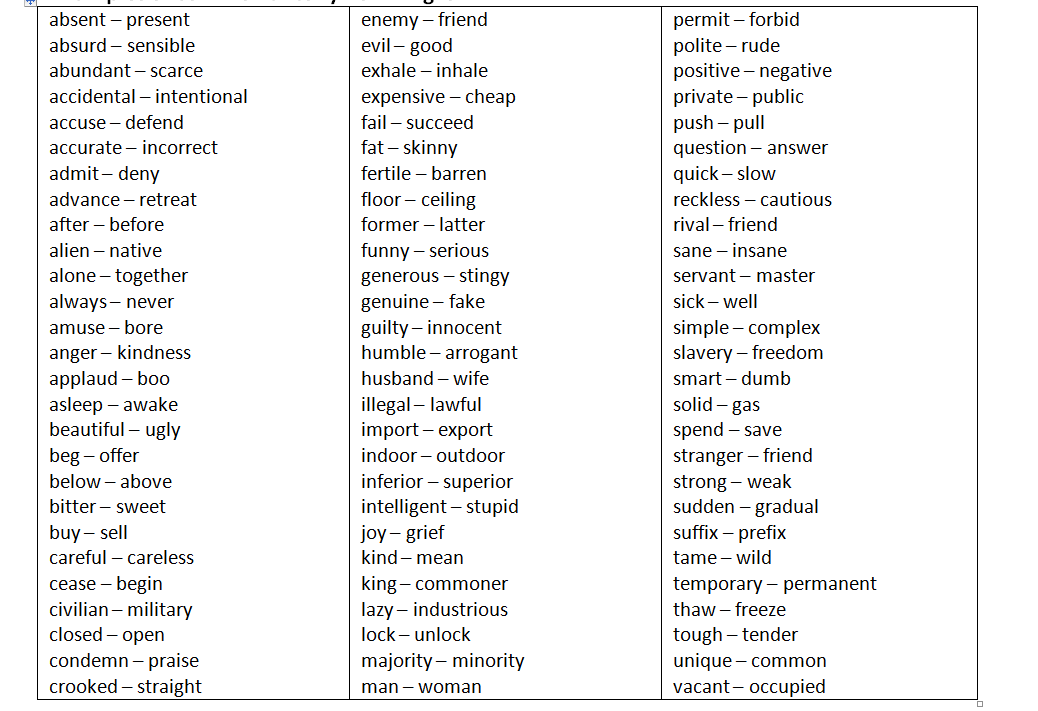
Exercise 9
Give the antonyms of the following words:
1. easy 6. sweat
2. whisper 7. stationary
3. triumph 8. strengthen
4. dull 9. precious
5. dangerous 10. naked
(v) Idioms and Sayings
An idiom is a phrase that has a special meaning as a whole.
The meaning of an idiom is different from the meanings of its separate words.
Examples:
It was raining cats and dogs.
The idiom raining cats and dogs does not mean that cats and dogs were falling out of the sky! It means “raining heavily”.
I put my foot in my mouth today.
The idiom put my foot in my mouth means “to say the wrong thing”.
Sometimes the context in which an idiom is used can give a hint of its meaning.
Example:
Jeff is talking through his hat when he says that he can spell every word in the English language.
This idiom clearly means that Jeff cannot possibly spell every word in the English language.
Hence, the idiom talking through his hat means talking nonsense
More examples of idioms in the English language

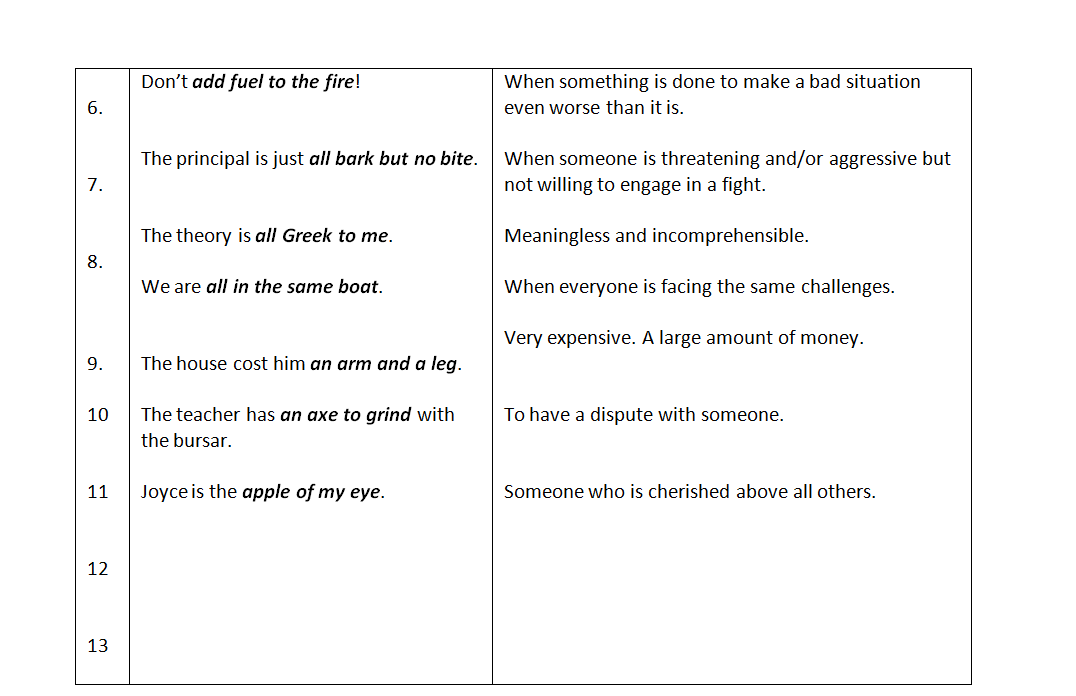
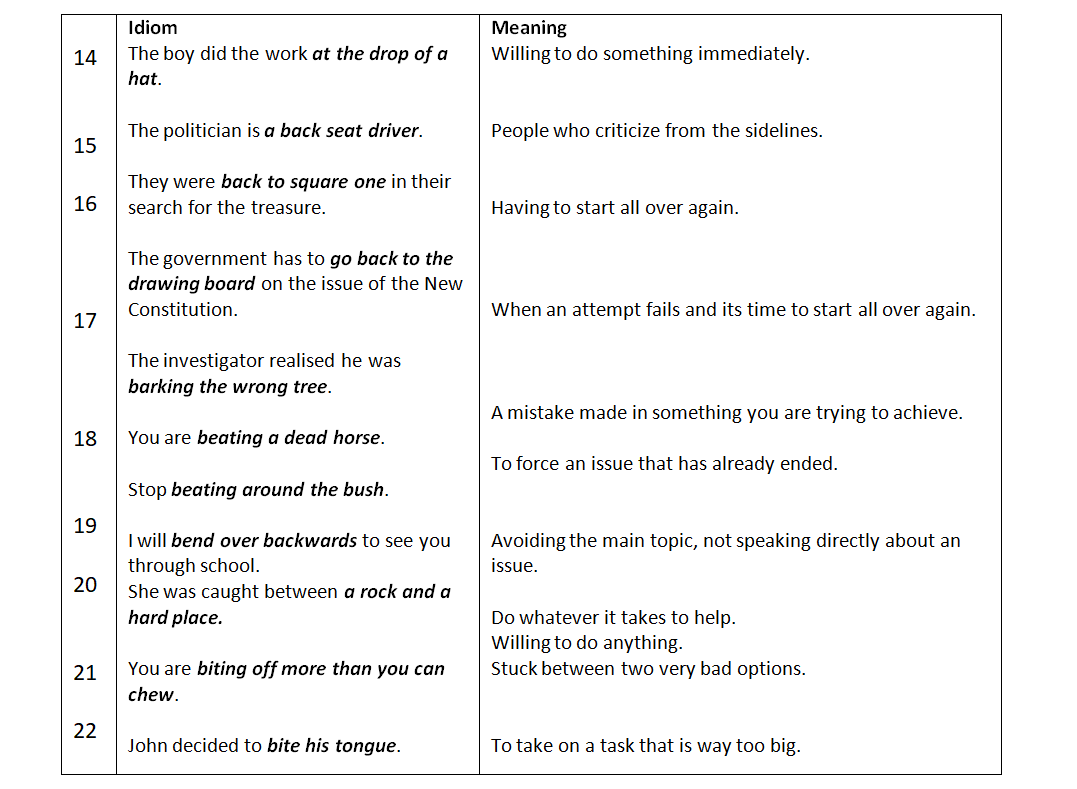
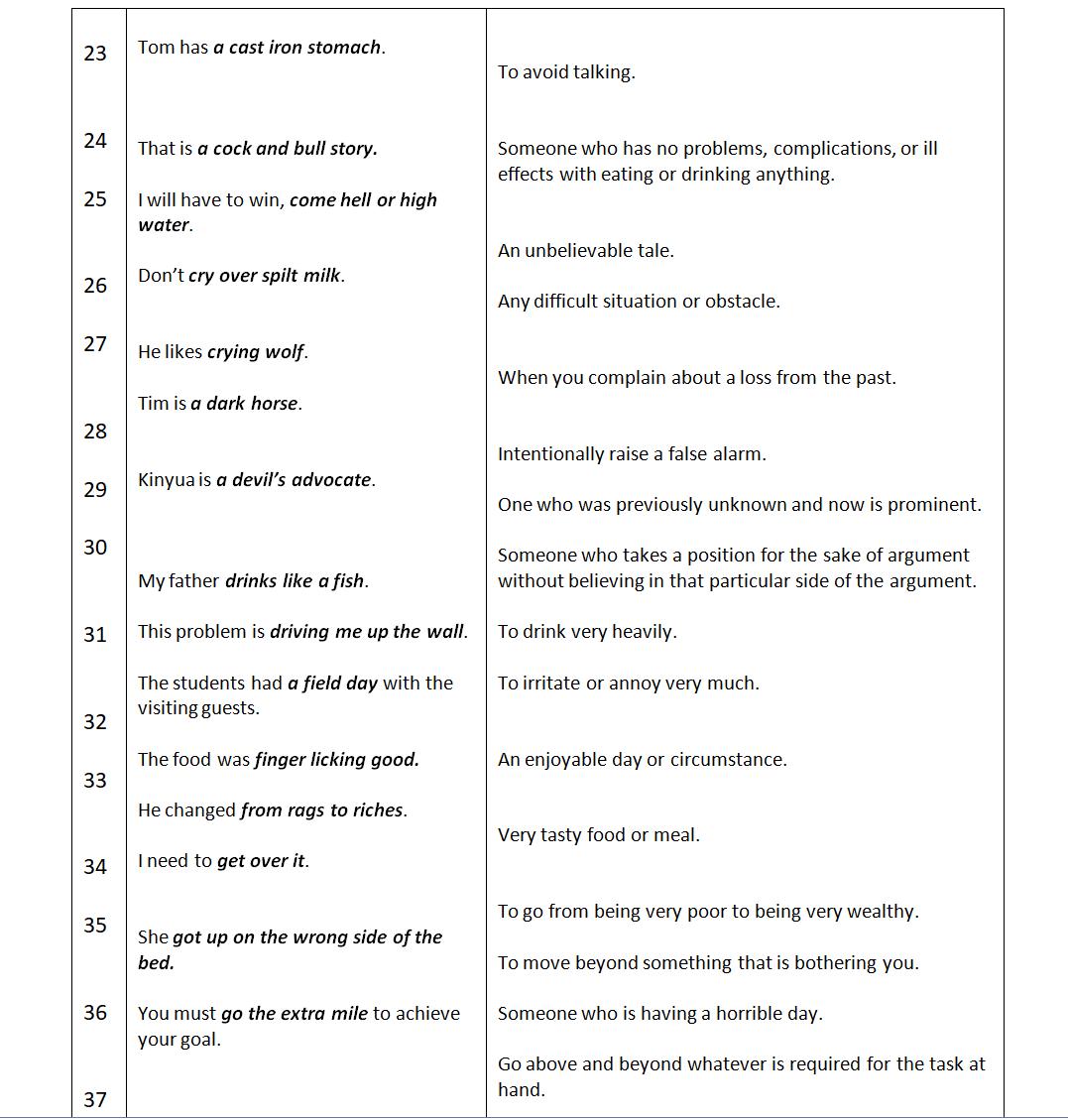
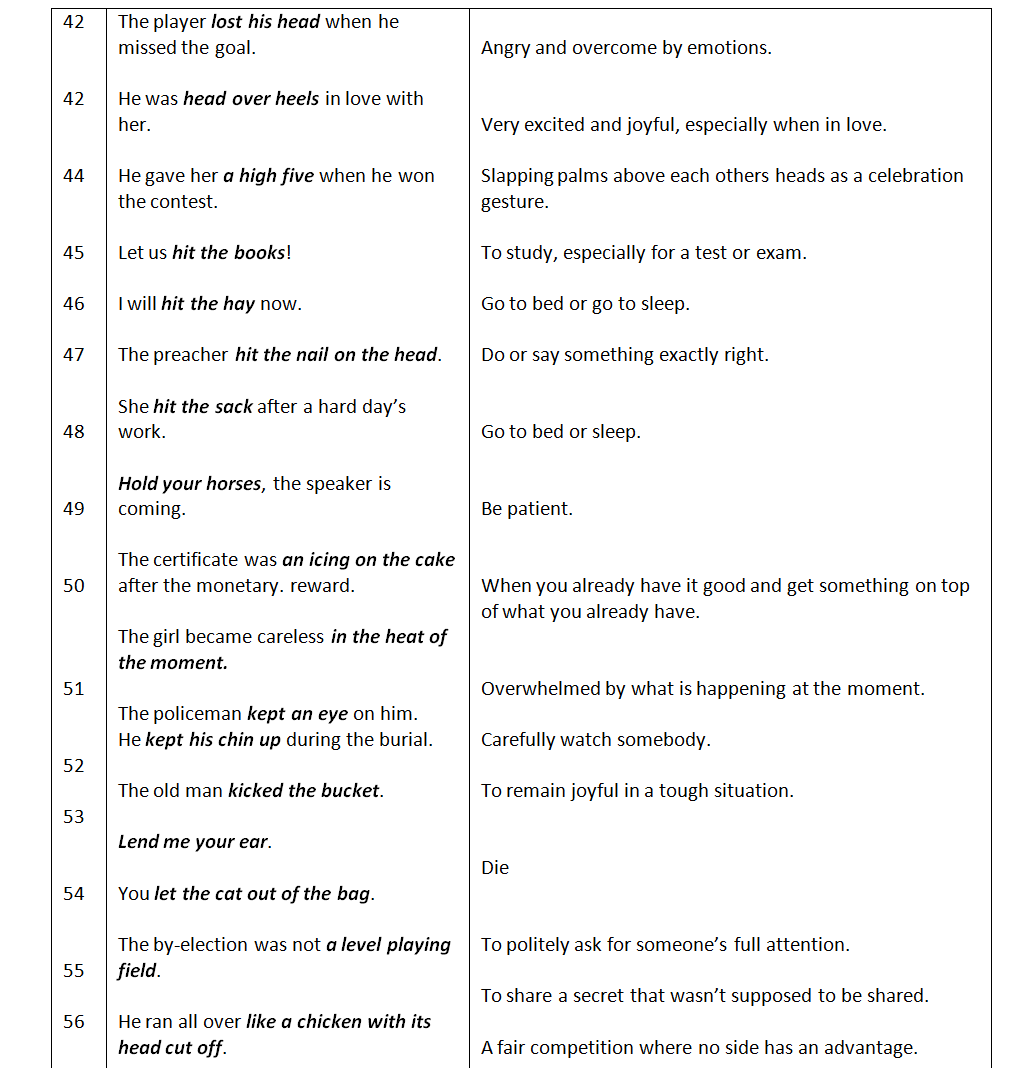
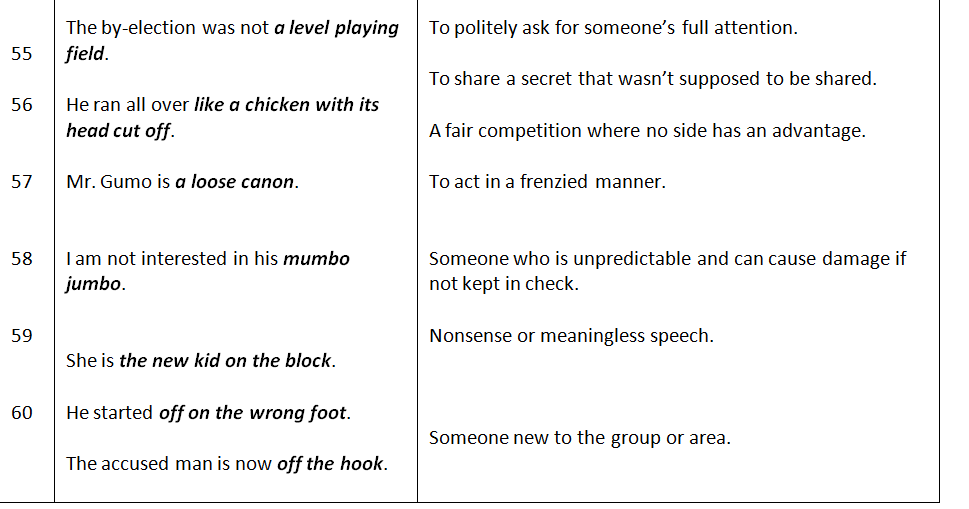
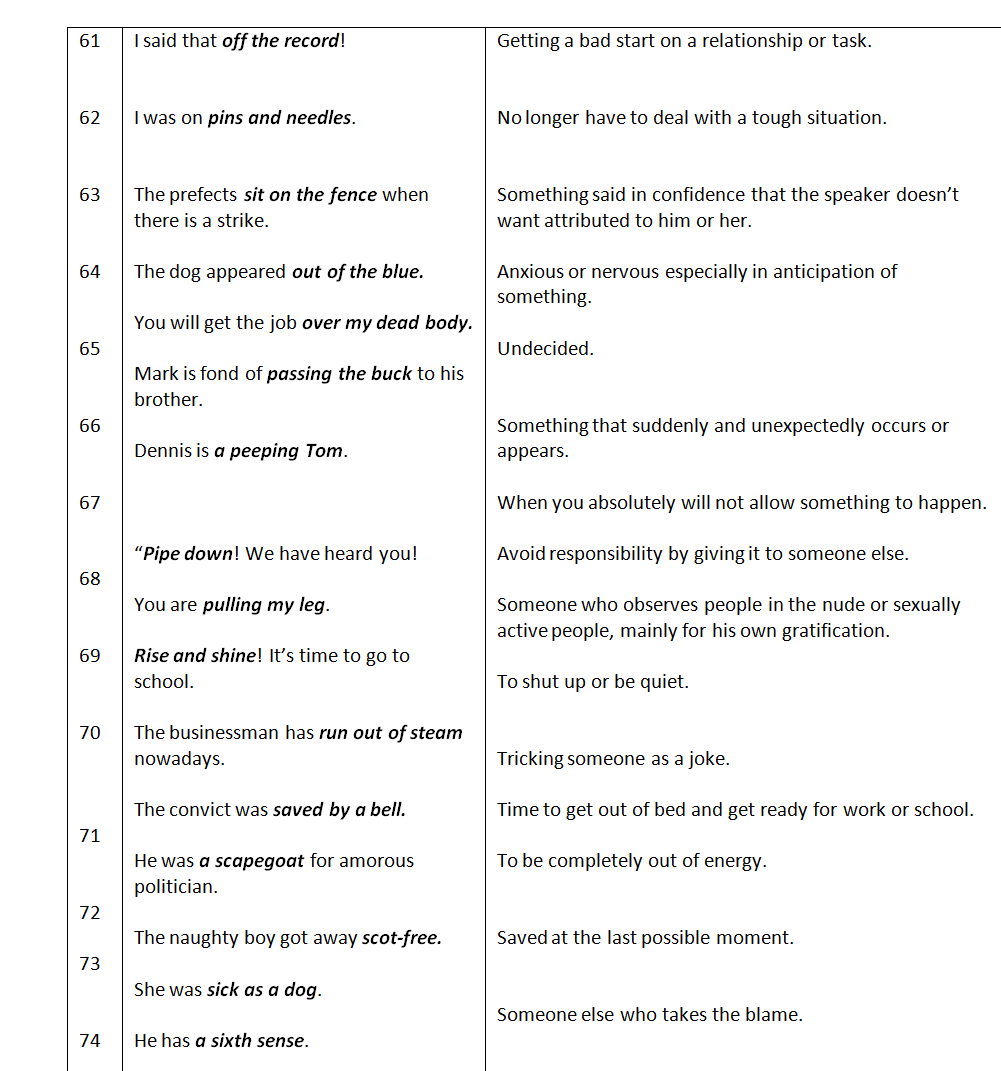
Common idiomatic expressions and sayings
1. A bird in the hand is worth to in the bush.
– Having something that is certain is much better than taking a risk for more, because chances are you might lose everything.
2. A fool and his money are easily parted.
– It’s easy for a foolish person to lose his/her money.
3. A house divided against itself cannot stand.
– Everyone involved must unify and function together or it will not work out.
4. A leopard can’t change his spots.
– You cannot change who you are.
5. A penny save is a penny earned.
– By not spending money you are saving money (little by little).
6. A picture paints a thousand words.
– A visual presentation is far more descriptive than words.
7. Actions speak louder than words.
– It’s better to actually do something than just talk about it.
8. Curiosity killed the cat.
– Being inquisitive can lead you into a dangerous situation.
9. Don’t count your chickens before they hatch.
– Don’t rely on it until you are sure of it.
10. Don’t look a gift horse in the mouth.
– When someone gives you a gift, don’t be ungrateful.
11. Don’t put all your eggs in one basket.
– Do not put all your resources in one possibility.
12. Drastic times call for drastic measures.
– When you are extremely desperate you need to take extremely desperate actions.
13. Elvis has left the building.
– The show has come to an end.
It’s all over.
14. Every cloud has a silver lining.
– Be optimistic, even difficult times will lead to better days.
15. Great minds think alike.
– Intelligent people think like each other.
16. Haste makes waste.
– Doing things quickly may result in a poor ending.
17. Idle hands are the devils’ tools.
– You are more likely to get it trouble if you have nothing to do.
18. If it’s not one thing, it’s another.
– When one thing goes wrong, then another, and another ….
19. It takes two to tango.
– A conflict involves two people and both must cooperate to have it resolved.
20.
It’s a small world.
– You cannot hide from your evil deeds in this world.
21. Let bygones be bygones.
– To forget about a disagreement or argument.
22. Let sleeping dogs lie.
– To avoid restarting a conflict.
23. Never bite the hand that feeds you.
– Don’t hurt anyone that helps you.
24. Practice makes perfect.
– By constantly practising, you will become better.
25. Rome was not built in one day.
– If you want something to be completed properly, then it’s going to take time.
26. The bigger they are, the harder they fall.
– The bigger and stronger opponent may be more difficult to beat, but when he does, he suffers a much bigger loss.
27. Variety is the spice of life.
– The more experiences you try the more exciting life can be.
28. When it rains, it pours.
– Since it rarely rains, when it does it will be a huge, storm.
29. You are what you eat.
– In order to stay healthy, you must eat healthy foods.
30.
You can’t judge a book by its cover.
– Decisions shouldn’t be made primarily on appearance.
Exercise 10
Give the meaning of the italicized idioms in the following sentences.
1. I was completely at sea when the Prime Minister visited my house.
2. Jane has her hands full.
She can’t take on more work.
3. Do you have a bone to pick with me?
4. I can’t make heads or tails of this story.
5. The test was as easy as pie.
6. I am sick and tired of doing nothing at work.
7. I am broke! I have to borrow some money.
8. She dropped me a line yesterday.
9. He filled in for her when she fell sick.
10. My business is in the red.
Answers From Chapter Two
Exercise 1
1. crack 6. quack
2. roar 7. pop
3. tick 8. lap
4. growl 9. boom
5. chime 10. hiss
Exercise 2
1. Lima bean – a broad, flat, pale-green or white bean used as a vegetable – named after Lima, the capital of Peru where it was grown first.
2. Cardigan – a kind of a pullover or sweater that buttons down the front – named after J.
T.
Brudwell, the 7th Earl of Cardigan.
3. Bloomer – a woman’s baggy and long garment for the lower body – named after Amelia Bloomer, an American women rights and temperance advocate.
4. Canary birds – yellow songbirds – named after Canary Islands, Spain, where they are found in large numbers.
5. Ferris wheel – a special wheel for an amusement park – named after the inventor G.
W.
Ferris.
6. Guppy – the most popular freshwater tropical fish – named after R.J.L. Guppy, the man who introduced it in England.
7. Cheddar – A firm Cheese – named after the English village of Cheddar, where it was first made.
8. Quisling – a person who treacherously helps to prepare for enemy occupation of his own county, a traitor – named after Vidkum Quisling, a Norwegian politician.
9. Silhouette – an outline portrait or profile – named after a French minister of finance, Etienne de Silhouette.
10. Marxism – the political and economic theories of Karl Marx and Friedrich Engels – named after Karl Marx.
11. Guillotine – a device used for carrying out executions – named after Dr.Joseph Guillotine, the designer.
12. Macadam – small, broken stones that are used for making roads – named after John L.
McAdam, a Scottish engineer who invented this kind of a road.
13. Pasteurisation – the process of heating milk, wine, beer, or other liquids hot enough to kill harmful bacteria and to prevent or stop fermentation – named after Louis Pasteur, a French chemist, who invented the process.
14. Watt – Unit of measuring electric power – named after James Watt, a Scottish engineer, who pioneered in the development of the steam engine.
15. Ohm – a measure of electrical resistance – named after George S.
Ohm, a German physicist.
Exercise 3
1. slithy – lithe + slimy 6. breathalyser – breath + analyser
2. chortle – chuckle + short 7. cablegram – cable + telegram
3. galumph – gallop + triumph 8. camcorder – camera + recorder
4. bash – bang + smash 9. edutainment – education + entertainment
5. blog – web + log 10. email – electronic + mail
Exercise 4
1. utra – beyond – ultraviolet, ultrasonic
2. syn – in union – synchronize, symmetry
3. sub – at a lower position – submarine, subsoil
4. peri – round, about – perimeter
5. out – surpassing, exceeding – outperform
6. infra – below – infrared, infrastructure
7. hypo – under – hypodermic, hypothermia
8. hemi – half – hemisphere
9. ex – previous – ex-wife, ex-policeman
10. dia – across, through – diagonal
Exercise 5
1. hopeful – full of hope 6. greenish – having green colour
2. reader – a person who reads 7. weary – tired
3. childish – having manners of a child 8. fearless – lacking fear
4. greyish – having grey colour 9. kindness – the quality of being kind
5. playful – fond of playing 10. washable – can be washed
Exercise 6
1. Pen – a device for writing
– an enclosure for sheep
2. Tire – to make weary
– the rubber material on the wheel of an automobile or bicycle.
3. Dove – past tense of dive
– a bird
4. Wound – past tense of wind
– an injury.
5. Mean – stingy
– average
6. Act – a dramatic performance
– doing something
7. Arms – upper limbs
– weapons
8. Block – a building
– obstruct
9. Box – a carton
– fight with gloves
10. Bank – edge of a river
– a money depository
Exercise 7
1. in –inn 6. knight – night
2. heard – herd 7. knows – nose
3. horse – hoarse 8. tick – tic
4. key – quay 9. rung – wrung
5. need – knead 10. sees – seize
Exercise 8
1. start – begin 6. collect – gather
2. come – arrive 7. assist – help
3. lengthy – long 8. build – construct
4. shattered – broken 9. reply – answer
5. fix – repair 10. purchase – buy
Exercise 9
1. easy – hard 6. sweet – sour
2. whisper – yell 7. stationary – mobile
3. triumph – fail 8. strength – weaken
4. dull – interesting 9. precious – worthless
5. dangerous – safe 10. naked – clothed
Exercise 10
1. at sea – confused
2. has his hands full – is busy
3. have a bone to pick with me – have a quarrel
4. make heads or tails – make sense
5. as easy as pie – very easy
6. sick and tired – can’t stand, hate
7. broke – to have no money
8. dropped me a line yesterday – sent me a letter or email
9. filled in for her – did her work while she was away
10. in the red – losing money, not profitable
Chapter Three
Phrases and Sentences
Phrases
A phrase is a group of words without a subject or a predicate or both and does not express a complete thought.
Therefore, a phrase can never stand on its own as a complete sentence.
Using different kinds of phrases enables a writer or a speaker to create informative and descriptive sentences that vary in structure.
phrases combine words into a larger unit that can function as a sentence element.
The most common kinds of phrases in English are: Noun phrases, verb phrases, prepositional phrases, gerund phrases and participial phrases.
(i) Noun Phrases
A noun phrase consists of a noun and all its modifiers.
It can function as a subject, object, or complement in the sentence.
The modifiers may include articles, prepositions and adjectives.
Examples:
(a) Noun phrases as subjects
The lazy old man sleeps all day long.
Some school boards reward teachers who produce good results.
(b) Noun phrases as objects
Teachers rejected the proposed performance contracts.
Critics opposed the controversial marriage bill.
(c) Noun phrases as complements
Teaching is a valuable profession.
Sheila is a hardworking no-nonsense lady.
Exercise 1
Identify the noun phrases in each of the following sentences and indicate whether it functions as a subject, object or complement.
1. I saw a TV show yesterday.
2. Playful animals really fascinate me.
3. Yesterday, I had a thrilling adventure.
4. Swimming is an exciting activity.
5. Twenty university students were expelled last month.
6. She is a certified public health officer.
7. Many of the soldiers were killed in the battle.
8. The old woman carried a heavy load of firewood on her back.
9. Peter seems a very complicated man to understand
10. A devastating earthquake hit China yesterday.
(ii) Verb phrases
A verb phrase consists of a main verb and its helping verbs.
It can function as the predicate of a sentence.
The predicate tells what the subject does or is.
(It tells something about the subject).
Examples:
John was born in Malindi.
This problem may have contributed to the collapse of the economy.
Without highly – trained workers, many Kenyan companies would be forced to close down.
Sometimes the parts of a verb phrase are separated from each other by words that are not verbs.
Examples:
He is finally buying a new house.
Salesmen must occasionally travel long distances.
Some words are joined with other words to make contractions.
Examples:
He hasn’t turned up for the meeting (has + not)
We couldn’t tell what had killed the cow.
(could + not)
I’ve ordered them to leave the house.
(I + have).
NB: The word not and the contraction n’t are adverbs.
They are never part of a verb or verb phrase.
Exercise 2
Write the verb phrase in each of the following sentences.
1. We should have taken pictures of the wild animals.
2. You must have seen the posters of the event.
3. They should have been told to come with flowers to plant in the school compound.
4. Mr.
Muchira would have told some interesting stories.
5. Scientists must’ve visited the Menengai Crater.
6. He must have seen some wonderful places.
7. Many advocates do fear the new Chief Justice.
8. The scouts have often made camp here.
9. The bull fighters would sometimes stampede noisily.
10. I could have read the book if he had allowed me.
(iii) Prepositional phrases
A prepositional phrase is made up of a preposition, the object of the preposition, and all the words between them.
It often functions as an adjective or adverb, but it can function as a noun as well.
Examples:
We carried the fruits in our school bags. (adverb telling where)
The plane flew through the cloud. (adverb telling where)
Almost half of Africa’s population suffers from water – related diseases. (adverb modifying suffers).
The water supply in the United States is expected to decline dramatically. (adjective modifying water supply).
The best time to practise water conservation is before a water shortage.
(noun functioning as a complement).
In sentence 1 above, the preposition is in, the object of the preposition is bags, and the modifiers or adjectives are our and school.
Sometimes two or more nouns or pronouns are used as objects in a prepositional phrase.
Example:
He needs a wife with diligence and a good character.
Diligence and character are objects of the preposition with.
When prepositional phrases function as adjectives and adverbs in sentences, they are called adjectival and adverbial phrases respectively.
(a) An adjectival prepositional phrase modifies nouns or pronouns.
Examples:
The woman wears shoes with sharp heels.
(an adjectival phrase modifying the noun shoes)
The man with a funny – looking dog crossed the road.
(an adjectival phrase modifying the noun man)
(b) An adverbial prepositional phrase modifies verbs, adjectives, or other adverbs.
Examples:
Soldiers train for many months.
(an adverbial phrase modifying the verb train)
People are lazy in the afternoons.
(an adverbial phrase modifying the adjective lazy.
)
She arrived late in the night.
(an adverbial phrase modifying the adverb late).
Sometimes one prepositional phrase immediately follows another.
Examples:
The man led him through the door on the left.
Note that the prepositional phrase through the door is an adverbial phrase modifying the verb led and tells where? The second prepositional phrase on the left is an adjectival phrase modifying the noun door and tells which one?
A prepositional phrase can be at the beginning, in the middle, or at the end of a sentence.
Examples:
At dusk, we began to walk home.
The map of the area was very helpful.
The path went by a forest and a large lake.
Exercise 3
Underline the prepositional phrases in the following sentences and indicate what type each of them is.
1. The oldest building is found in Mombasa.
2. Five companies around the country have bought new fire engines.
3. The barking of the dog scared the strangers.
4. Bulls are bred for hard work.
5. Most bridges are built over water.
6. Travellers were spared many miles of travel.
7. I went by bus to the market.
8. At the market, I saw beautiful and unusual people.
9. I also saw a display of colourful clothes.
10. She took him through the lesson with professional expertise.
(iv) Gerund phrases
A gerund is a verb form used as a noun.
It is formed by adding -ing to the present these of a verb.
Gerunds can be used as subjects, direct objects, objects of prepositions, and complements.
Examples:
Subject: Fishing is a popular activity in Nyanza Province.
(Fishing is a gerund, the subject of the verb is)
Direct object: The sport involves riding.
(riding is a gerund, the direct object of the verb involves)
Object of preposition: The sport is similar to fencing.
(fencing is a gerund, the object of the preposition to).
A gerund phrase includes a gerund, its modifiers, objects or complements.
It always functions as a noun.
Examples:
Becoming a Tusker Project fame finalist was Msechu’s lifetime dream.
(gerund phrase is the subject of the sentence.
)
Msechu dreamt all his life about winning the top award.
(the gerund phrase is an object of the preposition about).
One of Msechu’s biggest disappointments was losing to Alpha.
(the gerund phrase is a complement).
The game involves jumping over hurdles.
(object of the verb involves).
Exercise 4
Underline the gerund or gerund phrases in the following sentences and label each one subject, direct, object, object of preposition, or complement.
1. In early days, golfing was a game for the rich.
2. The rich were mostly interested in protecting their status.
3. Playing golf with a commoner would mean lowered status.
4. Much of the rich people’s time was spent playing the game.
5. Training thoroughly improved a golfer’s accuracy in the game.
6. There he learned about playing the game.
7. Later, he started contesting with other junior golfers.
8. At fifteen or sixteen, he began playing with the professionals.
9. Participating in international tournaments was the golfer’s dream.
10. But the greatest dream was winning an in international title.
(v) Participial phrases
A participle is a verb form that always acts as an adjective.
There are two types of participles:
(a) The past participle – it is usually formed by adding –d, or -ed to the present tense.
Examples:
Fooled, the shopkeeper bought fake products.
(Fooled is a past participle modifying the noun shopkeeper)
Shaken, he dashed to the police station.
(Shaken is a past participle modifying the pronoun he)
The participles of irregular verbs, however, do not follow the above rule: run-run, throw-thrown.
(b) The present participle – it is usually formed by adding -ing to the present tense of any verb.
Examples:
Smiling, the conman stepped out of the shop.
(Smiling is a present participle modifying the noun conman).
Using participles is a simple way of adding information to sentences and to vary sentences beginnings.
A participial phrase consists of a present or past participle and its modifiers, objects, or complements.
It always functions as an adjective.
Examples:
Rounding the corner, the conman met two policemen.
(Rounding the corner is a present participial phrase modifying the noun conman).
Surprised by the appearance of the conman, the policemen started blowing their whistles.
(Surprised by the appearance of the conman is a past participial phrase modifying the noun policemen).
A participle or participial phrase is not always at the beginning of a sentence.
Sometimes it may appear in the middle but it should be near the noun or pronoun it modifies.
Examples:
The skilled policemen arrested the conman.
The conman, losing control, fought the policemen fiercely.
Points to Note
Both the gerund and the present participle are created by a adding -ing to the present tense of a verb.
BUT how can you tell whether a word is a gerund or a participle? It all depends on how the word is used in a sentence.
(i) A participle is used as a modifier in a sentence.
Example:
Gaining courage, the conman attempted to escape.
(Gaining courage is a participial phrase modifying conman).
(ii) A gerund is used as a noun in a sentence.
Example:
Gaining courage made the conman look aggressive.
(Gaining courage is a gerund phrase, the subject of the verb made).
Exercise 5
Underline the participial phrases in the following sentences, indicating whether it is a past or present participial phrase and the noun or pronoun it modifies.
1. Defying all odds, Kisoi Munyao attempted to climb to the highest peak of Mt.
Kenya for seven times.
2. Failing each time, he refused to give up.
3. Seeing his passion to scale the peak, the government offered him financial assistance.
4. The climber ascended slowly, making steady progress.
5. Pleased with his progress, he camped at eleven thousand feet.
6. The climber, determined to hoist the Kenyan flag, progressed on the following morning.
7. Slipping on the snow, Munyao fell on a dry tree trunk.
8. A rope worn from too many climbs then broke.
9. One of his hot water bottles, slipping to the bottom of the cliff, broke into pieces.
10. Munyao, overcome with joy, finally hoisted the flag at Point Batian.
(vi) Infinitive phrases
An infinitive is a verb form that usually appears with the word to before it.
To is called the sign of the infinitive.
Examples:
to lift to eat to launch to register
To is a preposition if it is followed by a noun or noun phrase, but it is a sign of the infinitive if it is followed by a verb or verb phrase.
Examples:
Joseph longed for a flight to the moon.
(prepositional phrase)
Not until 1985 was he able to succeed.
(infinitive)
An infinitive phrase consists of an infinitive and its modifiers, objects or complements.
It can function as a noun, adjective, or adverb.
Examples:
To write clearly and concisely can be difficult sometimes.
(Infinitive phrase functioning as a noun and the subject of the sentence).
Proofreading your writing is a good way to ensure the absence of typing mistakes.
(Infinitive phrase functioning as an adjective modifying the noun way).
To greatly increase the amount of stress in your life, leave your writing task until the night before it is due.
(Infinitive phrase functioning as an adverb modifying the verb leave).
Exercise 6
Underline the infinitive phrases in each of the following sentences and state whether it is functioning as a noun, adjective or adverb.
1. To climb Mt.
Kenya was the dream of Kisoi Munyao.
2. The freedom hero decided to climb the mountain on the eve of the country’s independence.
3. He was one of the first Kenyans to try this risky climb.
4. His determination helped him to make rapid progress to reach Point Batian.
5. Munyao was able to reach the peak with very limited climbing gear.
6. To reach Point Batian was Munyao’s ultimate goal.
7. At first few other climbers bothered to listen to Munyao.
8. He was even forced to finance much of his expedition himself.
9. Munyao worked hard to achieve his dream of hoisting the Kenyan flag.
10. His success made it easier for other climbers to scale the tallest mountain in Kenya.
Answers on Chapter Three
Exercise 1
1. a TV show – object
2. Playful animals – subject
3. a thrilling adventure – object
4. an exciting activity – complement
5. Twenty university students – subject
6. a certified public health officer – complement
7. Many of the soldiers – subject
8. The old woman – subject, a heavy load – object
9. a very complicated man – complement
10. A devastating earthquake – subject
Exercise 2
1. should have taken 6. must have seen
2. must have seen 7. do fear
3. should have been told
8. have made
4. would have told 9. would stampede
5. must’ve visited 10. could have read
Exercise 3
1. in Mombasa – adverbial modifying the verb found.
2. around the country – adjectival modifying the noun companies.
3. of the dog – adjectival modifying the noun barking.
4. for hard work – adverbial modifying the verb bred.
5. over water – adverbial modifying the verb built.
6. of travel – adjectival modifying the noun miles.
7. by bus – adverbial modifying the verb went.
to the market – adverbial modifying the verb went.
8. At the market – adjectival modifying the noun.
9. of colours clothes – adjectival modifying the noun display.
10. with professional expertise – adverbial modifying the phrasal verb took through.
Exercise 4
1. golfing – complement
2. protecting their status – object of the preposition in.
3. Playing golf with a commoner – subject
4. playing the game – direct object
5. Training thoroughly – subject
6. playing the game- object of preposition
7. contesting with junior golfers – subject
8. playing with the professionals – direct object
9. Participating in international tournaments – subject
10. Winning an international title – complement
Exercise 5
1. Defying all odds – present participial phrase – Kisoi Munyao
2. Failing each time – present participial phrase – he
3. Seeing his passion to scale the peak – present participial phrase – government
4. making steady progress – present participial phrase – climber
5. Pleased with his progress – past participial phrase – he
6. determined to hast the Kenya flag – past participial phrase – climber
7. Slipping on the snow – present participial phrase – Munyao
8. worn from too many climbs – past participial phrase – rope
9. slipping to the bottom of the cliff- present participial – bottles
10. overcome with joy – past participial phrase – Munyao
Exercise 6
1. To climb Mt.
Kenya –noun
2. to climb the mountain – noun
3. to try this risky climb – adjective modifying the noun Kenyans
4. to make rapid progress – adverb modifying the verb helped
5. with very limited climbing gear – adverb modifying the verb reach
6. To reach Point Batian – noun
7. to listen to Munyao – noun
8. to finance much of his expedition – adverb modifying the verb forced
9. to achieve his dream of hasting the flag – adverb modifying the verb worked
10. to scale the tallest mountain in Kenya – adverb modifying the verb made.
Chapter Four
Sentences
What is a sentence?
A sentence is a group of words that expresses a complete thought.
A complete thought is clear.
A sentence always begins with a capital letter.
It ends with a full stop (.), a question mark (?) or an exclamation mark (!).
Examples:
Ted sent me a letter.
Jane slept soundly.
Sentence fragments
A sentence fragment does not express a complete thought.
The reader or listener cannot be sure what is missing in or the meaning of a sentence fragment.
He or she will be left wondering: What is this about? What happened?
Examples:
Fragment: The huge boat.
(What happened?)
Sentence: The huge boat sails down the river.
You can correct a sentence fragment by supplying the missing information.
Subjects and predicates
The two fundamental parts of every English sentence are the subject and the predicate.
A subject can be described as the component that performs the action described by the predicate.
It tells who or what does or did the action.
It may also name the topic.
The predicate tells about the subject.
It tells what the subject does or is.
Examples:
Subject Predicate
(Who or what) (What is said about the subject)
The antelope jumped over the high fence.
Pigs eat anything is sight when hungry.
In a sentence, a few key words are more important than the rest.
These key words make the basic framework of the sentence.
The verb and its subject are the key words that form the basic framework of every sentence.
The rest of the sentence is built around them.
Examples:
Sentence Key words
The young kids jumped playfully.
kids, jumped
Their faces shone brightly.
faces, shone
To find out the subject, ask who or what before the verb.
Examples:
Who jumped playfully? – kids
What shone brightly? – faces
To find out the verb, ask what after the subject.
Examples:
The young kids did what? – jumped
Their faces did what? – shone
The key word in the subject of a sentence is called the simple subject.
For example, kids, faces.
The complete subject is the simple subject plus any words that modify or describe it.
For example, The young kids, Their faces.
The key word in the predicate is called the simple predicate.
For example, jumped, shone.
The complete predicate is the verb plus any words that modify or complete the verb’s meaning.
For example, jumped playfully, shone brightly.
The simple subjects and predicates may sometimes be more than one word.
For simple subjects, it may be the name of a person or a place.
Examples:
Ballack Obama won the US presidential race.
South Africa is the home of many bats.
The simple predicate may also be more than one word.
There may be a main verb and a helping verb.
Tanya has acted in many TV shows.
She will be performing again tonight.
Objects
An object in a sentence is a word or words that complete the meaning of a sentence.
It is involved in the action but does not carry it out.
The object is the person or thing affected by the action described in the verb.
It is always a noun or a pronoun and it always comes after the verb.
Example:
The man climbed a tree.
Some verbs complete the meaning of sentences without the help of other words.
The action that they describe is complete.
Examples:
It rained.
The temperature rose.
Some other verbs do not express a complete meaning by themselves.
They need to combine with other words to complete the meaning of a sentence.
Examples:
Christine saw the snake.
Rose wears goggles.
He opened the door.
In the above examples, the snake, goggles and the door are the objects as they are the things being affected by the verbs in the sentences.
(Refer to the topic on Transitive and Intransitive Verbs under the main topic VERBS).
Exercise 1
Which groups of words are sentences and which ones are sentence fragments?
1. A huge storm was coming.
2. Behind the wattle tree.
3. After the earthquake.
4. The wind broke several houses.
5. Surprised by a loud noise.
6. Winds of high speed.
7. Rescue workers arrived.
8. From different parts of the world.
9. Many people were injured.
10. In the weeks after the earthquake.
Direct and indirect objects
Objects come in two types, direct and InDirect:
Direct objects
The direct object is the word that receives the action of a verb.
Examples:
Christine saw a snake.
( a snake receives the action of saw)
Rose wears goggles.
(goggles receives the action of wears)
Sometimes the direct object tells the result of an action.
Examples:
Tecla won the race.
She received a trophy.
To find the direct object first find the verb.
Then ask whom or what after the verb.
Examples:
Christine saw a snake.
Rose wears goggles
Verb: saw verb: wears
Saw what? a snake wears what? goggles
Tecla won the race She received a trophy
Verb: won verb: received
Won what? the race received what? a trophy
Remember, we said earlier that a verb that has a direct object is called a transitive verb and a verb that does not have an object is called an intransitive verb.
We also said that a verb may be intransitive in one sentence and transitive in another.
Other verbs are strictly intransitive like disagree.
Indirect objects
The indirect object refers to a person or thing who receives the direct object.
They tell us for whom or to whom something is done.
Others tell to what or for what something is done.
Examples:
I gave him the book.
He is the indirect object as he is the beneficiary of the book.
Direct object or adverb?
Direct objects are sometimes confused with adverbs.
The direct object tells what or whom as we have seen earlier.
Adverbs on the other hand tell how, where, when or to what extent.
They modify the verbs.
Examples:
Brian Swam slowly.
(slowly is an adverb telling how)
Brian Swam a tough race.
(race is a direct object telling what).
Verbs can also be followed by a phrase that tells how, when, or where.
This kind of a phrase is never a direct object but an adverbial phrase.
Example:
Brian swam across the pool.
(a cross the pool tells where Brian Swam).
Therefore, to decide whether a word or a phrase is a direct object or adverb, decide first what it tells about the verb.
If it tells how, where, when or to what extent, it is an adverb.
If it tells what or whom, it is a direct object.
Exercise 2
Identify the objects or the adverbs/adverbial phrases in the following sentences.
If the sentence has two objects, indicate the direct object and the indirect object.
1. Nanu sings pop music.
2. Nanu sings sweetly.
3. He spoke very quietly.
4. I have read that book three times.
5. She has gone to the bank.
6. David gave her a present.
7. David disagreed bitterly.
8. The player sat on his heels.
9. She made a list of the items to buy.
10. They offered him help.
Complements
Some sentences do not take objects or adverbs (or adverbial phrases) after the verbs.
Instead, they take complements.
A complement is the part of the sentence that gives more information about the subject (subject complement) or about the object (object complement) of the sentence.
Subject complements
Subject complements normally follow certain verbs like be, seem, look, etc.
Examples:
He is British. (British gives more information about he)
She became a nurse.(nurse gives more information about she)
Object complements
Object complements follow the direct objects of the verb and give more information about those direct objects.
Examples:
They painted the house red.
(red is a complement giving more information about the direct object house)
She called him an idiot. (an idiot is a complement giving more information about the direct object he).
The complement often consists of an adjective (e.
g.
red) or a noun phrase (e.
g.
an idiot) but can also be a participle phrase.
Example:
I saw her standing there.
(standing there is a complement telling more about her).
Exercise 3
Pick out the complements in the following sentences and indicate whether subject, object or participial complements.
1. The tourist is a German citizen.
2. She seems a very arrogant lady.
3. You look tired.
4. They painted the car green.
5. James nicknamed Lucy the queen.
6. I saw him stealing the mango.
7. They beat the thief senseless.
8. The priest looks a kind person.
9. We left her crying.
10. Job left her trembling.
Types of Sentences
Sentences can be categorised in terms of structure or in terms of purpose.
(A) In terms of structure
Sentences can be categorised into 3 main types:
(i) Simple sentences
(ii) Compound sentences
(iii) Complex sentences.
(i) Simple sentences
A simple sentence contains a single subject and predicate.
It describes only one thing, idea or question, and has only one verb.
It contains only an independent (main) clause.
Any independent clause can stand alone as a sentence.
It has a subject and a verb and expresses a complete thought.
Examples:
Bill reads.
Jack plays football.
Even the addition of adverbs, adjectives and prepositional phrases to a simple sentence does not change its structure.
Example:
The white dog with the black collar always barks loudly.
Even if you join several nouns with a conjunction, or several verbs with a conjunction, it remains a simple sentence.
Example:
The dog barked and growled loudly.
(ii) Compound sentences
A compound sentence consists of two or more simple sentences joined together using a co-ordinating conjunction such as and, or or but.
Example:
The sun was setting in the west and the moon was just rising.
Each clause can stand alone as a sentence.
Example:
The sun was setting in the west.
The moon was just rising.
Every clause is like a sentence with a subject and a verb.
A coordinating conjunction goes in the middle of the sentence; it is the word that joins the two clauses together.
Other Examples:
I walked to the shops, but my wife drove there.
I might watch the film, or I might visit my aunt.
My friend enjoyed the film, but she didn’t like the actor.
Note
Two simple sentences should be combined to form one compound sentence only if the ideas they express are closely related.
If the ideas are not closely related, the resulting sentence may not make sense.
Examples:
InCorrect:The car is old, and Dan likes sociology.
Correct: The car is old, but it functions superbly.
Punctuating compound sentences
When writing some compound sentences, a comma is used before the conjunction.
The comma tells the reader where to pause.
Without a comma, some compound sentences can be quite confusing.
Examples:
Confusing: Jane studied the specimen and her sister took notes.
(The sentence might cause the reader to think that Jane studied both the specimen and her sister)
Better: Jane studied the specimen, and her sister took notes.
(The comma makes the sentence to be clear)
Sometimes the parts of a compound sentence can be joined with a semicolon (;) rather than a comma and a conjunction.
Example:
Jane studied the specimen; her sister took notes.
Never join simple sentences with a comma alone.
A comma is not powerful enough to hold the sentences together.
Instead use a semicolon.
Example:
InCorrect:My father enjoyed the meal, he didn’t like the soup.
Correct: My father enjoyed the meal; he didn’t like the soup.
Correct: My father enjoyed the meal, but he didn’t like the soup.
(iii) Complex sentences
A complex sentence contains one independent (main) clause and one or more subordinate (dependent) clauses.
They describe more than one thing or idea and have more than one verb in them.
They are made up of more than one clause, an independent clause (that can stand by itself) and a dependent clause (which cannot stand by itself).
Example:
The picture looks flat because it is colourless.
(The picture looks flat is the independent (main) clause whereas because it is colourless is the subordinate (dependent) clause)
What is a clause?
A clause is a group of words that contains a verb and its subject.
There are two types of clauses – main clauses and subordinate clauses.
Main clauses
A main clause is a clause that can stand as sentence by itself.
A compound sentence contains two or more main clauses, because it is made up of two or more simple sentences.
Each of these simple sentences is a main clause.
Example:
Robots operate machines, and they solve many labour problems.
Robots operate machines and they solve many labour problems are both main clauses.
They are also simple sentences.
Main clauses are sometimes called independent clauses.
Subordinate clauses
Subordinate clauses are clauses that do not express a complete thought.
So they cannot stand by themselves.
Examples:
If technology will improve When robots can do the work
While electronics will work After the system is complete.
None of the above clauses express a complete thought.
They are sentence fragments that leave the reader wondering then what?
Subordinate clauses are introduced by subordinating conjunctions such as if, when, while, and after.
Other examples of subordinating conjunctions:
although because so that until
as before than whatever
as if in order that though wherever
as long as provided till whenever
as though since unless where
Now we can understand a complex sentence better.
We have said that it contains one main clause and one or more subordinate clauses.
Main clause subordinate clause
The bell started ringing before we were out of bed.
The battery needs recharging so that it can work tonight.
The subordinate clause can sometimes appear before the main clauses.
Examples:
When the power failed, the computer stopped.
Before you know it, your flat screen television will be stolen.
The subordinate clause can also sometimes appear in between the sentence.
Example:
The medicine man, who knew many tricks, cheated the man that he had been bewitched.
Types of subordinate clauses
Subordinate clauses may be used in sentences as adjectives, adverbs and nouns in complex sentences.
Such clauses are called adjectival, adverbial and noun clauses respectively.
They add variety to one’s writing.
They can also make one’s writing more interesting by adding details.
Examples:
Without subordinate clause: The bushman told us about the hidden cave.
With subordinate clause: The bushman, who knew the forest well, told us about the hidden cave.
(i) Adjectival clauses
An adjectival clause acts as an adjective in a sentence, that is, it modifies a noun or a pronoun.
Examples:
The bushman, who knew the forest well, told us about the hidden cave.
(who knew the forest well is an adjectival clause that modifies the noun bushman).
The bushman told us a legend that involved the cave.
(that involved the cave is an adjectival clause that modifies the noun legend).
An adjective clause usually comes immediately after the noun it modifies.
More Examples:
People still search for the treasure that the pirate hid.
As can be seen from the above examples, adjectival clauses, like adjectives, modify nouns or pronouns answering questions like which? or what kind of?
Adjective Adjective clause
The red coat the coat which I bought yesterday
Like the adjective red the adjectival clause which I bought yesterday modifies the noun coat.
Note than an adjectival clause usually comes after what it modifies while an adjective comes before.
Relative pronouns
Besides use of subordinating conjunctions, adjectival clauses can be introduced by relative pronouns.
Relative pronouns are the words who, whom, whose, that and which.
These words relate the subordinate clauses to the word it modifies in the main clause.
Examples:
The books that people read were mainly religious.
Some fire-fighters never meet the people whom they save.
The meat which they ate was rotten.
In the last sentence, the relative clause (called so because it is introduced by the relative pronoun which) which they ate modifies the noun meat and answers the question which meat?
More Examples:
They are searching for the one who borrowed the book.
The relative clause who borrowed the book modifies the pronoun one and answers the question which one?
Besides relating the adjectival clause to a noun or pronoun in the main clause, a relative pronoun may also act as the subject, object, predicate pronoun, or object of a preposition in the clause.
Examples:
Subject: This is the forest that has a secret cave.
(that is the subject of has)
Object: The map, which you saw, guides the way.
(which is the object of saw)
Object of a preposition: The map leads to the cave of which the bushman spoke.
(which is the object of the preposition of)
In informal writing or speech, you may leave out the relative pronoun when it is not the subject of the adjectival clause, but you should usually include the relative pronoun in formal academic writing.
Examples:
Formal: The books that people read were mainly religious.
Informal: The books people read were mainly religious.
Formal: The map which you saw guides the way.
Informal: The map you saw guides the way.
But never omit the relative pronoun if it is in the clause.
Examples:
Correct: This is the forest that has a secret cave.
InCorrect:This is the forest has a secret cave.
Commas are put around adjectival clauses only if they merely add additional information to a sentence.
Example:
The map, which you saw, shows the way.
This adjective clause can be left out without affecting the grammatical structure of the sentence.
It is merely adding information to the sentence by telling us which map?
The map shows the way.
(ii) Adverbial clauses
An adverbial clause is a subordinate clause which takes the place of an adverb in a sentence.
Just like adverbs and adverbial phrases, adverbial clauses answer the questions where, when, how, to what extent, with what goal/result and under what conditions.
In addition, an adverbial clause may tell why.
Note how an adverb clause can replace an adverb and an adverbial phrase in the following Example:
Adverb: The Prime Minister gave a speech here.
Adverbial phrase: The Prime Minister gave a speech in the afternoon.
Adverbial clause: The Prime Minister gave a speech where the workers were striking.
Usually, an adverbial clause is introduced by a subordinating conjunction like because, when, whenever, where, wherever, since, after and so that.
Note that a subordinate adverb clause can never stand alone as a complete sentence.
Example:
after they left dining hall
The above adverbial clause will leave the reader asking what happened after they left the dining hall?
Adverbial clauses express relationships of cause, effect, place, time and condition.
Cause
Adverb clauses of cause answer the question why?
Example:
Njoroge wanted to kill his uncle because he had murdered his father.
Effect
Adverbial clauses of effect answer the question with what goal/result?
Example:
Njoroge wanted to kill his uncle so that his father’s murder would be avenged.
Time
Adverbial clauses of time answer the question when?
Example:
After Njoroge’s uncle married his mother, he wanted to kill him
Condition
Adverbial clauses of condition answer the question under what conditions?
Example:
If the uncle cooperates, Njoroge may decide to pardon him.
Place
Adverbial clauses of place answer the question where?
Example:
Njoroge organised a demonstration where his father’s murder occurred.
Note that an adverbial clause can appear either before or after the main clause of the sentence.
(iii) Noun clauses
A noun clause is a clause which takes the place of a noun or a noun phrase.
It can be used in any way that a noun is used.
That is, it can act as the subject, object, object of a preposition, or predicate noun in a sentence.
Just like a noun, a noun clause answers the questions who, when, or what?
Examples:
As subjects
Noun: Kamau is unknown
Noun phrase: Their destination is unknown
Noun clause: Where they are going is unknown.
The noun clause where they are going is the subject of the verb is.
As objects
Noun: I know French.
Noun phrase: I know the three ladies.
Noun clause: I know that Latin is no longer spoken as a native language.
In the first sentence, the noun French acts as the direct object of the verb know.
In the third sentence, the entire clause that Latin is no longer spoken as a native language is the direct object of the verb know.
As objects of the preposition
Noun: He talked about him.
Noun phrase: He talked about the funny items.
Noun phrase: He talked about what you bought at the supermarket.
In the first sentence the pronoun him is the object of the preposition about.
In the third sentence, what you bought at the supermarket is the object of the preposition about and answers the question about what?
As predicate nouns
Her first day in school was what shaped her life.
The adverbial clause what shaped her life gives more information about the subject of the sentence Her first day in school.
Words often used to introduce noun clauses
that when whose
what whatever whoever
how who whoever
where whom
Note
You cannot tell the kind of a clause from the word that introduces it.
You can tell the kind of clause only by the way it is used in a sentence.
If the clause is used as a noun, it is a noun clause.
If the clause is used as a modifier, it is an adjectival clause or an adverbial clause.
Examples:
Whoever built the house was not an expert.
(noun clause as a subject)
No one knew where he came from.
(noun clauses a direct object)
He left the construction site whenever he wished.
(as an adverbial clause)
This is the layout which he left behind.
(as an adjectival clause).
Exercise 4
Identify the following sentences as simple, compound or complex.
If it is a complex sentence, indicate whether it has an adjective, an adverb or a noun subordinate clause.
1. The hotel is not very old.
2. The hotel is not very old; it was constructed in 1987.
3. It has a strange name, but it attracts many tourists.
4. Whoever broke the mirror will have to pay for it.
5. The Gor Mahia fans hope that the team will win again.
6. Did I tell you about the author whom I met?
7. They are searching for the man stole the cow.
8. People began riding horses at least five thousand years ago.
9. Some people watch the moon as though it affects their lives.
10. Some superstitions developed when people felt helpless about the world around them.
11. The parachute was really a sail that was designed for skiing.
12. The moon orbits the earth every 291/2 days.
13. My dog loves bread crusts.
14. I always buy bread because my dog loves the crusts.
15. Whenever lazy students whine, Mrs.
Ndegwa throws pieces of chalk at hem.
16. The lazy students whom Mrs.
Ndegwa hit in the head with pieces of chalk complained bitterly.
17. My dog Shimba, who loves bread crusts, eats them under the kitchen table.
18. A dog that drinks too much milk will always be alert.
19. You really do not want to know what Aunt Lucy adds to her stew.
20.
We do not know why, but the principal has been away from school for two months.
(B) In terms of purpose
We have seen how sentences are categorised into simple, compound and complex depending on their internal structures.
Now, we shall see how they can be categorised in terms of purpose.
There are five kinds of sentences classified according to their end marks and the different jobs they do:
(i) Declarative sentences
(ii) Interrogative sentences
(iii) Exclamatory sentences
(iv) Imperative sentences
(v) Conditional sentences
(i) Declarative sentences
A declarative sentence simply states a fact or argument without requiring either an answer or action from the reader or listener.
It is punctuated with a simple period.
(fullstop)
Examples:
Nairobi is the capital of Kenya
He asked which path leads back to the park.
Deserts are dry.
The declarative sentence is the most important type of sentences.
You can write an entire essay or report using only declarative sentences, and you should always use them for more often than any other type.
Some declarative sentences contain indirect questions but this does not make them into interrogative sentences.
Examples:
He asked which path leads back to the park.
(ii) Interrogative sentences
An interrogative sentence asks a direct question and always ends in a question mark.
Examples:
How many roads lead into Mombasa city?
Does money grow on trees?
Do you like deserts?
Note that an indirect question does not make a sentence interrogative.
Examples:
Direct/interrogative
When was professor Saitoti the Vice President of Kenya?
Indirect/Declarative
I wonder when Professor Saitoti was the Vice President of Kenya.
A direct question requires an answer from the reader or listener, while an indirect question does not.
A special type of direct questions is the rhetorical question.
A rhetorical question is one that you do not expect the reader or listener to answer.
Example:
Why did the Mau Mau war take place? Some people argue that it was simply a way of Kenyan Africans saying “enough is enough”.
Rhetorical questions can be very effective way to introduce new topics or problems in one’s writing or speech.
But if you use them too often, you sound patronising or even monotonous or mediocre!
(iii) Exclamatory sentences
An exclamatory sentence expresses strong feeling, emphasis or emotion.
It is actually a more forceful version of a declarative sentence that is marked at the end with an exclamation mark.
Examples:
It was so cold!
How beautiful this picture is!
You look so lovely tonight!
Exclamatory sentences are vey common in speech and sometimes in writing (but rarely).
Note that an exclamation mark can appear at the end of an imperative sentence, but this does not make it into an exclamatory sentence.
(iv) Imperative sentences
An imperative sentence gives a direct command to someone.
This sentence can end either with a period or with an exclamation mark, depending on how forceful the command is.
Examples:
Sit!
Read this book tomorrow.
Always carry water.
Wash the windows!
Note
You should not usually use an exclamation mark with the word “please”.
Example:
Close that door, please!
Please close that door.
In an imperative sentence, you is always the subject.
It is usually not stated in the sentence.
We say that you is the “understood” or “implied” subject.
Examples:
(You) Please bring my camera.
(You) Take your medicine before going to bed.
(v) Conditional sentences
A conditional sentence expresses what one would to if a condition were or were not met.
The condition in the conditional if-clause will determine the fulfilment of the action in the main clause.
Examples:
If I had a million dollars, I would buy a Hummer.
John would be very successful if he had more brains.
In sentence 1, the condition of having a million dollars will determine whether the speaker will buy a hummer or not.
In sentence, the condition of John not having more brains determines that he is not very successful.
Exercise 5
Label each of the following sentences declarative, imperative, exclamatory, interrogative or conditional
1. There is a terrible storm tonight.
2. Try to cover yourself with a blanket.
3. How strong the winds are!
4. If the storm continues, we shall have to go down into the bunker.
5. Do you think it will rip off the roof?
6. Look at that that flash of lighting!
7. What an amazing sight that is!
8. The night looks dark and scary.
9. Please tell the children to stop screaming.
10. Susan will sit beside me if the storm continues.
11. We are hopeful all will be well.
12. Dive under the table if it breaks the roof.
13. How will I find my way?
14. Can I take a glass of water?
15. John wants to know what will happen if our house collapses.
16. There goes the thunder!
17. We shall have to move to another city if we get out of this alive.
18. Tell me a good city where we can move to.
19. The storm is subsiding.
20.
Hooray! Safety at last!
DIRECT AND INDIRECT SPEECH
DIRECT SPEECH
Direct speech is used to give a speaker’s exact words.
It is also referred to as direct quotation.
Direct speech is always enclosed within quotation marks.
Examples:
Hemedi announced, “My aunt works in a biscuit factory ”
“Creating jobs will be my first priority” the governor said.
A comma always separates the quoted words from the speaker’s name, whether the name comes before or after the quotation
Examples:
Jim asked “Who are you voting fir?”
“I don’t know yet” answered Carol.
A direct quotation always begins with a capital letter
Example:
Senator Karabba said, “You must believe in the new constitution”.
When a direct quotation is divided by speech tags, the second part of the quotation must begin with a small letter.
Example:
“Register to vote,” said the senator, ‘before the end of the day”.
If the second part of the quotation is a complete sentence, the forst kword of this sentence is capitalized.
Example:
“I did register,” said Carol.
“It took only a few minutes”
Commas and full stops are placed inside quotation marks
Example:
“Last night,” said Joyce,” I listened to a debate”
Quotation marks and exclamation marks are placed inside a quotation mark if they belong to the quotation.
If they do not, they are placed outside the quotation.
Examples:
Joyce asked, “Whom are you voting for?
Did Carol say, “I don’t know yet’?
I can’t believe that she said, “I don’t know yet’!
Speech tags may appear before, in the middle or at the direct speech.
Examples:
He said, “You know quite well that you have to vote”
“You know quite well, he said, “that you have to vote”.
“You know quite well that you have to vote,” he said.
Exercise 6
Rewrite the following sentences correctly in direct speech.
Ensure you puntuiate them accordingly.
1. John said there was a terrible accident in Nairobi.
2. Petro added it happened in Umoja Estate.
3. it involved a train and a bus added John
4. sarah asked did anyone die
5. No one died, but the railway line was destroyed answered Peter
6. Over the months said John the railway line has been rebuilt
7. How lucky that no one died exclaimed sarah
8. I think kthey shoul put a railway-crossing sigh board
Petro said it would help bus0drivers a lot
9. Or they shoul put bumps on both sides of the railway line to slow down the buses John suggested
10. Who knows what might happen next wondered Sarah
Indirect Speech
Indirect speech is used to refer to a person’s words without quoting him or her exactly.
It is also referred to as indirect quotation or reported speech.
The original spoken words are not repeated.
The exact meaning is given without repeating the speaker’s words.
Example:
Direct speech: The governor said, “Creating new jobs will be my first priority”
Indirect speech: The governor said that creating new jobs would be his first priority.
Several changes do occur when changing a sentence from direct to indirect speech
1. Quotation marks
Quotation marks are left out when writing a sentence in direct speech.
Example:
Direct: Hemedi announced, “My aunt works in a biscuit factory”
InDirect: Hemedi announced that his aunt worked in a biscuit factory.
2. Tense – The tense of a verb in the direct sentence will change in indirect speech
Examples:
1. Simple present changes to past simple
Direct: John said, “She goes to school early”
InDirect: John said that she went to school early.
2. Simple past changes to past perfect
Direct: John said, “She went to school early”
InDirect: John said that she had gone to school early.
3. Present progressive changes to past progressive
Direct: “The baby is eating a banana,” the nurse said.
InDirect: The nurse said that the baby was eating a banana.
4. Present perfect changes to past perfect
Direct: “South Sudan has become a republic,” the new president declared.
InDirect: The new president declared that South Sudan had become a republic
5. Past progressive changes to past perfect progressive
Direct: “ I was dreaming when the fire started,” the boy said.
InDirect: The boy said the he had been dreaming when the fire started.
6. Future simple changes to modal
Direct: “I will visit you tomorrow,” my desk mate said.
InDirect:My desk mate said the he would visit me the following day.
7. May changes to might
Direct: : I may also visit you too,” I replied.
InDirect: I replied that I might also visit him too.
Sometimes the verb in indirect speech does not change tense.
This occurs in sentences that are universal truths
Direct: Our Geography teacher said “The earth rotates round the sun”
InDirect: Our Geography teacher said that the earth rotates round the sun
Words referring to place also change
Examples:
Direct: “I live here,” retorted the old man.
InDirect: The old man retorted that he lived there
Direct: “This place stinks,” noted the boy.
InDirect: The boy noted that that place stunk.
Words referring to time also change
Examples:
Direct: “I will visit you tomorrow,” he shouted.
InDirect: He shouted that he would visit me the following/next day
Direct : “ He died last year,” the policeman reported.
InDirect: The policeman reported that he had dies the previous year/ the year before.
Demonstrative pronouns also change:
Examples:
Direct: “This book is mine,” Jane claimed.
InDirect: Jane claimed that that book was hers.
Direct: “These are hard times,” observed the president.
InDirect: The president observed that those were hard times.
Pronouns also change when rewriting a sentence from direct to indirect speech.
Examples:
Direct: “My car is better than yours,” the teacher bragged.
InDirect: The teacher bragged that his/her car was better that his/hers/theirs.
Exercise 7
Change the following sentences from Direct to Indirect speech.
1. “Did you see the fire at the West gate Mall?” asked Joel.
2. Njagi said,” Ten fire-engines arrived in fifteen minutes.
”
3. Patty exclaimed, “It destroyed an entire block of building!”
4. “One fire fighter was slightly injured,” said Joel.
5. Njagi said, “Several people working in the building escaped unhurt.
”
6. “Tell me what will happen to them,” said Patty.
7. “Other people are giving them food and clothes,” replied Joel.
8. Njagi added,” They are resting in the school for now.
”
“These terrorists will finish us!” exclaimed Patty.
9. “Don’t worry,” Joels aid “They will be apprehended tomorrow”.
Question Tags
A question tag or a tag question is a phrase that is added at the end of a statement to turn into a question.
When a speaker uses a question tag at the end of a statement, he/she is seeking for approval, confirmation or correction.
Examples:
Approval: I look smart today, don’t I? Yes you do.
Corfirmation: These are the new students, aren’t they? Yes they are.
Correction: I paid your money yesterday, didn’t I ? No you didn’t
Many learners face a problem of supplying the correct question tags to sentences.
This is because they fail to observe the following rules of question tags:
1. A comma must be put to separate the statement with the question tag.
A question mark must be placed at the end of the question tag.
Examples:
Rufftone has released a new album, hasn’t he?
He is pushing for a decision by tomorrow, isn’t he?
2. The auxiliary verb in the statement must be repeated in the question tag
Examples:
Neson Mandela was in prison for 27 years, wasn’t he?
The people of South Africa have lost a great hero, haven’t they?
3. When there is no auxiliary verb in the statement, the appropriate form of the auxiliary verb Do must be used in the question tag
Examples:
Mark Francis wakes up very early, doesn’t he?
Peter Bryan bought an I-pad phone, didn’t he ?
4. The subject in the statement must be repeated in the question tag.
If it is a noun in the statement, it changes to the appropriate pronoun.
If it is a pronoun in the statement, it remains a pronoun in the question tag.
Examples:
Fatou Bensouda is prosecutor in ICC, isn’t she?
She does her work meticulously, doesn’t she?
5. Wen the statement is positive ( i.e. It does not have the word not in it), the question tag must be negative ( i.e. must use the negative word not) and visa versa.
Examples:
David Rudisha has broken another record, hasn’t he?
Cathrerine Ndereba hasn’t been very active, has she?
Douglas Wakiihuri does not run any more, does he?
Ezekiel Kemboi entertains the audience after winning, doesn’t he?
You will note form the above examples that the auxiliary verb is usually contrated (joined) with the negative indicator not when using question tags.
However, this does not apply when using primary auxiliary verb am and the modal auxiliary verbs will and shall.
Am does not allow contraction with not, will and shall usually change their forms to allow contraction.
Examples:
Wrong : am the next speaker, amn’t I?
Correct: I am the nest speaker, am I not?
Wrong: They will be late for church, willn’t they?
Correct: They will be late for church, won’t they?
Wrong: We shall attend the Memorial service, willn’t we?
Correct: we shall attend the memorial service, shan’t we?
6. Whereas there is no inversion in the statement, inversion must occur in the question tag i.e the auxiliary verb comes before the subject
Examples:
President Uhuru Kenyatta has won the case, hasn’t he?
Subject verb verb verb subject
He can now relax and attend to his duties, can’t he?
Subject verb verb subject
7. For sentences that are inform of requests and commands, the question tags will commonly take the auxiliary verb will or shall followed by the appropriate pronoun.
Examples:
Please help me with your pen, will you?
Let us go for a swim, shall we?
Bring me that chair, will you?
Stop that noise, will you?
Kneel down right away, will you?
Those are the rules that govern question tags and if followed well, the learners will not heve any problems with question tags.
Exercise 8
Supply the appropriate question tags in the following sentences.
1. The marriage caused rupture in her relationship with her mother,.
.
4. The Prime Minister must take a firm stand against extremist in his party,.
.
6. The amendments will strengthen the bill,.
7. The new tax is tantamount to stealing form the poor,.
8. Please send all your remarks to Prof Kibwana as soon as possible,.
.
9. She raised the gun and pulled the trigger,.
10. We need to learn to prioritize,.
11. Get out of this room now,.
12. We’ve made a reservation for next week,.
13. Thy couldn’t conceal the secret any more
.
14. We shall not accept anything less,.
.
15. I am not a conman,
16. Jonny wanted to pursue a career in theatre,.
17. Sharon’s parents claim that the house is legally theirs,.
18. I haven’t told you my name,.
19. Came and visit us tomorrow,.
20. Time will tell whether he made the right choice,.
Answers to Chapter Four
Exercise 1
1. A huge storm was coming.– sentence
2. Behind the wattle tree- sentence fragment
3. After the earthquake – sentence fragment
4. The wind broke several houses.– sentence
5. Surprised by a loud noise – sentence fragment
6. Winds of high speed – sentence fragment
7. Rescue workers arrived. – sentence
8. From different parts of the world – sentence fragment
9. Many people were injured. – sentence
10. In the weeks after the earthquake – sentence fragment
Exercise 2
1. pop music – object
2. sweetly – adverb
3. very quietly – adverbial phrase
4. that book – object, three times – adverbial phrase
5. to the bank- adverbial phrase
6. her – indirect object, a present – direct object
7. bitterly – adverb
8. on his heels – adverbial phrase
9. a list of the items to buy – object
10. help – object
Exercise 3
1. a German citizen – subject complement
2. a very arrogant lady – subject complement
3. tired – subject complement
4. green – object complement
5. the queen – object complement
6. stealing the mango – participial complement
7. senseless – object complement
8. a kind person – subject complement
9. crying – participial complement
10. trembling – participial complement
Exercise 4
1. Simple sentence
2. Compound sentence
3. Compound sentence
4. Complex – whoever broke the mirror – noun clause
5. Simple sentence
6. Complex sentence – whom I met – adjectival clause
7. Complex sentence – who stole the cow – adjectival clause
8. Simple sentence
9. Complex sentence – as though it affects their lives – adverbial clause
10. Complex sentence – when people felt helpless about the world around them – adverbial clause.
11. Complex sentence – that was designed for skiing – adjectival clause
12. Simple sentence
13. Simple sentence
14. Complex sentence – because my dog loves crusts – adverbial clause
15. Complex sentence – whenever lazy students whine – adverbial clause
16. Complex sentence – whom Mrs.
Ndegwa hit in the head with pieces of chalk – adjectival clause
17. Complex sentence – who loves bread crusts – adjectival clause
18. Complex sentence – that drinks too much milk – adjectival clause
19. Complex sentence – what Aunt Lucy adds to her stew – noun clause
20. Compound sentence
Answers to Exercise 5
1. Declarative 11. Declarative
2. Imperative 12. Imperative/conditional
3. Exclamatory 13. Interrogative
4. Conditional 14. Interrogative
5. Interrogative 15. Declarative
6. Exclamatory 16. Exclamatory
7. Exclamatory 17. Conditional
8. Declarative 18. Imperative
9. Imperative 19. Declarative
10. Conditional 20.
Exclamatory
Chapter Five
Capitalization and Punctuation
(A) Capitalization
Capitalization is the writing of a word with its first letter as an upper case and the remaining letters in lower case.
The following are the cases when capitalization is used:
(A) Abbreviations
Abbreviations begin with a capital letter.
(i) Titles of persons
Examples:
Prof.George Saitoti Mr. Stephen Kiama
Dr.Ephantus Maree Mrs.Teresa Ndegwa
Lt.James Conary Ms.Jacinta Atieno
Note that all the above abbreviations end with a period.
Miss is not an abbreviation, so it doesn’t end with a period.
(ii) Words used as addresses
Examples:
St. (street) Blvd. (Boulevard)
Ave.(Avenue Rte. (Route)
Rd. (Road) Apt. (Apartment)
(iii) Words used in businesses
Examples:
Co. (Company) Inc. (Incorporation)
Corp. (Corporation) Ltd.
(Limited)
(iv) Some abbreviations are written in all capital letters, with a letter standing for each important word.
Examples:
P.O.(Post Office) USA (United States of America)
P.D. (Police Department) E.A.(East Africa)
(v) Initials of names of persons
Examples:
E.W. Gichimu D.M. Weyama
W.W. Muriithi Everlyne A. Kira
B) Titles of books, newspapers, magazines, TV shows and movies.
Examples:
The Minister’s Daughter (book) Tahidi High (TV show)
The Daily Nation( newspaper) Harry Potter (movie)
Drum Magazine (magazine) The Day of the Jackal (book)
Capitalize the first and last words only.
Do not capitalize little words such as a, an, the, but, as, if, and, or, nor etc.
(C)Titles of shorts stories, songs, articles, book chapters and most poems.
Examples:
Half a Day (short story)
Kigeugeu (song)
Three Days on Mt.
Kenya (short story)
The Noun Clauses (chapter in a book)
Grass Will Grow (a poem)
(E) Religious names and terms
Examples:
God Allah Jesus the Bible the Koran
Do not capitalize the words god and goddess when they refer to mythological deities.
(F) Major words in geographical names
Examples:
Continents – Africa, Asia, Europe, Australia
Water bodies – the Indian Ocean, the Atlantic Ocean, the Nile River, River Tana, Lake Victoria.
Landforms – the Rocky Mountains, the Aberdares Mountains, the Rift Valley, the Sahara Desert.
Political Units – the Kirinyaga County, the Central Province, Inoi Sub-location.
Public Areas – Nairobi National Park, Wajee Nature Park.
Roads and Highways – Jogoo Road, Kenyatta Avenue, Uganda Road.
(G) Names of organisations and institutions
Examples:
Kianjege West Secondary School, United Nations, University of Nairobi, Nairobi Women’s Hospital
Note that here you capitalize only the important words.
Do not capitalize such words such as a, in, and of.
Do not capitalize such words as school, college, church and hospital when they are not used as parts of names.
Example:
There will be a beauty contest at school.
(H) Months, days and holidays
Examples:
June Labour Day
Tuesday December
Kenyatta Day Mashujaa Day
Do not capitalize names of seasons: autumn, summer, winter, spring
(I) Languages, races, nationalities and religions
Examples:
Chinese Kikuyu Christianity Caucasian
Bantu Nigerian Muslim Oriental
(J) The first word of every sentence
Example:
What an exciting day it was!
(K) The pronoun I
Example:
What should I do next?
(L) Proper Nouns
Examples:
Lang’ata Cemetery Ann Pauline Nyaguthii
Kangaita Women’s Group Muhigia Teachers Sacco
(M) Proper Adjectives
Examples:
We ate at an Italian restaurant
She is a German
(N) The first word in greetings and the closing of a letter.
Examples:
Dear Mark, Yours sincerely,
Dear Bryan, Yours faithfully,
My dear Mum, Very truly yours,
(O) Quotations
Examples:
Jamlick exclaimed, “This book would make a great movie!”
“Where,” asked the stranger, “is the post office?”
“It’s late,” Billy said.
“Let’s go home!”
(P) First word of each main topic and subtopic in an outline
Examples:
1. Parts of speech
(i) Proper nouns
Exercise 1
Correct all errors of capitalization in the following sentences.
1. this play is a revision of shakespeare’s earlier play, the merchant of venice.
2. john kiriamiti wrote my life in crime
3. i admire women who vie for parliamentary seats
4. benard mathenge and his wife have travelled to america.
5. my grandmother grew up in witemere.
6. the nile river is one of the largest rivers in africa.
7. each year tourists visit maasai mara national part.
8. the tv show papa shirandula has attracted many viewers.
9. uganda and kenya have signed an agreement over the ownership of migingo islands.
10. our country got it’s independence in december 1963.
11. on christmas day, all my relatives gathered at my home.
12. waiyaki is a fictional character in ngugi wa thiongo’s novel, the river between.
13. the city of mombasa gets its water from river tana.
14. i would like to become a famous writer like sydney sheldon.
15. they captured the stark beauty of hell’s gate national park in their movie.
(B) Punctuation
Punctuation is the system of symbols that we use to separate sentences and parts of sentences, and to make their meaning clear.
Each symbol is called a punctuation mark.
For example (.
, ! – : etc)
Punctuation marks can be grouped into:
(i) End marks
(ii) The comma
(iii) The semicolon and the colon
(iv) The hyphen
(v) The apostrophe
(vi) Quotation mark
(i) End Marks
There are three kinds of end marks: the full stop (.
), the question mark (?), and the exclamation mark (!).
End marks show where sentences end.
(a) The full stop (.)
A full stop is used to end a complete sentence.
We use a full stop to end:
Example:
The highest skyscraper in Nairobi is Times Tower.
Example:
Please climb the stairs carefully.
Note: An imperative sentence is followed by an exclamation mark when it expresses a strong emotion.
Example:
Be careful!
Example:
The naughty boy wanted to know why there was no mid-term break.
Other uses of the full stop
Full stops are also used:
Examples:
L.L.Coo J. Mr. Sammy Njagi 11:00 A.M.
Sept. Wed.
2hr.12min
Note that some abbreviations do not require full stops:
Examples:
M (metres) FM (frequency modulation) Km kilometres)
Examples:
Outline List
1.Parts of speech 1. Water – borne diseases
A.
Nouns 2. Air-borne disease
1.Types of nouns 3. Sexually – transmitted diseases
2. Uses of nouns 4. Skin diseases
B.
Verbs 5. Hereditary diseases
1. Types of verbs 6. Lifestyle diseases
2. Uses of verbs 7. Infectious diseases
Examples:
$ 25.65 165.42 25.3%
(b) The question mark (?)
The question mark is used at the end of an interrogative sentence (a sentence that asks a question).
Examples:
When was the Times Tower built?
Who built it?
(c)The Exclamation mark (!)
The exclamation mark is used at the end of the exclamatory sentence and after an interjection.
(An exclamatory sentence expresses strong feeling, emotion or emphasis.
An interjection is a word or group of words that expresses strong feelings).
Examples:
Exclamatory sentence: Oh, what a tall building it is!
Interjections: Superb! Fantastic! Impressive!
An exclamation mark can also be used at the end of an imperative sentence that expresses strong feeling.
Example:
Sit! And stay in that chair if you know what’s good for you!
(ii) The comma
There are a number of uses of the comma in English.
A comma generally tells the reader where to pause.
They are used:
The three or four items in a series can be nouns, verbs, adjectives, adverbs, phrases, independent clauses, or other parts of sentences.
Examples:
Nouns: John, Jim, Jack walk to school everyday.
Verbs: He located, patched, and sealed the leak in the tyre.
Adverbs: She walked quickly, steadily, and calmly.
Prepositional phrases: He walked through the park, over the bridge, and onto the streets.
Independent clauses: The match was over, the crowd cheered, and Barcelona received the first- place trophy.
Adjectives: The fresh, ripe fruit was placed in a bowl.
Note in the above examples that a comma must be used just before the conjunction.
Some students were taking their lunch, but others were studying.
Marto photographed the accident scene, and he sold the pictures to the newspaper.
Example:
Would she be a lawyer, or would she be a doctor?
Note: A comma is not required in very short compound sentence in which the parts are joined by and.
However, always use a comma before the conjunctions but and or.
Examples:
Marto photographed the accident scene and Toni reported it.
Marto photographed the accident scene, but Toni reported it.
Note also: A comma is not required before the conjunction that joins the parts of a compound verb unless there are more than two parts.
Examples:
Mary entered and won the beauty contest.
That camera focuses, flashes, and rewinds automatically.
Special elements add specific information to a sentence, but they are not essential.
A comma is used to separate a special element from the rest of the sentence.
Examples:
Word: Cautiously, he entered the building
Phrase: After his failure, he disappeared from the public scene.
Clause: Because he had practised daily, he presented his new song perfectly.
Note: If the pause after a short introductory element is very brief, you may omit the comma.
Examples:
At first he was unsure of his singing ability.
Finally it was his turn.
Commas are also used after introductory words such as yes, no, oh and well when they begin a sentence.
Examples:
Well, it’s just too cold out there.
No, it isn’t seven yet.
Oh, you have spilled the milk.
Interrupters are words that break, or interrupt the flow of thought in a sentence.
The commas are used before and after the interrupter to indicate pauses.
Examples:
I didn’t expect, however, to lose the job.
So many people, assumed, sing as well as he does.
He was chosen, nevertheless, as the new band leader.
Examples:
Yes, Kamau, you can borrow my book.
Serah, do you know where I kept my phone?
How is your leg, grandpa?
Examples:
Jackson said, “After my injury I had to learn to walk again.
”
“The therapists urged me to keep trying,” he continued.
If the speech tag interrupts the spoken words commas are used after the last word of the first part of the spoken words and after the last word in the speech tag.
Example:
“After a while,” he added, “I was walking without a cane”.
Note: When a sentence is indirect or reported, no commas are used.
Example:
He added that after a while he was walking without a cane.
Place a comma after the day of the month.
Examples:
July 3, 1965 December 12, 2010
Place a comma between the name of the town or city and the name of the state, district, or country.
Examples:
Kibingoti, Kirinyaga County Mombasa, Kenya
Examples:
Dear Rose, Yours sincerely,
(iii) The semicolon (;) and the colon(:)
(a) The semicolon (;)
The semicolon is used:
Example:
Mountain climbing is exciting; it can also be dangerous.
Note that the semicolon replaces the comma and the coordinating conjunction.
Conjunctions that are commonly replaced by semicolons are and, but, or, for, and nor.
Example:
The competition takes place in July; however, I prefer August.
Example:
Last year I flew to Johannesburg, South Africa; Cairo, Egypt; and Kingston, Jamaica.
(iv) The colon (:)
The colon is used:
Example:
My school bag contains the following items: exercise books, text books, pencils, pens, a geometrical set, and a packet of crayons.
Example:
Dear Mr. Mututho:
Examples:
9:00 A.M.
6:00 P.M. Exodus 2:1-3
(v) The Hyphen (-)
The hyphen is used:
Note that only words with two or more syllables may be divided at the end of a line and words should be divided only between syllables.
Example:
When walking along the streets of Naivasha Town, he met his friend, Waina-
ina.
Never divide a word of one syllable and do not divide words to leave a single letter at the end or beginning of a line.
InCorrect:a-ttraction
Correct: attra-ction.
Examples:
Samuel Wanjiru was a world-famous athlete.
She is my sister-in-law.
Examples:
seventy-three relatives one-quarter full
(vi) The Apostrophe (’)
The apostrophe is used:
Add an apostrophe and an s.
Examples:
the baby’s cot James’s car Joseph’s radio
Add an apostrophe and an s.
Examples:
children’s men’s women’s
Examples:
tricksters’ tenants’
Use an apostrophe and an s.
Examples:
everybody’s somebody’s nobody’s
Note: Never use an apostrophe with a possessive pronoun like our, yours, hers, theirs.
Show possession in the last word only
Example:
the United Nations’ brochure
Show possession in the last word only.
Example:
My mother-in-law’s photograph album
Show possession in the last word only.
Example:
Peter and Patrick’s Limousine
In contractions, apostrophes replace omitted letters.
Examples:
she’s = she is aren’t = are not I’m = I am
it’s = It is isn’t = is not we’ll = we will
can’t = cannot won’t = will not they’ve = they have
Examples:
The tribal clashes of ’08 (the tribal clashes of 2008)
The’82 coup attempt (the 1982 coup attempt)
(vii) Quotation Marks (“ “)
The quotation marks are used:
Indirect sentences need no quotation marks.
Example:
Direct speech: The presidential candidate promised, “Creating new jobs for the youths will be my first priority.
”
Indirect speech: The presidential candidate promised that creating new jobs would be his first priority.
Note:
(i) Always begin a direct quotation with a capital letter.
Example:
The minister said, “You must conserve our environment.
”
(ii) When the spoken words are divided by the speech tag, begin the second part of the quotation with a small letter.
Example:
“Bring me the money,” said the moneylender, “before the end of the day.
”
If the second part of the quotation is a complete sentence, the first word of this sentence is capitalized.
Example:
“I am scared,” said the borrower.
“That moneylender is a brute.
”
(iii) Place commas and fullstops inside quotation marks
Place semicolons and colons outside quotation marks.
Examples:
“Last month,” the borrower explained, “I borrowed some money from the moneylender.
”
Carol said to the borrower, “And you refused to repay back on time”; however, the borrower did not agree.
These candidates were suggested in the article “Our Country’s Future”: Raila Odinga, Uhuru Kenyatta, William Ruto, and Martha Karua.
(iv) Place question marks and exclamation marks inside quotation marks if they belong to the quotation.
Place them outside if they do not belong to the quotation.
Examples:
Carol asked, “How much money did you borrow?”
Did the borrower say, “I can’t remember”?
“You are a fool!” exclaimed Carol.
(v) Use single quotation marks to enclose a title or quotation within a quotation.
Example:
“Carol heard the borrower say, ‘I can’t remember’ before she lost her temper.
”
If the tile or quotation within the quotation ends the sentence, use both the single and the double quotation marks after the last word of a sentence.
Example:
“Carol heard the borrower say, ‘I can’t remember.
’”
(v) In a quotation of more than one paragraph, use quotation marks at the beginning of each paragraph and the end of the final paragraph.
Exercise 1
Punctuate each of the following sentences appropriately.
1. He earned about three million dollars that year
2. You know who Jomo Kenyatta was, don’t you
3. What a wonderful and inspired leader he was
4. He was also a person who helped many people
5. Some people write stories but others write poems.
6. Try to write a concise informative and interesting letter.
7. Also make sure your letter as a heading an inside address a salutation a body a closing and your signature.
8. One of the most exciting modern developments I believe is the computer.
9. Today is July 2 2011. I will never forget this date.
10. I have lived in Sagana Kirinyaga County since 2008.
11. Try submitting your work to these Publishers Longhorn Publishers Jomo Kenyatta Foundation or Oxford University Press.
12. Remember a writing career requires the following traits confidence perseverance and a thick skin!
13. Long ago people used hand sharpened straws or reeds as pens.
14. Fountain pens were invented in our great grandparents time
15. Soft tip pens and rolling ball pens were invented twenty five years ago
16. What would you do if you couldn’t build a house for yourself
17. Youd find someone who could built It for you wouldn’t you.
18. These archives are important to modern historians research.
19. In his play shreds of tenderness, John Ruganda said people who have never lived through a coup d’etat have romantic ideas about it.
20.
Mr.Mureithi said a short letter to a friend is an insult.
Answers to Chapter Five
Exercise 1
1. This play is a revision of Shakespeare’s earlier play, The Merchant of Venice.
2. John Kiriamiti wrote My life in Crime.
3. I admire women who vie for parliamentary seats.
4. Bernard Mathenge and his wife travelled to America.
5. My grandmother grew up in Witemere.
6. The Nile River is one of the largest rivers in Africa.
7. Each year tourists visit Maasai Mara National Park.
8. The TV show Papa Shirandula has attracted many viewers.
9. Uganda and Kenya have signed an agreement over the ownership of Migingo Islands.
10. Our country got independence in December, 1963.
11. On Christmas Day, all my relatives gathered at my home.
12. Waiyaki is a fictional character in Ngugi wa Thiongo’s novel, The River Between.
13. The city of Mombasa gets its water from River Tana.
14. I would like to become a famous writer like Sidney Sheldon.
15. They captured the stark beauty of Hell’s Gate National Park in their movie.
Exercise 2
1. He earned about three million dollars that year.
2. You know who Jomo Kenyatta was, don’t you?
3. What a wonderful and inspired leader he was!
4. He was also a person who helped many people.
5. Some people write stories, but other write poems.
6. Try to write a concise, informative, and interesting letter.
7. Also make sure that your letter has a heading, an inside address, a salutation, a body, a closing, and your signature.
8. One of the most exciting modern developments, I believe, is the computer.
9. Today is July 2, 2011. I will never forget this date.
10. I have lived in Sagana, Kirinyaga County, since 2008
11. Try submitting your work to the following publishers: Longhorn Publishers, Jomo Kenyatta Foundation, or Oxford University Press.
12. Remember, a writing career requires the following traits: confidence, perseverance, and a thick skin!
13. Long ago, people used hand – sharpened straws and reeds as pens.
14. Fountain pens were invented in our great – grandparents’ time.
15. Soft-tip pens and rolling-ball pens were invented twenty-five years ago.
16. What would you do if you couldn’t build a house for yourself?
17. You’d find someone who could build it for you, wouldn’t you?
18. These archives are important to modern historians’ research.
19. In his play Shreds of Tenderness, John Ruganda said, “People who have never lived through a coup d’etat have romantic ideas about it.
”
20. Mr.Mureithi said, “A short letter to a friend is an insult.
”
KCSE Revision Notes Form 1 – Form 4 All Subjects
Scholarships for Study in Africa » Scholarships for African Students » Undergraduate Scholarships » African Women Scholarships & Grants » Developing Countries Scholarships » Erasmus Mundus Scholarships for Developing Countries » Fellowship Programs » Funding Grants for NGOs » Government Scholarships » LLM Scholarships » MBA Scholarships » PhD and Masters by Research Scholarships » Public Health Scholarships – MPH Scholarships » Refugees Scholarships » Research Grants » Scholarships and Grants
Scholarships in Australia » Scholarships in Austria » Scholarships in Belgium » Scholarships in Canada » Scholarships in Germany » Scholarships in Ireland » Scholarships in Italy » Scholarships in Japan » Scholarships in Korea » Scholarships in Netherlands » Scholarships in Switzerland » Scholarships in UK » Scholarships in USA
Advanced English Grammar Pdf Free Download
Basic English Grammar Book 2 Pdf
Basic English Grammar Exercises
Basic English Grammar Notes Pdf
Basic English Grammar Rules With Examples
Basic English Grammar Rules With Examples Pdf
Best English Grammar Book
Complete English Grammar Book
Complete English Grammar Books Free Download Pdf
Creative Ways to Teach Grammar to High School Students
English Grammar 101 Pdf
English Grammar Basics
English Grammar Basics Pdf
English Grammar Book
English Grammar Book App
English Grammar Book Free Download
English Grammar Book Online
English Grammar Books
English Grammar Exercises
English Grammar Exercises With Answers
English Grammar Exercises With Answers Pdf Free Download
English Grammar for High School Students Pdf
English Grammar Full Version Pdf
English Grammar Notes
English Grammar Notes and Exercises
English Grammar Notes Free Download Pdf
English Grammar Online
English Grammar Pdf
English Grammar Pdf in Hindi
English Grammar Rules
English Grammar Rules and Usage
English Grammar Rules Pdf
English Grammar Rules Prepositions
English Grammar Rules Tenses
English Grammar Rules Tenses Pdf
English Grammar Tenses
English Grammar Tenses Rules
Grammar Activities for High School English
Grammar for High School Pdf
Grammar Lesson Plan for High School
Grammar Lessons for High School Students
Grammar Notes for High School Students
Grammar Notes for Tenses
Grammar Rules Book
Learn English Grammar Step by Step
Learn English Grammar Step by Step Pdf
List of Tenses
Present Tense
Sample Lesson Plan for English Grammar
Spoken English Grammar Pdf
Strategies for Teaching Grammar in High School
Teaching English Grammar
Tense Grammar
Tenses Chart
Tenses in English Grammar With Examples
Tenses Pdf
The Blue Book of Grammar and Punctuation
Top 10 English Grammar Books in the World
Types of Tenses
“Pdf” Revision Questions English Form 2
“Pdf” Revision Questions English Form 3
“Pdf” Revision Questions English Form 4
“Pdf” Revision Questions English Form Four
“Pdf” Revision Questions English Form One
“Pdf” Revision Questions English Form Three
“Pdf” Revision Questions English Form Two
1 a a KCSE Past Papers
10th Grade English Questions and Answers
10th Grade English Test
11th Ncert English
12th Class English Book Free Download
2014 KCSE Marking Schemes
2014 Pdf KCSE Past Papers 2015
2015 English Essay Questions and Answers Form 4
2016 KCSE Papers
2016 KCSE Prediction Questions
2017 English Hsc Answers
2017 KCSE Prediction Questions
2018 English KCSE Leakage
2018 English KCSE Questions
2018 KCSE Busineness Studies
2018 KCSE Exam
2018 KCSE Leakage
2018 KCSE Prediction Questions
2018 KCSE Questions
2019 English KCSE Leakage
2019 English KCSE Questions
2019 KCSE Leakage
2019 KCSE Questions
9th Grade English Study Guide
A a a English Notes
a a a English Notes!
a a a EnglishNotes!
A a KCSE Past Papers
A Biblical View of Social Justice
A Level English Biological Molecules Questions
A Level English Exam Questions by Topic
A Level English Notes Edexcel
A Level English Notes Xtremepapers
A Level English Past Papers
A Level English Questions and Answers
a Level English Questions and Answers
A Level English Questions and Answers (Pdf)
A Level English Questions and Answers Pdf
A Level English Questions by Topic Kidney Questions With Markschemes
A Level English Revision
A Level English Revision Edexcel
A Level English Revision Guide
A Level English Revision Notes
A Level English Revision Notes Pdf
A Level English Textbook Pdf
A Level English Year 1 / as Aqa Exam Questions by Topic
A Level Edexcel Notes a* English
aa English Form 3 Questions and Answers
Advance KCSE Past Papers
Advance-africa.com KCSE Rev Quiz
Advantages and Disadvantages.
All English Essays
All English Notes for Senior Two
All KCSE Past Papers English With Making Schemes
All Marking Schemes Questions and Answers
All Past K.c.s.e Questions With Answers
Alliance Mocks 2017
Ap Bio Quizzes
Ap English 1 Textbook Pdf
Ap English Essay Questions and Answers
Are Sourced From KNEC.
As Level English Notes
Atika English Notes
Atika School English Notes
B/s Book 2 Notes
Basic English Books Pdf
basic English Interview Questions and Answers Pdf
Basic English Interview Questions and Answers Pdf
Basic English Pdf
Basic English Questions and Answers
Basic English Questions and Answers Pdf
Bbc Bitesize English Ks3
Bihar Board English Objective Answer 2017
Bihar Board English Objective Answer 2018
Bio Answers
Bio Quesions
English 0478
English 101
English 12th
English 12th Class Notes Pdf
English 2019 Syllabus
English All KCSE Short Notes
English Answers
English Answers Online Free
English Answers Quizlet
English Bk 2 Notes
English Book 1
English Book 1 Notes
English Book 2
English Book 2 Notes
English Book 3
English Book 3 KLB
English Book 3 Notes
English Book 4
English Book 4 Notes
English Book 4 Pdf
English Book for Class 11
English Book Four
English Book Four Notes
English Book One
English Book One Notes
English Book Pdf Free Download
English Book Three
English Book Three Notes
English Book Three Pdf
English Book Two
English Book Two Notes
English Books Form Three
English Bowl English Study Guide
English Bowl Questions English
English Bowl Questions Earth English
English Bowl Questions Math
English Bowl Questions Middle School
English Brekthrough Form Two Notes
English Class 12 Ncert Solutions
English Class 12 Pdf
English Communication Syllabus
English Diagram Software
English Diagrams for Class 11
English Diagrams for Class 12
English Diagrams for Class 9
English Diagrams for Class-10
English Diagrams in Form 1
English Diagrams in Form 2
English Diagrams in Form 3
English Diagrams in Form 4
English Diagrams Pdf
English Diagrams to Label
English Essay Questions and Answers
English Essay Questions and Answers 2018
English Essay Questions and Answers Form 1
English Essay Questions and Answers Form 2
English Essay Questions and Answers Form 3
English Essay Questions and Answers Form 4
English Essay Questions and Answers Form 4 Pdf
English Essay Questions and Answers Pdf
English Essay Revision Q
English Essays and Answers
English Essays Form One to Form Four
English Essays Form One to Form Three
English Essays KCSE
English Essays Pdf
English Exam 1 Multiple Choice
English Exam 2 Advance
English Exam 2 Test
English Exam 2016
English Exam Form Four
English Exam Form One
English Exam Form Three
English Exam Form Two
English Exam Practice Test
English Exam Questions
English Exam Questions and Answers
English Exam Questions and Answers Pdf
English Exam Study Guide
English Exams
English Excretion Notes
English Exercise Form 4 With Answers
English Final Exam Answer Key
English Final Exam Answer Key 2016
English Final Exam Answer Key 2017
English Final Exam Answers 2018
English Final Exam Answers 2019
English Final Exam Questions and Answers
English Fom 1 Notes
English Fom 2 Notes
English Fom 3 Notes
English Fom 4 Notes
English Form 1
English Form 1 & 2 and Answers
English Form 1 and 2 Essays
English Form 1 and 2 Essays Questions and Answers
English Form 1 Chapter 1
English Form 1 Diagrams
English Form 1 Exams
English Form 1 Mid Year Exam
English Form 1 Notes
English Form 1 Notes and Questions
English Form 1 Notes Download
English Form 1 Notes Free Download
English Form 1 Notes GCSE
English Form 1 Notes KCSE-kcse
English Form 1 Notes Pdf
English Form 1 Notes Pdf Download
English Form 1 Past Papers
English Form 1 Pdf
English Form 1 Pressure
English Form 1 Question Papers
English Form 1 Questions
English Form 1 Questions and Answers
English Form 1 Questions and Answers Pdf
English Form 1 Quiz
English Form 1 Revision Questions
English Form 1 Summary Notes
English Form 1 Syllabus
English Form 1 Work
English Form 1-4 Notes
English Form 2
English Form 2 Chapter 1
English Form 2 Chapter 2
English Form 2 Diagrams
English Form 2 Exam Paper 2014
English Form 2 Exams
English Form 2 Notes
English Form 2 Notes and Questions
English Form 2 Notes GCSE
English Form 2 Notes KCSE-kcse
English Form 2 Notes Pdf
English Form 2 Notes Pdf Download
English Form 2 Past Papers
English Form 2 Pdf
English Form 2 Question Papers
English Form 2 Questions
English Form 2 Questions and Answers
English Form 2 Questions and Answers Pdf
English Form 2 Quiz
English Form 2 Revision Notes
English Form 2 Salts
English Form 2 Structure and Bonding
English Form 2 Summary Notes
English Form 2 Syllabus
English Form 2 Work
English Form 3
English Form 3 and 4 Essays
English Form 3 and 4 Essays Questions and Answers
English Form 3 Chapter 3
English Form 3 Classification
English Form 3 Diagrams
English Form 3 Ecology
English Form 3 Exams
English Form 3 Notes
English Form 3 Notes and Questions
English Form 3 Notes GCSE
English Form 3 Notes KCSE-kcse
English Form 3 Notes Pdf
English Form 3 Notes Pdf Download
English Form 3 Notes Topic 1
English Form 3 Past Papers
English Form 3 Pdf
English Form 3 Question Papers
English Form 3 Questions
English Form 3 Questions and Answers
English Form 3 Questions and Answers Pdf
English Form 3 Questions and Answers Term 3
English Form 3 Questions and Answers+pdf
English Form 3 Quiz
English Form 3 Revision Notes
English Form 3 Revision Questions
English Form 3 Summary Notes
English Form 3 Syllabus
English Form 3 Syllabus Pdf
English Form 3 Topics
English Form 3 Work
English Form 4
English Form 4 All Chapter
English Form 4 Chapter 1 Conversion of Units
English Form 4 Chapter 1 Exercise
English Form 4 Chapter 1 Exercise and Answers
English Form 4 Chapter 1 Exercise Pdf
English Form 4 Chapter 1 Mind Map
English Form 4 Chapter 2
English Form 4 Chapter 2 Exercise and Answers
English Form 4 Chapter 2 Exercise Pdf
English Form 4 Chapter 2 Experiment
English Form 4 Chapter 2 Formula
English Form 4 Chapter 2 Mind Map
English Form 4 Chapter 2 Momentum
English Form 4 Chapter 2 Notes Pdf
English Form 4 Chapter 2 Objective Questions and Answers
English Form 4 Chapter 2 Paper 2
English Form 4 Chapter 2 Slideshare
English Form 4 Chapter 3
English Form 4 Chapter 3 Questions and Answers
English Form 4 Chapter 4
English Form 4 Chapter 4 Notes Pdf
English Form 4 Chapter 5 Light Questions and Answers
English Form 4 Chapter 5 Notes Pdf
English Form 4 Diagrams
English Form 4 Exam Paper 1
English Form 4 Exams
English Form 4 Exercise
English Form 4 Exercise Pdf
English Form 4 Module With Answer
English Form 4 Note
English Form 4 Notes
English Form 4 Notes (Pdf)
English Form 4 Notes All Chapter Pdf
English Form 4 Notes and Questions
English Form 4 Notes Chapter 1
English Form 4 Notes Chapter 2
English Form 4 Notes Chapter 3
English Form 4 Notes Download
English Form 4 Notes Free Download
English Form 4 Notes GCSE
English Form 4 Notes KCSE-kcse
English Form 4 Notes Pdf
English Form 4 Notes Pdf Download
English Form 4 Paper 2 Questions and Answers
English Form 4 Past Papers
English Form 4 Question Papers
English Form 4 Questions
English Form 4 Questions and Answers
English Form 4 Questions and Answers Pdf
English Form 4 Quiz
English Form 4 Revision Notes
English Form 4 Schemes of Work
English Form 4 Summary Notes
English Form 4 Syllabus
English Form 4 Textbook Pdf
English Form 4 Work
English Form 5 Chapter 1 Exercise and Answers
English Form 5 Chapter 1 Notes Pdf
English Form 5 Chapter 2 Notes Pdf
English Form 5 Chapter 2 Slideshare
English Form 5 Chapter 3 Notes Pdf
English Form 5 Notes Pdf
English Form Four Book
English Form Four Notes
English Form Four Notes and Questions
English Form Four Notes GCSE
English Form Four Notes Pdf
English Form Four Past Papers
English Form Four Questions
English Form Four Questions and Answers
English Form Four Questions and Answers Pdf
English Form Four Quiz
English Form Four Study Notes
English Form Four Syllabus
English Form Four Topic 2
English Form Four Topic 4
English Form Four Topics
English Form Four Work
English Form One
English Form One Book
English Form One Book Pdf
English Form One Download Topic 1 Upto 3
English Form One Exam
English Form One Notes
English Form One Notes and Questions
English Form One Notes GCSE
English Form One Notes Pdf
English Form One Pdf
English Form One Questions
English Form One Questions and Answers
English Form One Questions and Answers Pdf
English Form One Questions and Their Answers
English Form One Quiz
English Form One Revision Question
English Form One Schemes of Work
English Form One Study Notes
English Form One Syllabus
English Form One Term Three Test
English Form One to Three Notes
English Form One Work
English Form Three
English Form Three Book
English Form Three Notes
English Form Three Notes and Questions
English Form Three Notes GCSE
English Form Three Questions and Answers
English Form Three Questions and Answers Pdf
English Form Three Quiz
English Form Three Reproduction
English Form Three Reproduction.
English Form Three Study Notes
English Form Three Work
English Form Three-questions and Answers
English Form Two
English Form Two Book
English Form Two Diagrams
English Form Two Notes
English Form Two Notes and Questions
English Form Two Notes GCSE
English Form Two Notes Pdf
English Form Two Notes-pdf
English Form Two Pdf
English Form Two Questions
English Form Two Questions and Answers
English Form Two Questions and Answers Pdf
English Form Two Quiz
English Form Two Study Notes
English Form Two Topics
English Form Two Work
English Form Two,schemes of Work
English Form2
English Form2 Textbook
English Game Form Four Question End Answers
English Grade 10 Exam Papers
English Hsc Pdf
English Human Reproduction Video
English IGCSE Past Papers Xtremepapers
English K.c.s.e 2017
English KCSE
English KCSE 2016
English KCSE 2017
English KCSE 2017 Paper 1
English KCSE Past Papers
English KCSE Questions
English KCSE Questions and Answer
English KCSE Quizzes & Answers
English KCSE Revision
English KCSE Revision Notes
English KCSE Setting Questions Form One and Two
English Ksce 2015
English Last Year K.c.s.e Questions
English Lesson Plan Form Two
English Made Familiar
English Mcq for Class 11
English Mcq for Class 12
English Mcq for Competitive Exams
English Mcq for Competitive Exams Pdf
English Mcq for Neet Pdf
English Mcq for Ssc
English Mcq Questions With Answers
English Mcq With Answers Pdf
English Mcqs for Class 12 Pdf
English Mcqs With Answers Pdf
English Mid Familia Form One
English Mock Papers
English Module Form 5
English Multiple Choice Questions and Answers Cxc
English Multiple Choice Questions and Answers Pdf
English Multiple Choice Questions With Answers Pdf
English Note
English Note Form Two All Chapters
English Notes
English Notes and Guestion and Answear
English Notes and Syllabus
English Notes Class 10
English Notes for Class 11 Pdf
English Notes for Class 12 Pdf
English Notes for High School Students
English Notes for IGCSE 2014
English Notes Form 1
English Notes Form 1 4
English Notes Form 1 Free Download
English Notes Form 1 KLB
English Notes Form 1 Pdf
English Notes Form 1-4
English Notes Form 1-4(1) English
English Notes Form 14
English Notes Form 2
English Notes Form 2 KLB
English Notes Form 2 Pdf
English Notes Form 2; English Notes
English Notes Form 3
English Notes Form 3 KLB
English Notes Form 3 Pdf
English Notes Form 4
English Notes Form 4 Chapter 2
English Notes Form 4 KLB
English Notes Form 4 Pdf
English Notes Form 4-pdf
English Notes Form Four
English Notes Form Four KLB
English Notes Form Four Pdf
English Notes Form One
English Notes Form One KLB
English Notes Form One Pdf
English Notes Form One to Form Four
English Notes Form Three
English Notes Form Three KLB
English Notes Form Three Pdf
English Notes Form Two
English Notes Form Two KLB
English Notes Form Two Pdf
English Notes Form2
English Notes IGCSE
English Notes Kenya
English Notes on Agroforestry
English Notes Pdf
English Notes:
English Objective Answer
English Objective Answer 2018
English Objective Questions for Competitive Exams
English Objective Questions for Competitive Exams Pdf
English Oral Exam Questions
English Paper 1
English Paper 1 2018 Marking Rules
English Paper 1 Notes
English Paper 1 Questions
English Paper 1 Questions and Answers
English Paper 1 Topics
English Paper 1 With Answers
English Paper 2
English Paper 2 2017
English Paper 2 2018 Marking Rules
English Paper 2 Questions and Answers
English Paper 2 Questions and Answers Pdf
English Paper 2 Revision
English Paper 2 Topics
English Paper 2018
English Paper 3 2018 Marking Rules
English Paper 3 Question and Answer
English Paper 3 Question Paper 2014 KCSE
English Paper 3 Question Paper 2015 KCSE
English Paper 3 Question Paper 2016 KCSE
English Paper 3 Question Paper 2017 KCSE
English Paper 3 Question Paper 2018 KCSE
English Paper 3 Questions and Answers
English Paper One Questions and Answers
English Paper One Topics
English Paper Two Qestions With Answers
English Paper1
English Paper2
English Paper3
English Paper4
English Past Papers
English Past Papers 2017
English Past Papers a Level
English Past Papers Form 1
English Past Papers Form 2
English Past Papers Form 3
English Past Papers O Level
English Pdf Download
English Pp1 KCSE 2016
English Practical Book Class 12 Pdf
English Practical Exam
English Practicals Form One
English Practicals Questions and Answers
English Practice Test 9th Grade
English Practice Test Answers
English Practice Test Questions and Answers
English Practice Test Quizlet
English Predicted Questions This Year KCSE
English Preparation Notes
English Pretest High School Pdf
English Question and Answer With Explanation
English Question and Answers 2019
English Question and Answers 2020
English Question and Answers 2021
English Question and Answers 2022
English Question and Answers Note
English Questions
English Questions and Answers
English Questions and Answers for High School
English Questions and Answers for High Schools
English Questions and Answers for High Schools Pdf
English Questions and Answers for Secondary Schools
English Questions and Answers Form 1
English Questions and Answers Form 2
English Questions and Answers Form 3
English Questions and Answers Form 4
English Questions and Answers Multiple Choice
English Questions and Answers Notes
English Questions and Answers O
English Questions and Answers Online
English Questions and Answers Pdf
English Questions and Answers Pdf for Class 12
English Questions and Answers Pdf for Competitive Exams
English Questions and Answers-form 2
English Questions for High School
English Questions for High School Students With Answers
English Questions for Senior 1
English Questions for Senior 2
English Questions for Senior 3
English Questions for Senior 4
English Questions for Senior 5
English Questions for Senior 6
English Questions for Senior Five
English Questions for Senior Four
English Questions for Senior One
English Questions for Senior Six
English Questions for Senior Three
English Questions for Senior Two
English Questions Form One
English Questions Multiple Choice
English Questions Quizlet
English Questions to Ask Your Teacher
English Quetion and Answer Form Four
English Quetion and Answer Form One
English Quetion and Answer Form Three
English Quetion and Answer Form Two
English Quiz for Class 9
English Quiz for Class 9 English
English Quiz Questions and Answers for Class 10
English Quiz Questions and Answers for Class 10 Pdf
English Quiz Questions and Answers for Class 12
English Quiz Questions and Answers for Class 9
English Quiz Questions and Answers for Class 9 Pdf
English Quiz Questions and Answers for High School
English Quiz Questions and Answers Multiple Choice
English Quiz Questions and Answers Pdf
English Quiz Questions for Class 12
English Quiz Questions for College Students
English Quiz With Answers
English Quiz With Answers Pdf
English Quizlet
English Revision
English Revision a Level
English Revision English Notes English
English Revision Exam
English Revision Examination
English Revision Form One
English Revision Notes
English Revision Notes English
English Revision Notes Form 1
English Revision Notes Form 2
English Revision Notes Form 3
English Revision Notes Form 4
English Revision Notes IGCSE
English Revision Paper One
English Revision Questions
English Revision Questions and Answers
English Revision Questions and Answers Form 1
English Revision Questions and Answers Form 2
English Revision Questions and Answers Form 3
English Revision Questions and Answers Form 4
English Revision Questions and Answers Form Four
English Revision Questions and Answers Form One
English Revision Questions and Answers Form Three
English Revision Questions and Answers Form Two
English Revision Questions Form 1
English Revision Questions Form 2
English Revision Questions Form 3
English Revision Questions Form 4
English Revision Questions Form Four
English Revision Questions Form One
English Revision Questions Form Three
English Revision Questions Form Two
English Revision Quiz
English Revision Test
English Secondary School Revision
English Simple Notes
English Spm Notes Download
English Spm Notes Pdf
English Spm Questions
English Study Form 2
English Study Guide
English Study Guide Answer Key
English Study Guide Answers
English Study Guide English Questions and Answers
English Study Guide Ib
English Study Guide Pdf
English Study Guides
English Study Notes
English Study Notes Materials Form 1 Pdf
English Study Notes Materials Form 2 3 Pdf
English Study Notes Materials Form 2 Pdf
English Study Notes Materials Form 3 Pdf
English Study Notes Materials Form 4 Pdf
English Syllabus in Kenya
English Syllabus Pdf
English Test 1 Quizlet
English Test Questions
English Test Questions and Answers
English Test Questions and Answers Pdf
English Topic One Form Four
English Topics Form One
English Unit 1 Quiz
English Vol 3
English | Revision English
English,form 4
English.form Four.topic Three
EnglishExam Form Three
EnglishModule Form 5
EnglishNotes
EnglishNotes for Class 11 Pdf
EnglishNotes for Class 12 Pdf
EnglishNotes Form 1
EnglishNotes Form 1 Free Download
EnglishNotes Form 2
EnglishNotes Form 3
EnglishNotes Form 3 Pdf
EnglishNotes IGCSE
EnglishNotes Pdf
EnglishPast Papers
EnglishQuestions and Answers Pdf
EnglishSimple Notes
EnglishSpm Notes Download
EnglishSpm Notes Pdf
EnglishSpm Questions
EnglishStudy Guide Answers
EnglishStudy Guide Pdf
EnglishStudy Guides
Blologytextpapers
Bridge English
Business Past KCSE Past Papers
Business Studies Form 3 Notes Pdf
Business Studies Form 4 Notes Pdf
C R E Form One KLB
C R E Form One Oli Topic
C.r.e Form 1 Notes Kenya
C.r.e Form 2 Notes Kenya
C.r.e Form 3 Notes
C.r.e Form 3 Notes Kenya
C.r.e Form 3 Pdf
C.r.e Form 4 Notes Kenya
C.r.e Form One Notes Pdf
C.r.e Notes Form 1
C.r.e Revision Notes
C.r.e Short Notes
Cambridge IGCSE English
Cambridge IGCSE English 3rd Edition
Cambridge IGCSE English 3rd Edition Plus Cd South Asia Edition
Cambridge IGCSE English Answers
Cambridge IGCSE English Coursebook Pdf Download
Cambridge IGCSE English Practical Workbook
Cambridge IGCSE English Revision Guide Pdf
Cambridge IGCSE English Study and Revision Guide 2nd Edition Pdf
Cambridge IGCSE English Study and Revision Guide Pdf
Cambridge IGCSE English Workbook Free Download
Cambridge IGCSE English Workbook Pdf
Cambridge IGCSE® English Coursebook
Caucasian Chalk Circle Essay Questions
Chapter 1 Introduction to English
Chapter 1 Introduction to English Studies
Cie a Level English Notes 2016
Cie a Level English Notes Pdf
Cie Past Papers
Class 10 English Chapter 1 Mcqs
Class 8 English Notes KCSE-kcse
College English Notes
College English Practice Test
College English Quiz
College English Quiz Chapter 1
College English Quizlet
College English Study Guide
College English Study Guide Pdf
College English Test Questions and Answers
College English Volume 3 Pdf
College EnglishNotes
Complete English for Cambridge IGCSE
Complete English for Cambridge IGCSE Revision Guide Pdf
County Mocks 2017
Cse Past Papers English 2017
Dl English Form 3 Pdf Kusoma
Download English Form 1
Download English Form 2
Download English Form 2 Notes
Download English Form 3
Download English Form 3 Notes
Download English Form 4
Download English Form Four
Download English Form One
Download English Form Three
Download English Form Two
Download English Notes Form 3
Download English Notes Form One
Download EnglishNotes Form 3
Download Form Three English Notes
Download Free KCSE Past Papers English
Download Free KCSE Past Papers From KNEC.
Download KCSE Past Papers With Answers
Download KCSE Revision Notes
Download KLB English Book 2
Download KLB English Book 3
Download KLB English Book 4
Download Notes of English
Downloads | English | Form Four Exams | Exams
Downloads | English | Form One Exams | Exams
Downloads | English | Form Three Exams | Exams
Downloads | English | Form Two Exams | Exams
Downloads | KCSE Papers and Marking Schemes |
Dvance KCSE Past Papers
Easy English Questions
Edexcel a Level English B
Edexcel a Level English Notes Pdf
Edexcel a Level English Salters Nuffield
Edexcel A2 English Notes
Edexcel as English Revision Guide Pdf
Edexcel English A2 Revision Notes Pdf
Edexcel English Unit 2 Revision Notes
Edexcel GCSE English Revision Guide Pdf
Edexcel IGCSE English Past Papers
Edexcel IGCSE English Revision Guide Free Pdf Download
Edexcel IGCSE English Revision Guide Pdf
Edexcel IGCSE English Revision Guide Pdf Download
Electronics Form Four Notes
Energy Questions English Bowl
Essay Questions and Answers KCSE English Notes
Essay Questions and Answers on Betrayal in the City
Essay Questions Based on Betrayal in the City
Evolving World English Book 1 Pdf
Evolving World English Book 4 Notes
Evolving World English Book Form 1
Evolving World-history Book 3
Exam Notes for English 101
Exams KCSE English Paper 1 Questions and Answers
F3 English Test Paper
Find Download KCSE Past Papers With Answers
Find KCSE English Essay Questions and Answers
Form 1 English Exam
Form 1 English Notes
Form 1 English Questions and Answers
Form 1 English Questions and Answers Pdf
Form 1 English Revision Notes
Form 1 English Summurized Revision Pdf
Form 1 English Syllabus
Form 1 English Test Paper Pdf
Form 1 English Topics
Form 1 EnglishNotes
Form 1 EnglishQuestions and Answers
Form 1 EnglishRevision Notes
Form 1 EnglishSyllabus
Form 1 EnglishTest Paper Pdf
Form 1 Past Papers
Form 1 Past Papers With Answers
Form 1 Revision Papers
Form 1 Subjects in Kenya
Form 2 English Exam
Form 2 English Exam Paper
Form 2 English Exam Paper 2016
Form 2 English Exam Paper Free Download
Form 2 English Exam Paper With Answer
Form 2 English Final Year Exam Paper 2
Form 2 English Notes
Form 2 English Notes and Revision Questions
Form 2 English Notes Pdf
Form 2 English Past Papers
Form 2 English Questions
Form 2 English Questions and Answers
Form 2 English Questions and Answers >
Form 2 English Questions and Answers Pdf
Form 2 English Revision Notes
Form 2 English Short Notes
Form 2 English Syllabus
Form 2 EnglishExam Paper
Form 2 EnglishExam Paper Free Download
Form 2 EnglishExam Paper With Answer
Form 2 EnglishFinal Year Exam Paper 2
Form 2 EnglishPast Papers
Form 2 EnglishRevision Notes
Form 2 EnglishShort Notes
Form 2 EnglishSyllabus
Form 2 Revision Papers
Form 2 Subjects in Kenya
Form 3 English Book
Form 3 English Exam
Form 3 English Exam Paper
Form 3 English Notes
Form 3 English Past Papers
Form 3 English Questions
Form 3 English Questions and Answers
Form 3 English Questions and Answers Pdf
Form 3 English Revision Notes
Form 3 English Syllabus
Form 3 EnglishExam Paper
Form 3 EnglishNotes
Form 3 EnglishPast Papers
Form 3 EnglishQuestions
Form 3 EnglishQuestions and Answers Pdf
Form 3 EnglishRevision Notes
Form 3 EnglishSyllabus
Form 3 C.r.e
Form 3 Notes of English Topic on Fish
Form 3 Past Papers
Form 3 Revision Papers
Form 3 Subjects in Kenya
Form 4 English Exam
Form 4 English Notes
Form 4 English Notes Pdf
Form 4 English Questions and Answers
Form 4 English Questions and Answers Pdf
Form 4 English Revision Notes
Form 4 English Syllabus
Form 4 English Topics
Form 4 EnglishNotes
Form 4 EnglishRevision Notes
Form 4 EnglishSyllabus
Form 4 EnglishTopics
Form 4 Exam Papers
Form 4 Revision Papers
Form 4 Subjects in Kenya
Form 5 English Topics
Form 5 EnglishTopics
Form Five English Notes
Form Five EnglishNotes
Form Four English Book
Form Four English Notes
Form Four English Notes Pdf
Form Four English Questions and Answers
Form Four English Questions and Answers Pdf
Form Four English Revision Questions
Form Four English Syllabus
Form Four English Topics
Form Four EnglishNotes
Form Four EnglishQuestions and Answers
Form Four EnglishQuestions and Answers Pdf
Form Four EnglishTopics
Form Four Notes
Form Four Revision Papers
Form Four Subjects in Kenya
Form One English Book
Form One English Examination
Form One English First Topic
Form One English Lesson Plan
Form One English Notes Pdf
Form One English Past Papers Pdf
Form One English Questions
Form One English Questions and Answers
Form One English Questions and Answers Pdf
Form One English Revision Questions
Form One English Short Notes
Form One English Syllabus
Form One English Topics
Form One EnglishExamination
Form One EnglishPast Papers Pdf
Form One EnglishQuestions and Answers
Form One EnglishQuestions and Answers Pdf
Form One EnglishTopics
Form One Exams
Form One Notes of English
Form One Past Papers
Form One Subjects in Kenya
Form One Term One English Exam
Form One Term One EnglishExam
Form Three English Book
Form Three English Book Pdf
Form Three English Notes
Form Three English Notes Pdf
Form Three English Questions and Answers
Form Three English Questions and Answers Pdf
Form Three English Revision Questions
Form Three English Syllabus
Form Three English Topics
Form Three EnglishNotes
Form Three EnglishNotes Pdf
Form Three EnglishQuestions and Answers
Form Three EnglishQuestions and Answers Pdf
Form Three EnglishTopics
Form Three Subjects in Kenya
Form Two English Book
Form Two English Cat
Form Two English Examination
Form Two English Notes
Form Two English Notes Pdf
Form Two English Past Papers
Form Two English Questions and Answers
Form Two English Questions and Answers Pdf
Form Two English Revision Questions
Form Two English Syllabus
Form Two English Topics
Form Two EnglishNotes
Form Two EnglishNotes Pdf
Form Two EnglishQuestions and Answers
Form Two EnglishQuestions and Answers Pdf
Form Two EnglishSyllabus
Form Two EnglishTopics
Form Two Notes
Form Two Subjects in Kenya
Free a-level English Revision App | Pass Your English Exams
Free English Form 1 Notes
Free English Notes Form 1
Free English Notes Pdf
Free EnglishNotes Pdf
Free College English Practice Test
Free Form1,form2,form3 Past Papers Free KCSE Past Papers
Free KCSE Mocks 2015
Free KCSE Past Papers 2014
Free KCSE Past Papers KCSE Past
Free KCSE Past Papers Kenya,
Free KCSE Past Papers With Answers
Free KCSE Questions and Answers on English
Free KCSE Revision Notes
Free Marking Schemes
Free Mocks Online KCSE Answers Past Exams Question Papers
Free Revision Papers
From Three Notes Topic One KLB
Fun English Questions
Funny English Questions
Funny English Questions and Answers
Funny English Questions to Ask
Funny English Quotes
GCSE English Exam Questions and Answers
GCSE English Past Papers
GCSE English Revision
GCSE English Revision Notes
GCSE English Revision Notes Pdf
GCSE English Revision Notes Pdf 9-1
GCSE English Revision Questions and Answers
GCSE English Textbook Pdf
GCSE English Topics Pass My Exams: Easy Exam Revision Notes
General English Notes Pdf
General English Practice Test With Answers
General English Quiz
General English Quiz Pdf
General English Test Questions and Answers
General English Test Questions and Answers Pdf
General Knowledge in English Human Body
Good English Questions to Ask
GRE English Practice Test
GRE English Subject Test Pdf
Handbook of English Pdf Free Download
Hard English Questions
Hard English Questions and Answers
Hard English Questions to Ask Your Teacher
Hard English Quiz Questions
Hard Form 3 English Question
High School English Final Exam Doc
High School English Final Exam Pdf
High School English Final Exam Questions
High School English Final Exam Questions and Answers
High School English Notes
High School English Practice Test
High School English Pretest With Answers
High School English Questions and Answers Pdf
High School English Study Guide
High School English Test Questions and Answers Pdf
High School EnglishNotes
High School EnglishStudy Guide
How to Answer KCSE English Question
How to Motivate a Form 4 Student
How to Motivate a KCSE Candidate
How to Motivate a KCSE Student
How to Pass English Questions & Answers Form 1&2 | Text Book
How to Revise English
How to Revise Effectively for KCSE
How to Study English: 5 Study Techniques to Master English
Hsc English 2018
Hsc English 2019
Https://www.knec.ac.ke/ Www.knec-portal.ac.ke/ KNEC Portal:
Ial English Notes
Ib English Cold War Notes
Ib English Notes
Ib English Notes Pdf
Ib English of the Americas Notes
Ib English of the Americas Study Guide
Ib English Paper 2 Study Guide
Ib English Question Bank by Topic
Ib English Study Guide Pdf
Ict Notes Form 1
IGCSE English Alternative to Practical Revision
IGCSE English Alternative to Practical Revision Notes
IGCSE English Book
IGCSE English Book Pdf Download
IGCSE English Notes
IGCSE English Notes 2017 Pdf
IGCSE English Notes Edexcel
IGCSE English Paper 2 Notes
IGCSE English Paper 6 Notes
IGCSE English Past Papers
IGCSE English Past Papers 2014
IGCSE English Past Papers 2017
IGCSE English Pdf
IGCSE English Pre Release Material 2018
IGCSE English Resources
IGCSE English Revision Guide
IGCSE English Revision Guide Free Download
IGCSE English Revision Guide Pdf Download
IGCSE English Revision Notes Pdf
IGCSE English Revision Worksheets
IGCSE English Workbook Pdf
IGCSE English Znotes
IGCSE EnglishPast Papers
IGCSE Notes English
Importance of Agroforestry
Inorganic English Multiple Choice Questions With Answers Pdf
Inorganic English Questions and Answers Pdf
Interesting English Questions
Interesting English Questions and Answers
Interesting Questions to Ask About English
Intro to English Quiz
Introduction of English Form One
Introduction to English
Introduction to English Notes
Introduction to English Pdf
Introduction to EnglishNotes
Is Agroforestry Sustainable?
K.c.s.e Answers English Paper One 2018
K.c.s.e English 2017
K.c.s.e English 2018
K.c.s.e English Paper 1 2017
K.c.s.e Mocks 2018
K.c.s.e Papers 2015
K.c.s.e Papers 2016
K.c.s.e Past Papers 2014
K.c.s.e.English Paper 2 Year 2018
K.c.s.e.results 2018 for Busia County
K.l.b English Form 3
K.l.b English Notes
K.l.b EnglishNotes
Kasneb Past Papers for Colleges English Past Papers
KCSE 2010 Marking Scheme
KCSE 2010 Past Papers
KCSE 2011 English Paper 1
KCSE 2011 Marking Scheme
KCSE 2012 English Paper 2 Marking Scheme
KCSE 2012 Marking Schemes
KCSE 2013 English Paper 1
KCSE 2013 Marking Scheme
KCSE 2013 Marking Scheme Pdf
KCSE 2014
KCSE 2015 English Paper 2
KCSE 2015 English Paper 3
KCSE 2015 Marking Scheme
KCSE 2015 Past Papers
KCSE 2016 English Paper 1
KCSE 2016 English Paper 2
KCSE 2017 English Paper 1
KCSE 2017 English Paper 2
KCSE 2017 Hostory Papers With Answers.com
KCSE 2017 Marking Scheme
KCSE 2017 Papers
KCSE 2017 Papers and Marking Scheme
KCSE 2017 Papers Pdf
KCSE 2017 Past Papers
KCSE 2017 Prediction Pdf
KCSE 2018 English and Answers
KCSE 2018 English Prediction
KCSE 2018 Leakage
KCSE 2018 Marking Scheme
KCSE 2018 Papers
KCSE 2018 Prediction Pdf
KCSE 2018 Predictions
KCSE 2018 Questions
KCSE 2018 Questions and Answers
KCSE 2019 Leakage English
KCSE 2019 Marking Scheme
KCSE 2019 Questions
KCSE 2019 Questions and Answers
KCSE 2020 Questions
KCSE 2020 Questions and Answers
KCSE Answers
KCSE Answers Past Exams Question Papers Downloads |
KCSE English 2011
KCSE English 2016
KCSE English Diagramsbiology Revision Tips
KCSE English Essay Questions and Answers
KCSE English Essay Questions and Answers Pdf
KCSE English Essays
KCSE English Essays Pdf
KCSE English Marking Schemes
KCSE English Notes
KCSE English Notes Pdf
KCSE English Notes, Syllabus, Questions, Answers
KCSE English Paper 1
KCSE English Paper 1 2011
KCSE English Paper 1 2012
KCSE English Paper 1 2013
KCSE English Paper 1 2015
KCSE English Paper 1 2016
KCSE English Paper 1 2017
KCSE English Paper 1 2017 Pdf
KCSE English Paper 1 Questions and Answers
KCSE English Paper 2
KCSE English Paper 2 2012
KCSE English Paper 2 2012 KCSE English Paper 2 2015
KCSE English Paper 2 2013
KCSE English Paper 2 2014
KCSE English Paper 2 2015
KCSE English Paper 2 2016
KCSE English Paper 2 2017
KCSE English Paper 3
KCSE English Paper 3 2012
KCSE English Paper 3 2016
KCSE English Paper 3 2017
KCSE English Paper 3 Past Papers
KCSE English Past Papers
KCSE English Past Papers and Answers
KCSE English Past Papers Pdf
KCSE English Practical
KCSE English Practical 2015
KCSE English Practical 2016
KCSE English Practical Past Papers
KCSE English Practicals
KCSE English Practicals KCSE English Paper 1
KCSE English Question and Answer
KCSE English Questions and Answers
KCSE English Questions and Answers Ap English
KCSE English Revision
KCSE English Revision Notes
KCSE English Revision Papers
KCSE English Revision Questions
KCSE English Revision Questions and Answers
KCSE English Syllabus
KCSE EnglishNotes
KCSE EnglishPaper 1
KCSE EnglishPaper 2
KCSE EnglishPaper 2 Pdf
KCSE EnglishSyllabus
KCSE Business Paper 1 2016
KCSE Business Past Papers
KCSE Business Studies Past Papers
KCSE Essay Questions in Betrayal in the City
KCSE Essays
KCSE Exam Papers 2018
KCSE Exam Papers Answers
KCSE Form 1 English Revision
KCSE Form 2 English Revision
KCSE Form 3 English Revision
KCSE Form 4 English Revision
KCSE Form Four English Revision
KCSE Form One English Revision
KCSE Form Three English Revision
KCSE Form Two English Revision
KCSE KCSE Past Papers KNEC
KCSE Leakage
KCSE Leakage English
KCSE Made Familiar English
KCSE Made Familiar English Pdf
KCSE Marking Scheme 2016
KCSE Marking Schemes
KCSE Marking Schemes 2017
KCSE Marking Schemes Pdf
KCSE Mock Exams
KCSE Mock Papers 2015
KCSE Mock Papers 2017
KCSE Mock Papers 2018
KCSE Mock Papers Pdf
KCSE Mock Papers Pdf 2018
KCSE Mock Papers Pdf KCSE Past Papers
KCSE Mocks 2017
KCSE Mocks 2018
KCSE Notes
KCSE Online Notes
KCSE Online Past Papers
KCSE Online Registration
KCSE Papers 2015
KCSE Papers and Marking Schemes | Exams
KCSE Past Papers
KCSE Past Papers 2007
KCSE Past Papers 2009
KCSE Past Papers 2010
KCSE Past Papers 2011
KCSE Past Papers 2011 Pdf
KCSE Past Papers 2012
KCSE Past Papers 2013
KCSE Past Papers 2013knec
KCSE Past Papers 2014
KCSE Past Papers 2014 Pdf
KCSE Past Papers 2015
KCSE Past Papers 2015 Marking Schemes
KCSE Past Papers 2015 Pdf
KCSE Past Papers 2016
KCSE Past Papers 2016 Pdf
KCSE Past Papers 2017
KCSE Past Papers 2017 Pdf
KCSE Past Papers 2018
KCSE Past Papers English
KCSE Past Papers English and Answers
KCSE Past Papers English Pdf
KCSE Past Papers English With Answers
KCSE Past Papers Englishand Answers
KCSE Past Papers Business Studies and Answers
KCSE Past Papers KCSE and Answers
KCSE Past Papers KCSE and Answers Free Mocks Online
KCSE Past Papers Marking Scheme
KCSE Past Papers Pdf Download
KCSE Past Papers Pdf Download KCSE 2013
KCSE Past Papers With Answers
KCSE Past Papers Woodwork and Answers
KCSE Prediction 2017
KCSE Prediction 2018
KCSE Prediction 2018 Pdf
KCSE Prediction Papers 2018
KCSE Prediction Questions
KCSE Prediction Questions 2018
KCSE Prediction Questions and Answers
KCSE Questions
KCSE Questions and Answers
KCSE Questions and Answers.
KCSE Questions on English
KCSE Results, Online Registration, KCSE Result Slip.
KCSE Revision
KCSE Revision Notes
KCSE Revision Notes English
KCSE Revision Notes Pdf
KCSE Revision Papers
KCSE Revision Papers 2014
KCSE Revision Papers With Answers
KCSE Revision Question for English
KCSE Revision Questions
KCSE Revision Questions and Answers
KCSE Revision | Secondary School | Text Books | Text Book Centre
KCSE Syllabus Pdf
KCSE Trial 2017
KCSE Trial Exams 2017
Kenya Secondary School English Syllabus
Kenya Secondary School English Syllabus Pdf
Kenya Secondary School EnglishSyllabus Pdf
Kenya Secondary School Syllabus Pdf
Kenya-kcse-christian Religious Education Syllabus
Kenyaplex KCSE Past Papers
Kenyaplex Past Papers for Secondary
KLB English Book 1 Download
KLB English Book 1 Notes
KLB English Book 1 Pdf
KLB English Book 2
KLB English Book 2 Notes
KLB English Book 2 Notes Pdf
KLB English Book 2 Pdf
KLB English Book 3 Notes
KLB English Book 3 Pdf
KLB English Book 3 Pdf Download
KLB English Book 4 Notes
KLB English Book 4 Pdf
KLB English Book 4 Pdf Download
KLB English Book 4 Topics
KLB English Book One
KLB English Form 1
KLB English Form 1 Notes
KLB English Form 1 Pdf
KLB English Form 2
KLB English Form 2 Book
KLB English Form 2 Notes
KLB English Form 2 Pdf
KLB English Form 2 Pdf Download
KLB English Form 2 Schemes of Work
KLB English Form 3
KLB English Form 3 Notes
KLB English Form 3 Notes Pdf
KLB English Form 3 Pdf
KLB English Form 3 Pdf Download
KLB English Form 4
KLB English Form 4 Notes
KLB English Form 4 Pdf
KLB English Form Four
KLB English Form Four Notes
KLB English Form One
KLB English Form One Notes
KLB English Form Three
KLB English Form Three Notes
KLB English Form Two
KLB English Form Two Notes
KLB English Notes
KLB English Notes Form 4
KLB English Pdf
KLB EnglishNotes
KLB EnglishNotes Form 4
KLB EnglishPdf
KNEC English Syllabus
KNEC Examiners Portal KNEC Website
KNEC Ict Past Papers
KNEC Past Papers for Colleges
KNEC Past Papers Free Download
KNEC Past Papers Free Downloads
KNEC Past Papers Pdf
KNEC Portal Confirmation
KNEC Portal KCSE Results
KNEC Portal KNEC Past Papers for Colleges Kasneb Past Papers
KNEC Revision Papers
KNEC Technical Exams Past Papers
Kusoma English Notes
Kusoma English Notes Pdf
Kusoma Notes English
Kusoma.co.ke
Kusoma.com Past Papers
Learner Guide for Cambridge IGCSE English
Longhorn English Book 3 Pdf
Made Familiar English
Made Familiar English Pdf
Made Familiar English Questions
Maktaba Tetea Notes
Marking Scheme KCSE English Past Papers
Math Form2 Note
Mcqs About Gaseous Exchange
Middle School English Bowl English Questions
Mock Past Papers 2017
Mock Past Papers With Answers
Mokasa Mock 2017
More Than 1800 English Questions and Answers to Help You Study
Multiple Choice Questions on English
Necta English Past Papers
Necta English Practicals
Necta EnglishPast Papers
Necta EnglishPracticals
Necta Form Four Past Papers
Necta Past Papers Form 4
Necta Past Papers Form 4 2016
Necta Past Papers Form Six
Necta Past Papers Form Two
Necta Questions and Answers
Necta Review Questions
Notes English Form 1
Notes English Form 2
Notes English Form 3
Notes English Form 3 Notes Pdf
Notes English Form 3 Syllabus
Notes English Form 4 Syllabus
Notes on English Studies
Notes Za English 4m 2
Notes Za English Form One
Notes Za English Form Three
O Level English Practical Experiments
O Level English Questions and Answers Pdf
Orm Three English Notes
Page Navigation
Papacambridge English IGCSE
Papers KNEC KCSE Online Past
Papers KNEC KCSE Results Past Papers
Past KCSE Papers
Past Paper Questions by Topic English
Past Papers 2014
Past Papers in Kenya
Pdf English Form 3
Pdf English Notes
Pdf English Notes Form 1
Pdf English Notes Form 2
Pdf English Notes Form 3
Pdf English Notes Form 4
Pdf English Notes Form Four
Pdf English Notes Form One
Pdf English Notes Form Three
Pdf English Notes Form Two
Pdf Form 1 English Questions and Answers
Pdf Form 2 English Questions and Answers
Pdf Form 3 English Questions and Answers
Pdf Form 4 English Questions and Answers
Pdf Form Four English Questions and Answers
Pdf Form One English Questions and Answers
Pdf Form Three English Questions and Answers
Pdf Form Two English Questions and Answers
Pdf Free KCSE Past Papers and Marking Schemes
Pdf” Revision Questions English Form 1
Practical English Experiments Pdf
Practical English Question and Answer Pdf
Pre Mocks 2018
Preliminary English
Primary and Secondary Tillage Implements Ppt
Pte KNEC Past Papers
Questions and Answers Pdf English Form 1
Questions and Answers Pdf English Form 2
Questions and Answers Pdf English Form 3
Questions and Answers Pdf English Form 4
Questions and Answers Pdf English Form Four
Questions and Answers Pdf English Form One
Questions and Answers Pdf English Form Three
Questions and Answers Pdf English Form Two
Questions Based to Introduction to English
Questions on Gaseous Exchange in Humans
Questions on Introduction to English
Questions to Ask in English Class
Questions to Confuse Your English Teacher
Quizlet English Test
Quizlet Test Questions
Qustions in English and Answers
Revision
Revision English Notes and Questions?
Revision Quiz for English for Form Three
S.1 English Questions
S.2 English Questions
S.3 English Questions
S.4 English Questions
Sample Essays on Betrayal in the City
School English Notes
Secondary English Notes
Secondary English Notes Pdf
Secondary EnglishNotes Pdf
Senior 1 English Notes
Senior 2 English Notes
Senior 3 English Notes
Senior 4 English Notes
Senior 5 English Notes
Senior 6 English Notes
Senior Five English Notes
Senior Four English Notes
Senior One English Notes
Senior Six English Notes
Senior Three English Notes
Senior Two English Notes
Simple Scientific Questions
Smart Questions to Ask a English Teacher
Snab English Revision Notes
Southwest Mock Paper 2 2016 English Only
Spm English Revision Notes
Spm Notes
Success English Spm Pdf
Success EnglishSpm Pdf
Summary of English Form 3
Tahossa Past Papers
To Motivate a Form 4 KCSE Student
To Motivate a Form 4 Student
Topical Revision Material
Tricky English Questions and Answers
Tricky English Questions for Adults
Tricky English Questions With Answers
Tricky English Quiz Questions
Two English Revision Questions
University English Volume 3 Openstax
University English Volume 3 Pdf
University English Volume 4 Pdf
Ur Revision Guide IGCSE English
What Are the Types of Gametes
Working of Excretory System
Www.English Form One Notes.com
Www.English From One KLB.com
Www.form 1 English.com
Www.form 2 English.com
Www.form 3 English.com
Www.form 4 English.com
Www.form Four English.com
Www.form One English.com
Www.form Three English.com
Www.form Two English.com
Www.kusoma Notes
Www.kusoma Revision Materials
Www.kusoma.co.ke English Notes
Xtremepapers IGCSE English
Year 11 English
Z Notes English IGCSE
Znotes as English
15 Common English Questions From Form 1
15 Common English Questions From Form 2
15 Common English Questions From Form 3
15 Common English Questions From Form 4
15 Common English Questions From Form Four
15 Common English Questions From Form One
15 Common English Questions From Form Three
15 Common English Questions From Form Two
150 Common English Questions From Form 1
150 Common English Questions From Form 2
150 Common English Questions From Form 3
150 Common English Questions From Form 4
150 Common English Questions From Form Four
150 Common English Questions From Form One
150 Common English Questions From Form Three
150 Common English Questions From Form Two
2019 KCSE Exams English Papers
All Subjects Online Form1 Notes
All Subjects Online Form2 Notes
All Subjects Online Form3 Notes
All Subjects Online Form4 Notes
All Subjects Online Form 1 Notes
All Subjects Online Form 2 Notes
All Subjects Online Form 3 Notes
All Subjects Online Form 4 Notes
All Subjects Online Form One Notes
All Subjects Online Form Two Notes
All Subjects Online Form Three Notes
All Subjects Online Form Four Notes
2019 KCSE Exams Papers
2020 KCSE Exams English Papers
2021 KCSE Exams English Papers
Best English Books for KCSE Knec
English
English 2 Topic Form Two
English Diagrams
English Form 1 and 2 Notes
English Form 1 Download
English Form 1 Notes Online
English Form 1 Notes Revision
English Form 1 Pastpapers and Marking Scheme
English Form 1 Questions and Answers Pdf
English Form 1 Revision Notes
English Form 1 Text Book
English Form 1 Text Book Notes
English Form 2 Download
English Form 2 Notes
English Form 2 Notes Online
English Form 2 Notes Revision
English Form 2 Pastpapers and Marking Scheme
English Form 2 Pdf
English Form 2 Questions and Answers Pdf
English Form 2 Revision Notes
English Form 2 Text Book
English Form 2 Text Book Notes
English Form 3 Download
English Form 3 Notes Online
English Form 3 Notes Revision
English Form 3 Pastpapers and Marking Scheme
English Form 3 Questions and Answers Pdf
English Form 3 Revision Notes
English Form 3 Text Book
English Form 3 Text Book Notes
English Form 4 Download
English Form 4 Notes Online
English Form 4 Notes Revision
English Form 4 Pastpapers and Marking Scheme
English Form 4 Questions and Answers Pdf
English Form 4 Revision Notes
English Form 4 Text Book
English Form 4 Text Book Notes
English Form Four Download
English Form Four Notes Online
English Form Four Notes Revision
English Form Four Pastpapers and Marking Scheme
English Form Four Questions and Answers Pdf
English Form Four Revision Notes
English Form Four Text Book
English Form Four Text Book Notes
English Form One Download
English Form One Notes Online
English Form One Notes Revision
English Form One Pastpapers and Marking Scheme
English Form One Questions and Answers
English Form One Questions and Answers Pdf
English Form One Revision Notes
English Form One Text Book
English Form One Text Book Notes
English Form Three Download
English Form Three Notes Online
English Form Three Notes Revision
English Form Three Pastpapers and Marking Scheme
English Form Three Questions and Answers Pdf
English Form Three Revision Notes
English Form Three Text Book
English Form Three Text Book Notes
English Form Two Download
English Form Two Notes Online
English Form Two Notes Revision
English Form Two Pastpapers and Marking Scheme
English Form Two Questions and Answers Pdf
English Form Two Revision Notes
English Form Two Text Book
English Form Two Text Book Notes
English Full Exam Papers
English K.C.S.E Revision Papers
English KCSE Revision
English Notes Book Four
English Notes Book One
English Notes Book Three
English Notes Book Two
English Notes Form 2
English Questions and Answers for High Schools Pdf
English Questions and Answers Form 1
English Questions and Answers Form 2
English Questions and Answers Form 3
English Short Note for Revising Form 1
English Short Note for Revising Form 2
English Short Note for Revising Form 3
English Short Note for Revising Form 4
English Short Note for Revising Form Four
English Short Note for Revising Form One
English Short Note for Revising Form Three
English Short Note for Revising Form Two
English Short Notes Form 1
English Short Notes Form 2
English Short Notes Form 3
English Short Notes Form 4
English Short Notes Form Four
English Short Notes Form One
English Short Notes Form Three
English Short Notes Form Two
English Form 2 Questions and Answers Pdf
Brief Notes English Form 1
Brief Notes English Form 2
Brief Notes English Form 3
Brief Notes English Form 4
Brief Notes English Form Four
Brief Notes English Form One
Brief Notes English Form Three
Brief Notes English Form Two
Brief Notes English Form3 Chapter1
Download Book 1 English Notes
Download Book 2 English Notes
Download Book 3 English Notes
Download Book 4 English Notes
Download Book Four English Notes
Download Book One English Notes
Download Book Three English Notes
Download Book Two English Notes
Download Book1 English Notes
Download Book2 English Notes
Download Book3 English Notes
Download Book4 English Notes
Download KCSE English Study Notes
Download Secondary Subjects
Download Secondary Subjects in Kenya
Download Secondary Subjects KCSE
Exams Revision Kenya
Exams Revision Kenya KCSE
Expected Questions and Answers in English Form One
Form 2 English Notes
Form 2 English Notes Pdf
Form 2 English Topics
Form 3 English Book Pdf
Form Iii Topics of English Revisios
How to Answer English Paper 1 Questions?
How to Answer English Paper 2 Questions?
How to Answer English Paper 3 Questions?
How to Answer KCSE English Paper 1 Questions?
How to Answer KCSE English Paper 2 Questions?
How to Answer KCSE English Paper 3 Questions?
How to Answer Paper 1 English Questions?
How to Answer Paper 2 English Questions?
How to Answer Paper 3 English Questions?
K.C.S.E Revision Papers
K.C.S.E Revision Papers English
KCSE English Essay Questions and Answers Pdf
KCSE English Revisions
KCSE English Study Notes
KCSE Free English Qussions
KCSE Free Qussions
KCSE Revision Kenya
KCSE Revisions
English Form Two Questions
Revision Kenya
Revision Kenya Kcsse
Sammary Note for English Form 1
Sammary Note for English Form 2
Sammary Note for English Form 3
Sammary Note for English Form 4
Sammary Note for English Form Four
Sammary Note for English Form One
Sammary Note for English Form Three
Sammary Note for English Form Two
Www.last Year KCSE Exams.com
[ad_2]
Source link
Comments


SportyBet Powers Vurugu 2 — Nairobi’s Biggest Celebrity Fight Night Lands at Sarit Expo Center on 20 June 2026

Allan Chesang Goons Brutally Attack Standard and K24 Journalists in Cherengany as Corruption Cover-Up Claims Deepen

How the DCI and Kisumu County Officials Shield the Medprime Training College Syndicate While Students Buy Worthless Certificates

How Interior PS Raymond Omollo and Senator Allan Chesang Ran a Sh60 Million Fake Tender Scam

The NSSF Audit Dossier on Mismanaged Billions and Stalled Housing Projects

The Absa Kenya Dossier on Extortion Cartels, Boardroom Purges, and the Million-Dollar Client Hunt

“Enough is Enough”: DP Kindiki Issues Stern Warning to Ruto Critics