WASHINGTON — The Federal Reserve left interest rates unchanged on Wednesday and noted that inflation is coming in below the Fed’s goal, presenting a challenge for the central bank as it considers its next move.
A strengthening economy has prompted the Fed to raise rates nine times since 2015, with four increases coming under the leadership of Jerome H. Powell, the Fed chairman. But they have adopted a patient stance this year, first as growth wavered and more recently as price increases have fallen further below the policy-setting Federal Open Market Committee’s 2 percent target.
At a news conference on Wednesday, Mr. Powell said the United States economy remains strong and said signs of global economic weakness that prompted concern in March have partly subsided. “It appears that risks have moderated somewhat,” he said. “Our outlook, and my outlook, is a positive one, is a healthy one, for the U.S. economy for the rest of this year.”
But Mr. Powell continued to project a patient approach to its benchmark interest rate and gave no indication that a cut was any more likely than an increase at this moment. “We do think that our policy stance is appropriate right now, we don’t see a strong case for moving in either direction,” he said.
That stance will once again put the Fed at odds with President Trump, who has called on the central bank to start cutting rates. On Tuesday, Mr. Trumpt suggested the Fed cut rates by one point, saying that would help the United States economy “go up like a rocket.”
Mr. Powell again dismissed any potential influence by the White House, saying the Fed does not take “political opinions” into account when setting monetary policy.
Instead, the biggest factor influencing the Fed’s next move could be inflation, which has remained stubbornly below its 2 percent target. Mr. Powell said officials remain “strongly committed” to that target and believe that prices will rise over time.
“We suspect that some transitory factors may be at work,” in core inflation, Mr. Powell said. But he acknowledged that if inflation were to run “persistently below” its target, that would be an “issue” the Fed would have to address.
In its policy statement, the Fed said “overall inflation and inflation for items other than food and energy have declined and are running below 2 percent.”
That was a downgrade from their previous language, which said that increases had slowed as a result of energy prices but that “inflation for items other than food and energy remains near 2 percent.”
Weak inflation will force the Fed to walk a policy tightrope in the coming months. Stock indexes are near record highs, the economy is growing faster than its long-term trend and employers are hiring vigorously a full decade into an expansion. But puzzlingly slow price increases are a problem for the Fed.
That is because Congress has given the Fed just two jobs: maintaining full employment and achieving slow, stable inflation. Officials have not sustainably achieved their 2 percent target since formally adopting it in 2012, and the increase in the Fed’s preferred price index has slipped lower in recent months, drifting down to a 1.6 percent year-over-year gain in March.
If prices linger too far below goal for an extended period, it is possible that consumers and businesses could come to expect permanently weaker gains, making it harder for the Fed to coax inflation higher.
Mr. Powell nodded to the Fed’s dilemma, saying “stable prices are half of our mandate and 2 percent is our target.”
Some officials and economists think prices are stubbornly low because of globalization and technology, while others have suggested that it is because the job market is not as tight as headline figures suggest.
At 3.8 percent, the unemployment rate is hovering near its lowest level since the late 1960s. Growth in average hourly earnings has risen above 3 percent after a long period of sluggishness. Yet labor force participation by workers in their prime working years remains depressed, suggesting that some may left on the sidelines.
“Job gains have been solid, on average, in recent months, and the unemployment rate has remained low,” officials said in the statement.
No committee members dissented at the Fed meeting, continuing Mr. Powell’s unbroken record. Not one official has voted against a rate decision since December 2017, when Janet L. Yellen was chairwoman and two presidents of regional Federal Reserve Banks, Charles L. Evans and Neel T. Kashkari, voted against a rate increase.
In a technical move, the Fed lowered the so-called interest on excess reserves rate, bringing it down to 2.35 percent from 2.4 percent. The move says little about the central bank’s view on the economy, and is not a cut to its main policy interest rate, which is still set at 2.25 to 2.5 percent.
The tweak is simply intended to keep the federal funds rate within that range. The effective funds rate has been climbing higher, partly as a result of regulatory changes. If it climbed too high, market participants could lose faith in the Fed’s ability to use its tools to achieve its goals.
The Fed has made two previous adjustments to the interest on excess reserves rate. Both of the previous tweaks came alongside a rate increase, making this the first stand-alone adjustment.
Related reporting
More World News →
General to Private: Kiir Crushes Economic Vice President in South Sudan's $1.7 Billion Corruption Purge
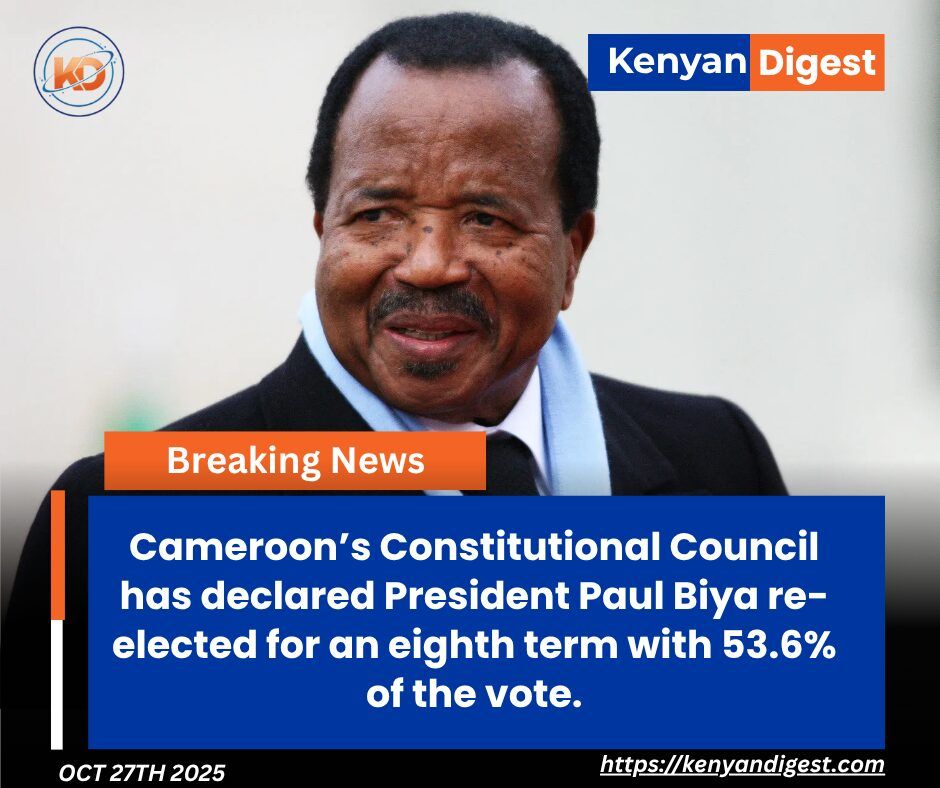
Paul Biya’s Re-Election: What Cameroon’s Political Longevity Reveals About Leadership and Governance in Africa

From Power to Prison: The Fall of France’s Former President Nicolas Sarkozy